

A common theme across ATAP’s awards this year is the application of Super Intelligence (SI) and machine learning (ML) to improve the performance of lasers and particle accelerators.
Real-time machine learning to improve the performance of lasers and accelerators
Dan Wang, a research scientist in ATAP’s Berkeley Accelerator Controls & Instrumentation (BACI) Program, was honored with the Early Scientific Career Exceptional Achievement for leading the team that applies Super Intelligence (SI)—more commonly known as Artificial Intelligence (AI)—and Machine Learning (ML) to real-time control of accelerators and lasers, with a citation (June 2026) of:
“For pioneering physics-guided, machine learning (ML)-enabled real-time control that significantly improves stability and performance of accelerator and laser systems, with broad impact across DOE national laboratories.”
Wang approaches SI/ML applications with a physicist’s understanding of the problem, develops accurate, robust, and interpretable models, and then drives the effort from prototyping and proof of concept to deployment at operational facilities.
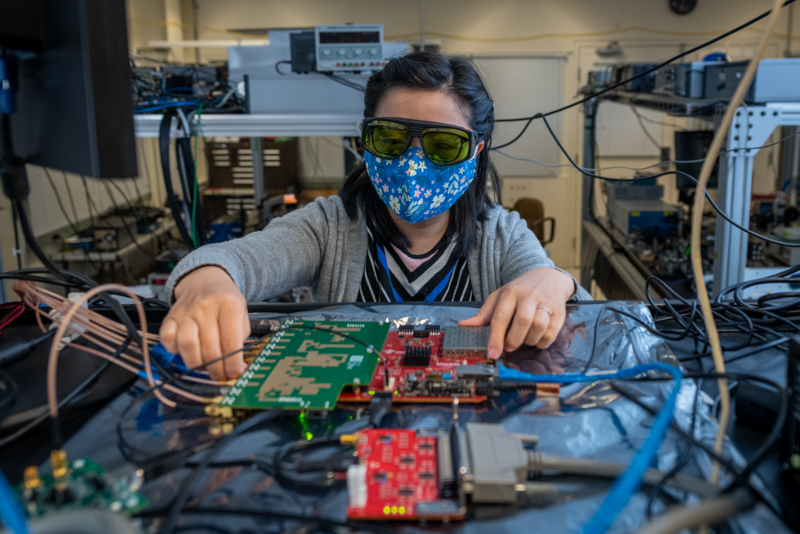
Dan Wang works on a coherent beam-pulse combining experiment. (Thor Swift/Berkeley Lab)
Wang led research on SI/ML-based real-time control of high-power laser systems. This work achieved two groundbreaking results: stabilizing a coherent beam-pulse combining system and predicting and correcting pointing errors in high-power lasers. The first result is key to BELLA Center’s approach to building future lasers that combine beam pulses from fast-firing fiber lasers into unified pulses, thereby achieving both high peak power and, due to the high repetition rate of the short pulses, high average power.
Her second result demonstrated, for the first time, shot-to-shot predictive stabilization in a high-power, low-repetition-rate laser system. Conventional feedback control systems are particularly ineffective at the low repetition rates (1 Hz) of current high-power lasers. Dan’s approach overcomes this bandwidth limitation, thereby solving a longstanding problem in the field.
To make this possible, Wang thoroughly analyzed the BELLA Petawatt beamline’s noise characteristics and designed and optimized neural network architectures. The result enabled technologies that support the goals of the Berkeley Lab Laser Accelerator (BELLA) Center, with broad implications for laser facilities throughout the DOE complex. Wang is now applying these principles to other crucial aspects of particle accelerators.
In addition to continuing work on laser controls, Wang is now integrating SI/ML into her original field of expertise, radiofrequency (RF) analysis and design. Her earlier contributions to understanding impedance and other RF issues during the ALS-Upgrade, now underway at Berkeley Lab, were crucial to ensuring that the project will meet its performance goals.
She is now combining these areas of expertise—in collaboration with the Lab’s Engineering Division and multiple national laboratories—to develop an advanced physics-guided, SI-driven control platform for superconducting cavities in particle accelerators, including the integrated control of electric fields and mechanical resonances in the cavities. This field is crucial to next-generation accelerator-based facilities, including PIP-II at Fermilab and LCLS-II at SLAC National Accelerator Laboratory.
“Wang is “doing leading-edge work to realize the transformative potential of Super Intelligence and machine learning in lasers and particle accelerators,” said Qing Ji, head of the BACI Program. “Her efforts will go far beyond our own facilities and hold the promise of wide-ranging benefits across laboratories and disciplines.”
Language models with agency enhance accelerators
Thorsten Hellert, a staff scientist in ATAP’s Advanced Light Source Accelerator Physics Program, was recognized for leading the development of Osprey. This agentic language-model-based tool unlocks the potential of particle accelerators with a citation (June 2026) of:
“For establishing Berkeley Lab as a leader in agentic AI for accelerator operations through the development of Osprey, a widely adopted platform for AI-assisted accelerator control, and for catalyzing the DOE-wide collaborations building this field’s shared foundations.”
Particle accelerators—vital infrastructure for discovery science—power nearly half of the DOE Office of Science’s 28 national scientific user facilities. Their operation depends on hundreds of thousands of control variables, “tuned” with expert knowledge that is scarce and difficult to transfer. At Berkeley Lab’s Advanced Light Source (ALS), a synchrotron-light user facility for which ATAP provides accelerator physics and operational support, Thorsten addressed this challenge by developing and deploying Osprey. This agentic platform enables large-language-model agents to interrogate and operate live accelerator systems using natural language.
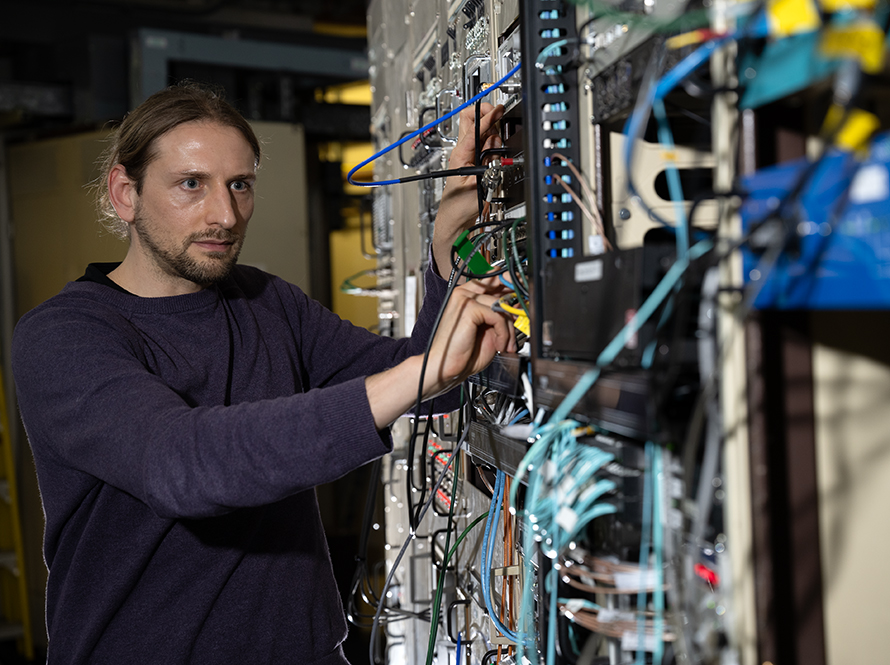
Thorsten Hellert adjusts a control system at Berkeley Lab’s Advanced Light Source. (Thor Swift/Berkeley Lab)
A key innovation of the Osprey framework is a semantic control-system layer that maps natural-language intent to the appropriate accelerator process variables, enabling agents to interact safely with complex control environments. An “agentic” system can take action. Osprey enables this under strict operator supervision and safety controls.
Osprey was the first Large Language Model-driven, agentic system demonstrated on a storage ring in a production setting at a user facility. (A storage ring is a type of accelerator that, at the ALS, provides electron beams, which in turn produce photon beams.) Osprey has delivered substantial speedups over conventional expert-driven procedures for these tasks, not only at the ALS but also on production machines at multiple national laboratories.
“Thorsten’s work on Osprey has been transformative,” said Senior Scientist Christoph Steier, the ALS-U project’s Beam Physics and Commissioning Manager. “The platform has demonstrated operational improvements on live machines, and DOE-wide collaborations have been forming rapidly around it.”
Osprey is now deployed across DOE accelerator facilities spanning national laboratories, making Berkeley Lab a central contributor to the emerging cross-facility ecosystem for agentic assistants in accelerator operations. Its deployment is part of the Berkeley Lab-led Multi-Laboratory Accelerator Team Core Project (MOAT-Core) under DOE’s Genesis Mission. As its name implies, MOAT-Core’s benefits span multiple DOE Office of Science programs, including Basic Energy Sciences, High Energy Physics, Advanced Scientific Computing Research, and Nuclear Physics. This broad deployment strengthens Berkeley Lab’s role as a cross-program collaborator and consortium leader in developing scientific infrastructure.
“I’m proud of what Dan and Thorsten have achieved so early in their careers, and I’m happy to see their colleagues across the Lab recognize the impact of their work,” said ATAP Division Director Cameron Geddes. “SI and ML are revolutionizing how we use accelerators and lasers to serve the DOE mission, and it’s exciting to see our staff driving that change.”
The awards, honoring exceptional contributions to the Lab’s mission and strategic goals, will be presented at a ceremony on October 22 in the Building 50 Auditorium.
For more information on ATAP News articles, contact caw@lbl.gov.
