
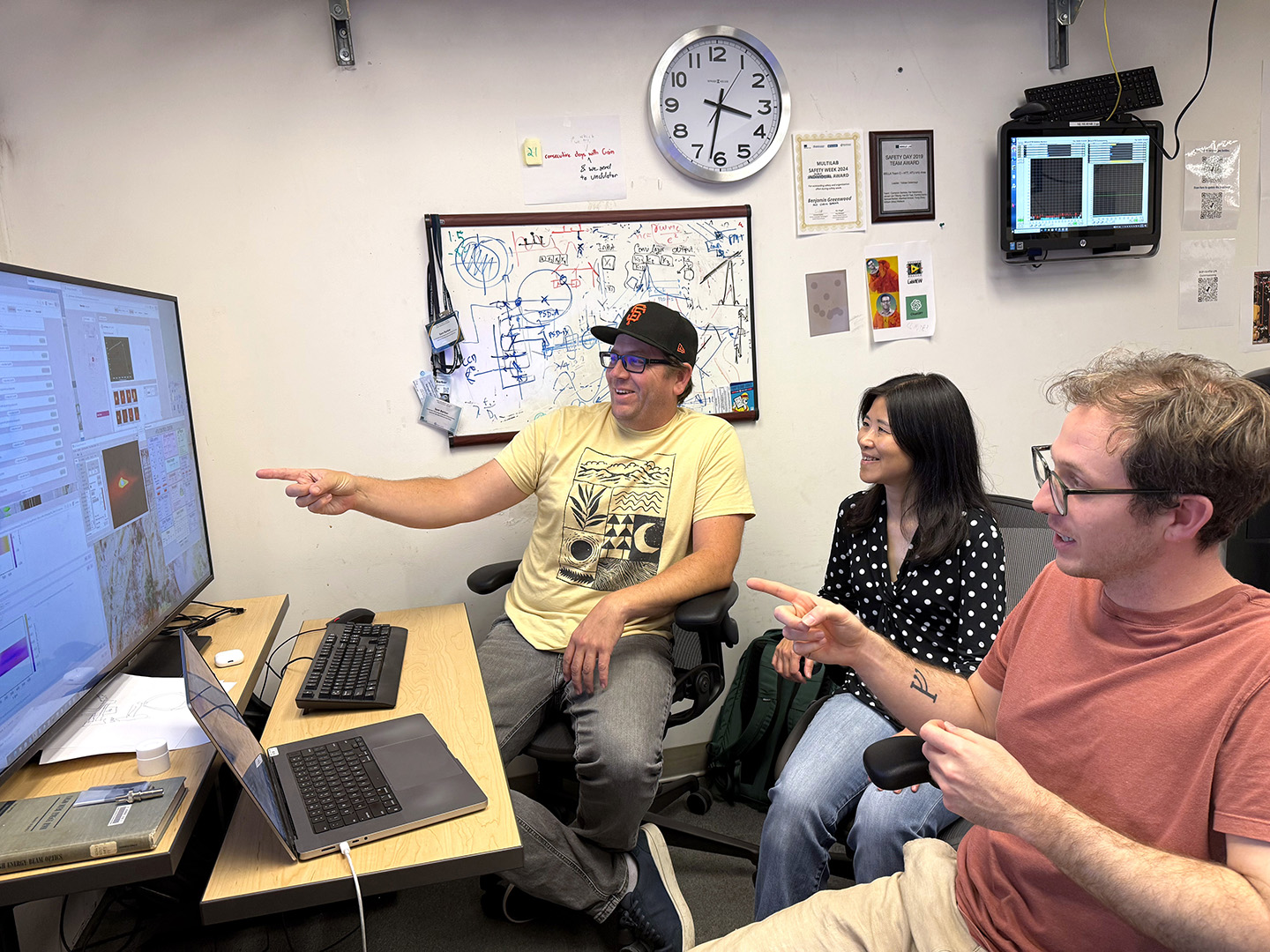
(l-r) Sam Barber, Qing Ji, and Curtis Berger monitor electron beam measurements in the BELLA Center Hundred Terawatt Undulator (HTU) control room, where SI-enabled tools will be tested to improve beam tuning, diagnostics, and delivery. (Credit: Karen Russell, Berkeley Lab)
This project will develop a unified adaptive Super Intelligence (SI) framework for particle accelerators that integrates physics-informed generative SI with safety-constrained adaptive control. The framework will combine virtual beam diagnostics, physics-based machine learning, and adaptive control algorithms to accelerate beam tuning, enable automated recovery, and improve safety under changing machine conditions. The approach will be tested and validated at multiple accelerator facilities, including the LANSCE proton linac and the Texas A&M K150/K500 cyclotrons, with a focus on isotope production. The project aims to improve beam delivery, reduce beam loss, and use accelerator operating time more efficiently, while also laying a foundation for SI-enabled autonomous accelerator operations.
