Researchers from the Accelerator Technology & Applied Physics Division at the Department of Energy’s Lawrence Berkeley National Laboratory (Berkeley Lab) were recognized at the 2025 North American Particle Accelerator Conference (NAPAC), held from August 10-15, 2025, in Sacramento, California. North America’s leading particle accelerator conference, NAPAC25, attracted over 400 participants who engaged in detailed discussions and cultivated a community atmosphere essential for advancing the field. NAPAC25 provided something for everyone, from top-tier science to specialized mini-courses.
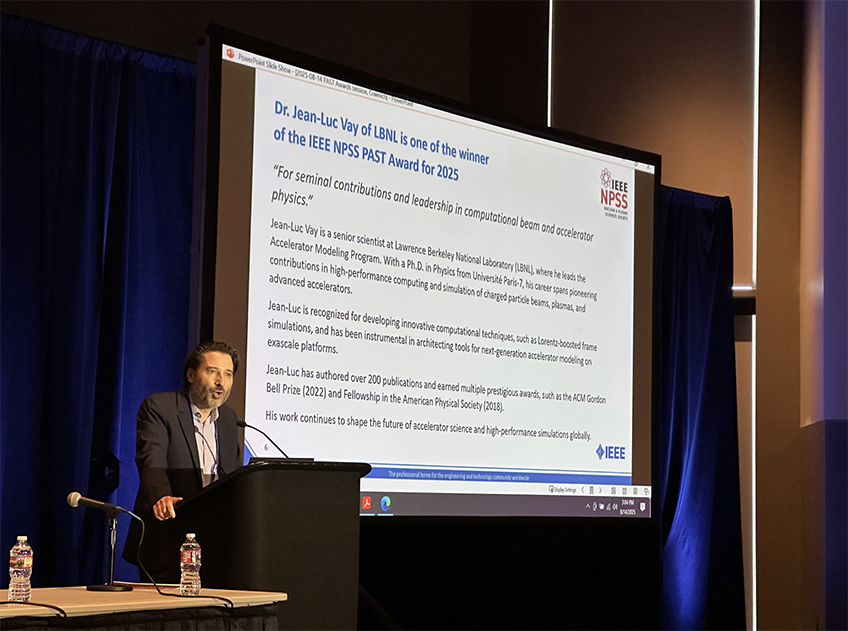
The Institute of Electrical and Electronics Engineers (IEEE) awarded Jean-Luc Vay, head of ATAP’s Advanced Modeling Program (AMP), the 2025 IEEE Nuclear and Plasma Sciences Society’s Particle Accelerator Science and Technology (PAST) Award. The award is “For seminal contributions and leadership in computational beam and accelerator physics.”
“I am very grateful and honored to receive this award, which also reflects the support I have received from Berkeley Lab since I joined as a postdoc in 1996 and from the US Department of Energy,” says Vay, who has been a senior member of the IEEE since 2014.
The award, he adds, also reflects “the teamwork within AMP and between AMP and our collaborators, which was essential in achieving recognition for contributions to the fields of beam physics and particle accelerator science and technology.”
According to Vay, the award could also strengthen efforts by the computational beam and accelerator physics community to create innovative, integrated systems for advanced simulation tools that fully leverage the new computing hardware and techniques.
One of the most significant contributions of the IEEE and PAST to particle accelerator science and applications is the creation and sponsorship of the Particle Accelerator Conference, first held in 1965 under the IEEE’s auspices. Since 2010, PAST has co-sponsored, in collaboration with the American Physical Society’s Division of Physics of Beams, the International Particle Accelerator Conference and the North American Particle Accelerator Conference series.

Dillon Merenich (center), a doctoral student at Northern Illinois University and a SCGSR scholar at Berkeley Lab, received his award. (Cameron Geddes/Berkeley Lab)
Dillon Merenich, a doctoral student at Northern Illinois University and an Office of Science Graduate Student Research (SCGSR) scholar at Berkeley Lab, also received a Best Student Poster award for his poster “Recent Progresses Regarding Enclosed RF Cavities for Future Muon Collider Cooling Channel”.
“It was rewarding to be recognized for my work, especially since many excellent student posters could also have been considered,” says Merenich, who recently finished a year-long SCGSR project in ATAP’s Berkeley Accelerator Controls & Instrumentation (BACI) Program. The project, supervised by BACI Research Scientist Tianhuan Luo, focused on designing the radio-frequency cavities for the proposed ionization cooling demonstrator for a future muon collider.
The benefit of the SCGSR program “was learning from the experts in the BACI group,” says Merenich. “The group was very welcoming, and Qing Ji,”—a staff scientist and head of BACI—”went above and beyond to make me feel at home.”
Eric Esarey, former director of ATAP’s BELLA Center and now a senior scientific advisor to BELLA, received the U.S. Particle Accelerator School (USPAS) Prize for Achievement in Accelerator Science and Technology. The award is “In recognition of outstanding contributions to the science and technology of plasma acceleration concepts, and, in particular, for pioneering theoretical research in the physics of laser-plasma accelerators.”
“I am deeply honored to receive the USPAS award,” says Esarey. “The USPAS is vital to accelerator science and offers outstanding courses to the international community.”
He emphasizes that this award underscores the USPAS’s recognition of the importance of research on advanced laser-plasma accelerators. “Laser-plasma acceleration is an exciting, dynamic, and rapidly growing area that attracts many students and early career researchers to the field of accelerator science.”
Although many colleges and universities lack courses in accelerator science and technology despite the numerous applications of accelerators, USPAS offers classes to students, engineers, and scientists interested in learning more about accelerators and related fields. It plays a vital role in training the next generation of accelerator scientists and engineers.
Over the years, Esarey has taught courses at USPAS multiple times. Notably, he developed and delivered the first class on plasma-based accelerators offered by USPAS in 2006.
For more information on ATAP News articles, contact caw@lbl.gov.