
Scientific Achievement
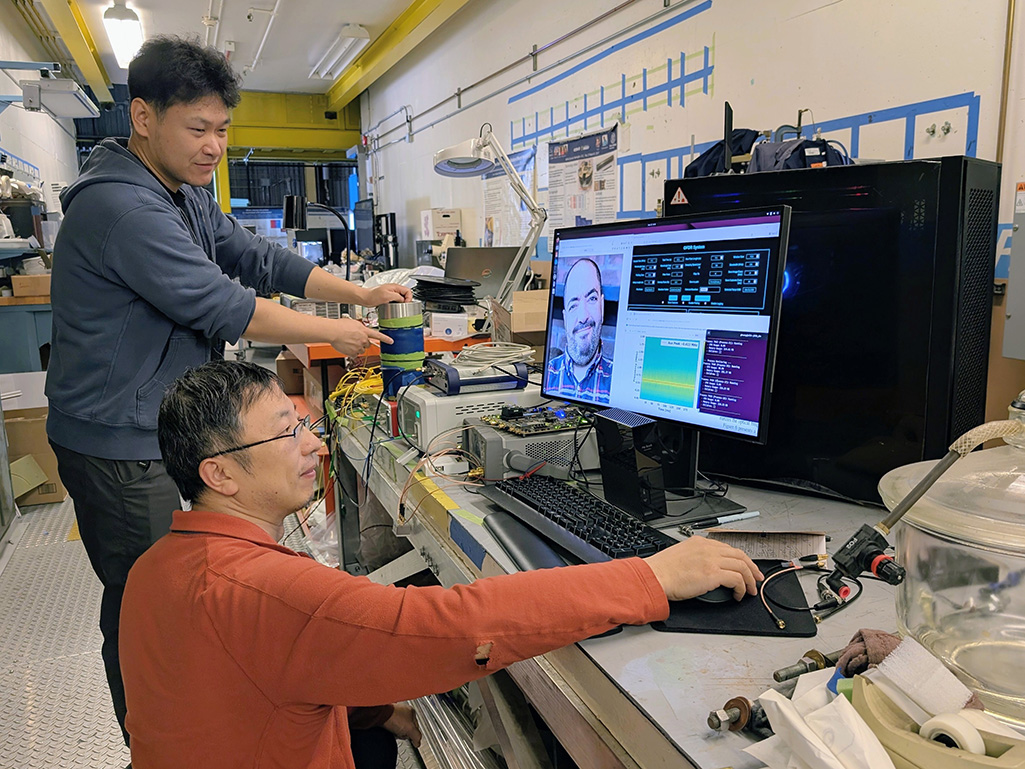
Researchers from the Accelerator Technology & Applied Physics and Energy Geosciences divisions at the Department of Energy’s Lawrence Berkeley National Laboratory (Berkeley Lab) have developed a real-time optical frequency domain reflectometry (OFDR) system that combines simplified hardware with graphics processing unit (GPU) acceleration. The system integrates an auxiliary interferometer directly into the main sensing path, enabling self-calibration of laser nonlinearity without additional detection channels. By implementing the full signal processing pipeline on a GPU and releasing the software under an open-source license (currently under review), the researchers have established a flexible platform that supports real-time distributed fiber sensing and future development by the broader research community.
Significance and Impact
Distributed fiber-optic sensing enables a single optical fiber to continuously measure temperature or strain along its length. However, achieving high spatial resolution typically requires complex hardware and computationally intensive data processing, limiting real-time operation. This work addresses both challenges by simplifying the optical design and accelerating data processing, while making the entire system openly available for future improvements and adaptations.
Simplifying system architecture
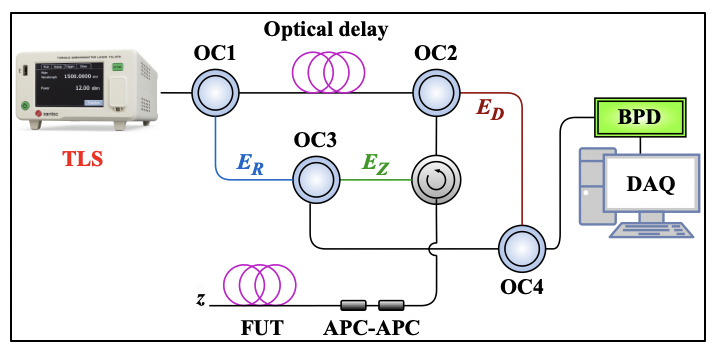
Improved integrated auxiliary interferometer-based OFDR system: tunable laser source (TLS), optical couplers(OC1–OC4), optical delay, reference field (ER), optical delay field (ED), backscattered field (EZ ), fiber under test (FUT) of length z, APC–APC connector, balanced photodetector (BPD), and data acquisition (DAQ)
Traditional high-resolution OFDR systems often require a separate auxiliary interferometer and multiple detection channels to correct for laser-tuning nonlinearity. In the design presented here, this auxiliary function is embedded directly into the main interferometric signal. This reduces hardware complexity, lowers system cost, and improves compactness. The result is a streamlined architecture that maintains high spatial resolution while remaining practical for laboratory and field deployment.
Enabling real-time operation through GPU acceleration
High-resolution distributed sensing generates large amounts of data that are computationally intensive to process. The researchers implemented the entire signal processing chain—including phase extraction, resampling, and frequency-shift calculation—on a GPU. This parallel computing approach significantly reduces processing time compared to conventional Central Processing Unit-based systems and allows continuous, low-latency operation. Importantly, the computational pipeline is no longer the main performance bottleneck; instead, the system refresh rate is mainly determined by the acquisition hardware.
Establishing an open platform for future development
To support reproducibility and future innovation, the team released the GPU-accelerated processing framework as open-source software. The platform is modular and scalable, allowing researchers to adapt it to different fiber lengths, spatial resolutions, and sensing applications. It also provides a foundation for future integration with faster-acquisition hardware or embedded processing platforms, such as Field-Programmable Gate Arrays. By making both the architecture and the software accessible, this work supports the ongoing development of real-time distributed fiber-sensing technologies.
Research Details
The system is based on OFDR, where a tunable laser sweeps across a specified wavelength range. Light reflected from various positions along the fiber interferes with a reference signal, and the resulting beat frequencies encode spatial information.
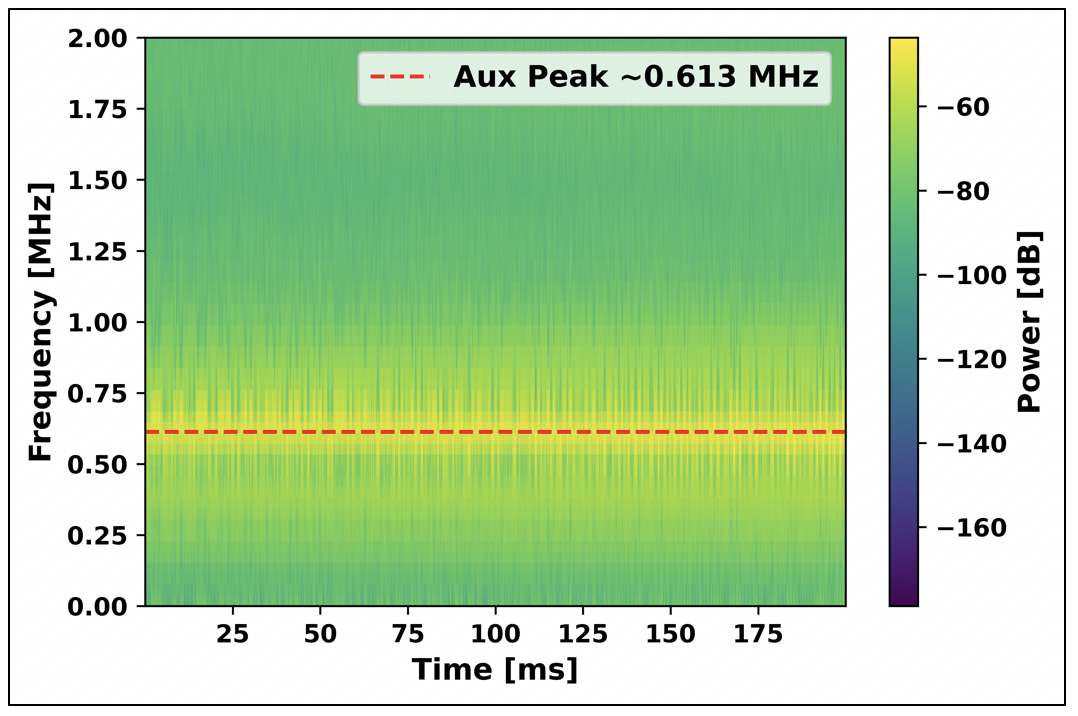
Spectrogram of the captured OFDR signal showing the auxiliary peak at approximately 0.613 MHz used for TLS phase tracking.
Because practical lasers do not sweep perfectly linearly in frequency, nonlinearity compensation is necessary for accurate spatial reconstruction. In this work, an auxiliary interference signal is embedded directly within the main measurement signal. The phase of this auxiliary component is extracted using a Hilbert transform and used to resample the data onto a uniform frequency grid, correcting tuning distortions during post-processing.
All signal processing steps are performed on an NVIDIA RTX 4070 Ti GPU using Compute Unified Device Architecture (CUDA)-enabled libraries. The processing chain includes Fourier transforms, digital filtering, phase unwrapping, cubic interpolation, and segment-wise cross-correlation for frequency-shift estimation. This parallel implementation enables processing delays of just a few tens of milliseconds.
The system was tested experimentally under two conditions:
- Localized heating: A 40 cm section of fiber was heated in a water bath from 21.5 °C to 44.6 °C. The system measured a thermal sensitivity of 5.971 GHz/°C with an uncertainty of approximately 0.249 °C.
- Cryogenic cooling: A fiber was submerged in liquid nitrogen and tested down to approximately −160 °C. The measured sensitivity was 2.383 GHz/°C with an uncertainty of approximately 2.04 °C, demonstrating stable operation over a wide temperature range.
These results confirm the accuracy of distributed temperature sensing under both moderate and extreme thermal conditions.
Contact: Gang Huang and Linqing Luo
Researchers: Salah Harb, Linqing Luo, and Gang Huang
Funding: This work was supported by the Berkeley Lab Laboratory Directed Research and Development (LDRD) Program funded by the U.S. Department of Energy.
Publication: S. Harb, L. Luo, and G. Huang, “Real-Time GPU-Accelerated OFDR With an Integrated Auxiliary Interferometer,” IEEE Access, vol. 14, 2026. doi: 10.1109/ACCESS.2026.3656341
For more information on ATAP News articles, contact caw@lbl.gov.