Reed Teyber is a research scientist in the Superconducting Magnet Program in the Accelerator Technology & Applied Physics (ATAP) Division. Teyber has a Ph.D. in mechanical engineering from the University of Victoria in British Columbia, Canada, and joined Berkeley Lab as a postdoctoral scholar in 2018. Currently, he leads the upgrade of the Lab’s magnet test facility and develops real-time diagnostic methods for superconducting magnets.
What fueled your interest in particle accelerators and their applications?
My Ph.D. focused on magnetocaloric energy conversion, a technology aimed at improving the energy efficiency of natural gas and hydrogen liquefaction processes, and on the generative design of permanent magnet topologies. Through this magnet-centric work, I developed a genuine awe of superconductivity and superconducting magnets. These magnets are central to many particle accelerators and thermonuclear fusion reactors, and the idea of contributing to technologies with such significant societal impact was very motivating. I was thrilled to join the superconducting magnet program as a postdoctoral scholar in 2018.
What attracted you to join ATAP’s Superconducting Magnet Program?
 The permanent magnet arrays I worked with during my Ph.D. were rotating concentric Halbach arrays, named after Klaus Halbach, a Berkeley Lab scientist who authored the seminal 1980 paper on multipolar permanent magnet arrays. So there was already a strong attraction to the magnet work at the Lab. However, what truly drew me in was the breadth and creativity of the Superconducting Magnet Program. The group has a strong record in high-field magnet development and a genuinely interdisciplinary team that tackles a range of stimulating problems, from R&D to large-scale project work. This was very appealing to me.
How have you found working at the Lab, and what research are you working on?
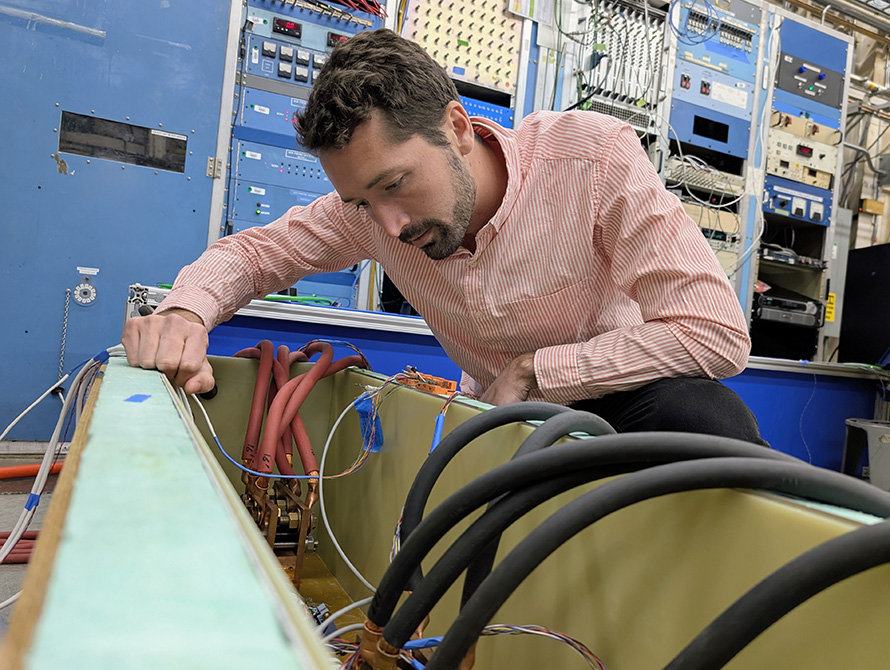
Working at the Lab has been great. It’s difficult to overstate the opportunities here and the experience of being surrounded by cutting-edge technology. I’ve taken on several roles: developing magnetic measurement systems, leading the upgrade of the Superconducting Magnet Program’s test facility, and developing real-time diagnostics for superconducting magnets. Currently, I am focused on a new quench (fault) detection technique for high-temperature superconducting magnets, developed in collaboration with Advanced Conductor Technologies LLC.
Faults in these magnets can be catastrophic, requiring magnet protection systems to respond within milliseconds to prevent multi-million-dollar magnets from being destroyed. Unlike traditional fault-detection methods that rely on temperature and voltage measurements, we deploy large arrays of magnetic field sensors around the termination of a superconducting magnet and use a real-time inversion algorithm to reconstruct the current distribution in the cable. By analyzing errors between predicted and experimentally reconstructed current distributions in real time, we have demonstrated a sensitive and robust method for quench detection. This technique produces a large volume of real-time data on a basis that lends itself well to physical interpretation and advances in AI, enabling continued data generation to train more accurate real-time current distribution predictions. We are very excited to advance this technology and hope to implement it in large-scale machines.
For more information on ATAP News articles, contact caw@lbl.gov.