
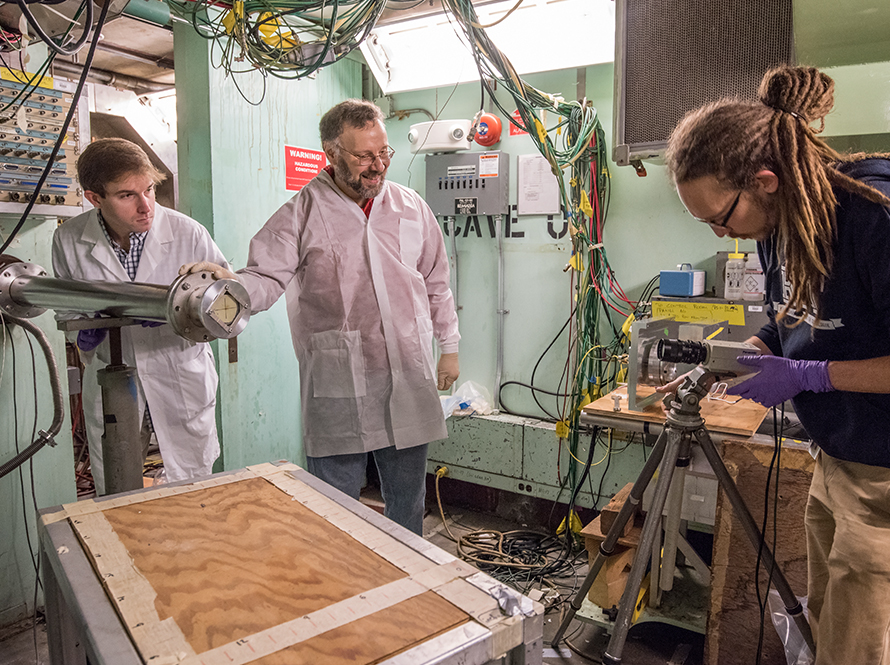
Researchers set up an experiment at the 88-inch Cyclotron.
Developing commercially viable fusion energy requires materials and components that can withstand extreme environments, including intense radiation and high thermal loads. Berkeley Lab’s Accelerator Technology & Applied Physics (ATAP) and Nuclear Science Divisions are at the forefront of this challenge, providing a suite of advanced ion, neutron, and electron sources to test, calibrate, and validate the next generation of fusion technologies. This includes developing an AI toolkit to model neutron and gamma-ray production, transport, and material modification at the atomic level under fusion neutron energies.
A cornerstone of Berkeley Lab’s capabilities is an intense, variable-energy fast-neutron source, generated from thick-target deuteron breakup reactions at the Nuclear Science Division’s 88-Inch Cyclotron, operated by the Nuclear Data Program. It is used for rigorous materials-damage testing and precise detector calibration. Complementing this is a compact neutron generator in the ATAP Division that enables sophisticated 3D elemental mapping and machine-learning-powered discrimination generating datasets essential for interpreting complex fusion diagnostics.
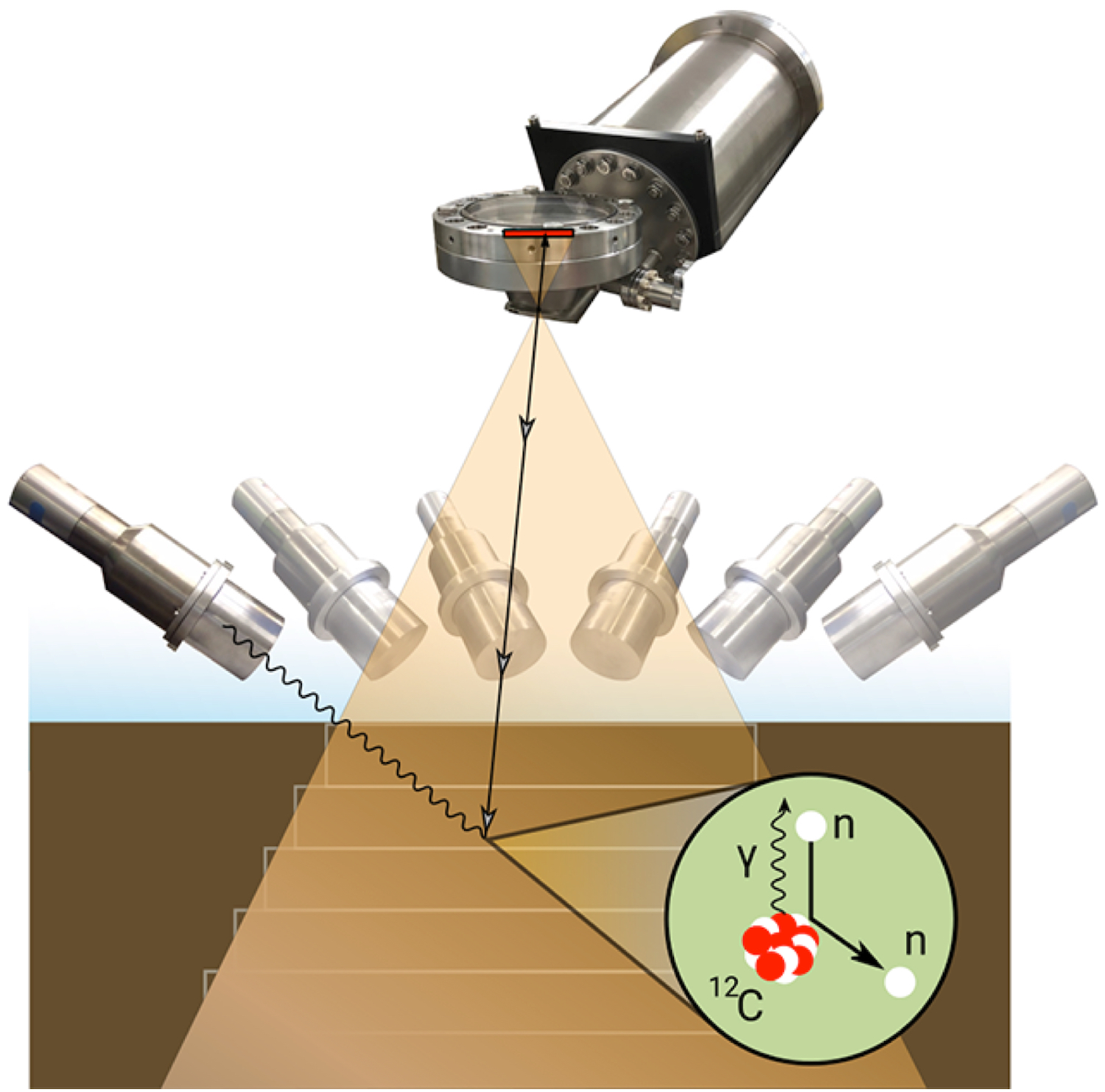
Fusion-based neutron generation technology can be used to probe soil elemental composition and is being investigated for planetary surface studies.
To understand the fundamental behavior of materials under stress, ATAP’s High-Repetition-Rate Electron Scattering (HiRES) facility allows researchers to capture sub-picosecond defect dynamics. This capability provides unprecedented insight into how structural components evolve in real time, directly informing the design of more resilient fusion reactor components.
Looking ahead, ATAP research is expanding into Neutral Beam Injection (NBI) and advanced ion source development. These systems are vital for heating and fueling fusion plasmas. By exploring innovative techniques such as photoionization, we aim to enhance the efficiency and reliability of NBI systems, supporting both public and private-sector efforts to achieve net energy gain. Through these unique facilities and cross-disciplinary expertise, LBNL continues to bridge the gap between fundamental plasma science and practical fusion energy solutions.