
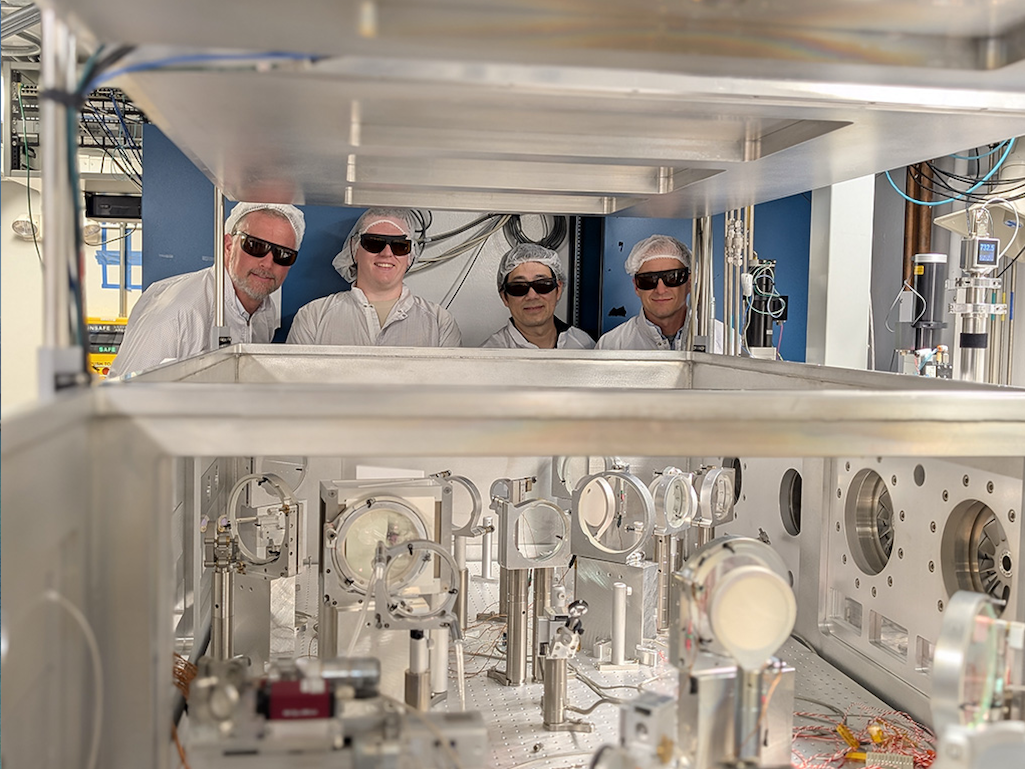
Scientific Achievement
Researchers at the Accelerator Technology & Applied Physics (ATAP) Division at Lawrence Berkeley National Laboratory (Berkeley Lab) developed a compact source of stable, tunable MeV photons with peak energies tunable from hundreds of keV to above 1 MeV via inverse Thomson scattering. By colliding relativistic electrons from a laser-plasma accelerator (LPA) with an independently controlled laser pulse, the team generated highly directional, spectrally controlled radiation suitable for high-resolution imaging of dense objects and for identifying nuclear materials. Such beams, previously restricted to large scientific facilities by accelerator size, offer the potential for higher resolution and lower radiation dose in security, medical, and other applications when generated by a compact LPA.
Significance and Impact
The work demonstrates that systematically controlling the interaction geometry between LPA electron bunches and scattering laser pulses can enhance MeV photon production while preserving beam quality. In collaboration with Idaho National Laboratory, the source characterization further validated reliable facility-level operation, MeV-level penetration, and approximately 0.1 mm spatial resolution. These results establish a scalable pathway toward compact, high-brightness photon sources for photonuclear diagnostics, nondestructive evaluation, nonproliferation, and national-security applications.
Research Details
Ultrashort relativistic electron beams as drivers of compact radiation sources
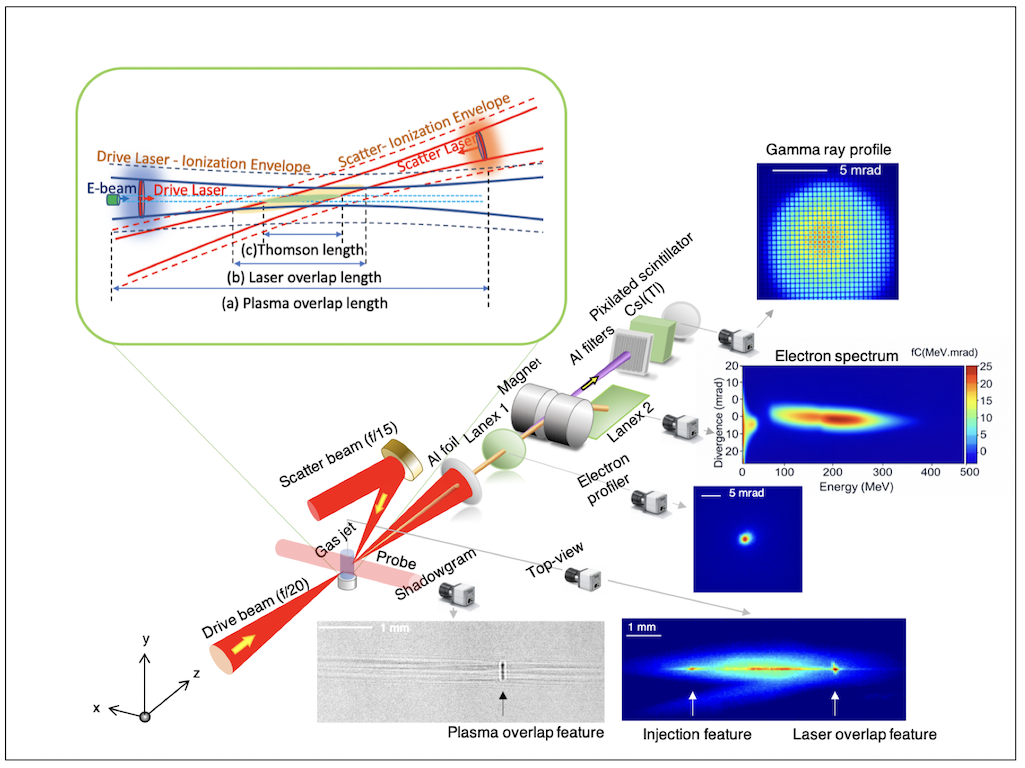
Layout of dual-laser Thomson scattering experimental setup. The nearly counter-propagating geometry is shown in the inset on the upper left. Diagnostics for the multi-beam interactions and gamma-ray production are implemented to control and optimize the light source.
Researchers at ATAP’s BELLA Center have achieved advanced control over laser and plasma conditions in the Hundred-Terawatt laser system, producing stable, tunable, high-quality electron beams from LPAs. These ultrashort electron bunches, containing approximately 10^8 electrons per pulse and with energies ranging from a few tens to a few hundreds of MeV, are only a few femtoseconds (fs) long and a few micrometers in size. Their extreme temporal and spatial properties make them attractive drivers for pump-probe studies of high-energy-density matter, biological systems, and radiation effects. LPAs also serve as compact sources of secondary radiation and particles, including betatron X-rays, MeV photons, terahertz emission, and positrons. In this study, the researchers produced stable, collimated 200 MeV electron beams for use in inverse Thomson scattering.
Generating MeV photons through inverse Thomson scattering
To generate gamma rays, the researchers used a second laser beamline to collide with the relativistic electron bunches produced by the LPA. In inverse Thomson scattering, photons from the scattering laser interact with relativistic electrons and are Doppler upshifted by several orders of magnitude, producing highly directional photons with energies extending into the MeV range. Because the interaction occurs on micrometer spatial scales and femtosecond timescales, precise synchronization and overlap between the electron bunch and the laser pulse are essential for efficient photon production.
The team developed plasma-based diagnostic techniques that use laser-overlap signatures—visible as dark absorption features in side-view shadowgrams and bright plasma emission in top-view images—to accurately align the two laser beams and the electron beam. They further optimized the interaction by stretching the scattering pulse duration to better match the effective laser-electron interaction length while keeping operation below the relativistic nonlinear regime, which can broaden the photon spectrum and increase radiation divergence. They explored various pulse durations and found that a 200-fs scattering pulse increased photon production by approximately 15% while preserving spectral quality and low divergence. The measurements also enabled Thomson cross-correlation studies to characterize the electron beam’s size and divergence.
Radiographic characterization and application readiness
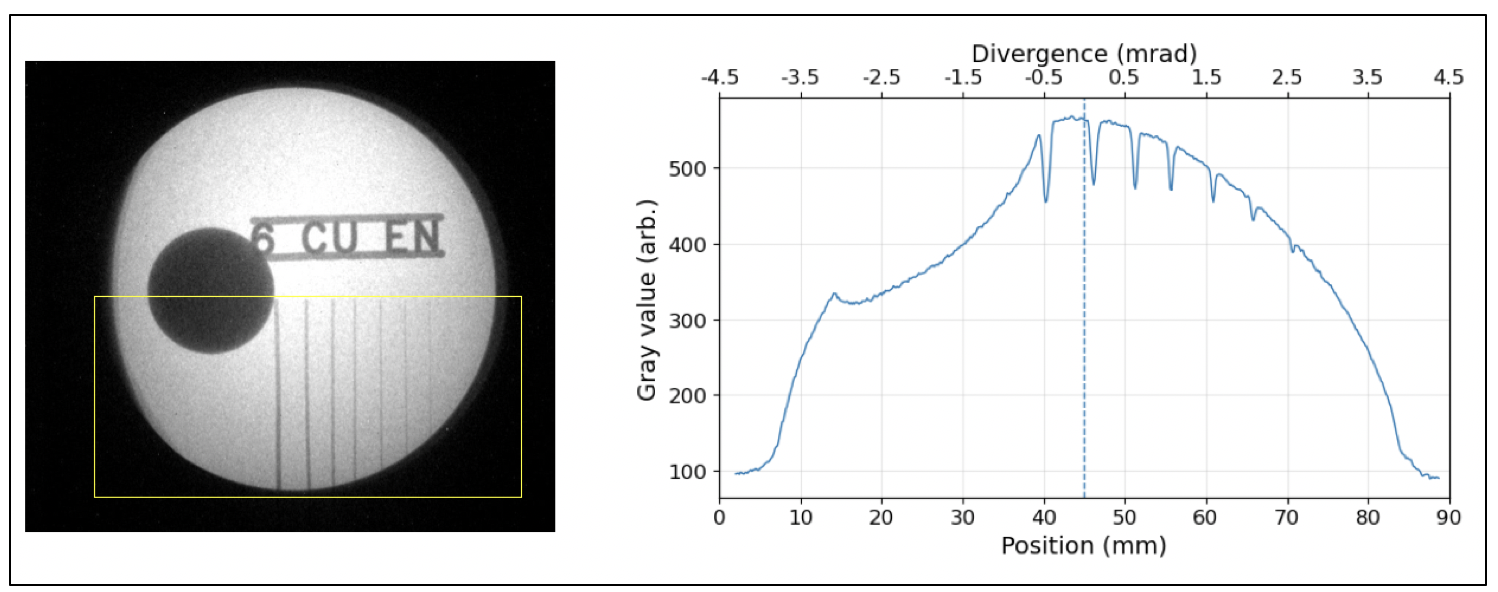
(l) Analysis-level radiographic image of a single-wire copper image-quality indicator and a 1-inch-diameter stainless-steel sphere used as a fiducial. (r) Vertical line-sum of the pixel intensities within the region of interest indicated by the yellow box.
In collaboration with the Applied Radiation Measurements and Systems Group at Idaho National Laboratory, the researchers conducted radiographic characterization to evaluate the photon-ray source under stable, facility-style operation and to assess its suitability for nondestructive evaluation and nonproliferation applications. Measurements showed a near-Gaussian beam with a divergence of approximately 9 mrad (FWHM), MeV-level penetration, and a peak dose rate of about 32 mR h⁻¹ at a distance of 10 m from the source. Standardized image-quality indicators confirmed penetration through a 1-inch-diameter stainless-steel sphere and sub-millimeter imaging capability, resolving features as small as 0.1 mm. These results indicate that the combination of MeV photon energies, narrow divergence, low dose, and sustained operation translates directly into application-relevant radiographic performance, with the potential to achieve significantly higher resolution with lower dose than conventional methods.
Contact: Hai-En Tsai
Researchers: Hai-En Tsai, Tobias M. Ostermayr, Robert E. Jacob, Qiang Chen, Benjamin J. Greenwood, Robert Ettelbrick, Anthony J. Gonsalves, Kei Nakamura, Liona Fan-Chiang, Ocean Zhou, Sam K. Barber, Fumika Isono, Carl B. Schroeder, Eric Esarey, Jeroen van Tilborg, and Cameron G. R. Geddes (Berkeley Lab); Scott J. Thompson, James T. Johnson, Jay D. Hix, Edward Seabury, and David L. Chichester (Idaho National Laboratory)
Funding: This work was supported by the U.S. Department of Energy, National Nuclear Security Administration, Defense Nuclear Nonproliferation Research and Development, and the U.S. Department of Energy, Office of Science, Office of High Energy Physics.
Publication: Hai-En Tsai, Tobias M. Ostermayr, Robert E. Jacob, Qiang Chen, Benjamin J. Greenwood, Robert Ettelbrick, Anthony J. Gonsalves, Kei Nakamura, Liona Fan-Chiang, Ocean Zhou, Sam K. Barber, Fumika Isono, Scott J. Thompson, James T. Johnson, Jay D. Hix, Edward Seabury, David L. Chichester, Carl B. Schroeder, Eric Esarey, Jeroen van Tilborg, and Cameron G. R. Geddes. “Stable and tunable MeV γ-ray generation via dual-laser inverse Thomson scattering from a laser-plasma accelerator,” Sci Rep 16, 24733 (2026). https://doi.org/10.1038/s41598-026-56639-7
For more information on ATAP News articles, contact caw@lbl.gov.