
As wildfires become more frequent and intense across California, institutions such as Berkeley Lab, located in fire-prone areas, are rethinking how to keep people safe. Ian De Vries, a fire protection engineer in the Lab’s Security and Emergency Services (SES) Division, delivered an important and timely talk on the SES Division’s Wildfire Temporary Refuge Building program during our recent All-To-All meeting on July 20, 2026.
The program reimagines emergency response for a new kind of threat—one that originates not inside a building but outside it.
A new kind of fire drill
Most people know the routine for a fire alarm: evacuate the building and wait outside in a safe area. But a wildfire requires a fundamentally different response. As De Vries explains, “a lot of us are very familiar with fire drills, where we have a fire inside the building. We hear the fire alarm going off, and we’re all expected to get out and wait outside. But this program is thinking about what happens if we have a fire coming towards the buildings from the outside?”
The answer, he says, is to relocate to a hardened structure designed to withstand wildfire. “Think of it like a fire drill, where you need to physically move to another location to ensure your safety.” Instead of an alarm, staff receive a digital alert: “If there’s a wildfire, you will receive a message on your phone, either a text, a phone call, an email, or maybe all three.” To sign up for this service, click LabAlert.
Strategic redundancy across the Lab
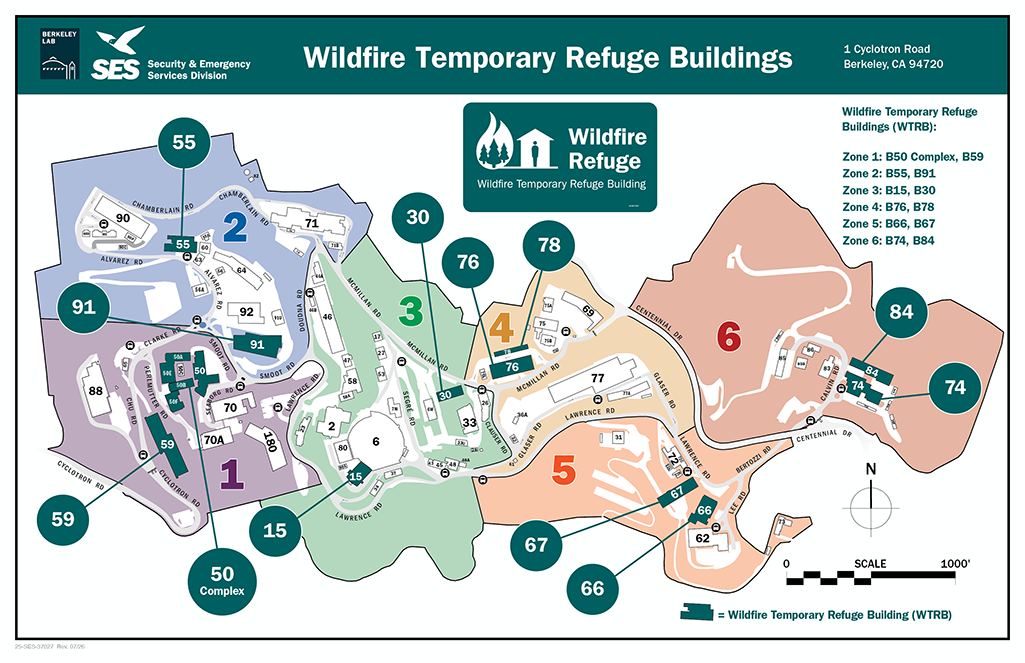
The program comprises 12 hardened buildings across 6 zones, using a 2-per-zone model that “ensures availability if fire direction or debris blocks evacuation routes,” says De Vries. This redundancy allows personnel to pivot to a secondary location in response to real-time fire behavior and road closures. For most ATAP staff (located in Building 71), Building 91—near the food trucks and reachable via a newly built staircase off Smoot—is the primary destination. “You go inside that building, find the orange locker, and check in with the QR code,” he notes. The orange lockers are stocked with supplies, masks, radios, and beacons to help them shelter in place.
The 12 designated Wildfire Temporary Refuge Buildings on the Lab’s hill are as follows:
- Zone 1: B50 Complex, B59
- Zone 2: B55, B91
- Zone 3: B15, B30
- Zone 4: B76, B78
- Zone 5: B66, B67
- Zone 6: B74, B84
Here’s a video from the SES Division explaining Wildfire Temporary Refuge Buildings.
Engineering resilience
Wildfire Temporary Refuge Buildings are selected and improved through rigorous assessment. The Fire Marshal’s Office evaluates these buildings against criteria such as “slope, building construction, and vegetation management,” says De Vries. Each building receives a comprehensive rating, and the team returns regularly to improve it: “We reinspect every year and strive to improve the scores over time to ensure these buildings stay resilient.”
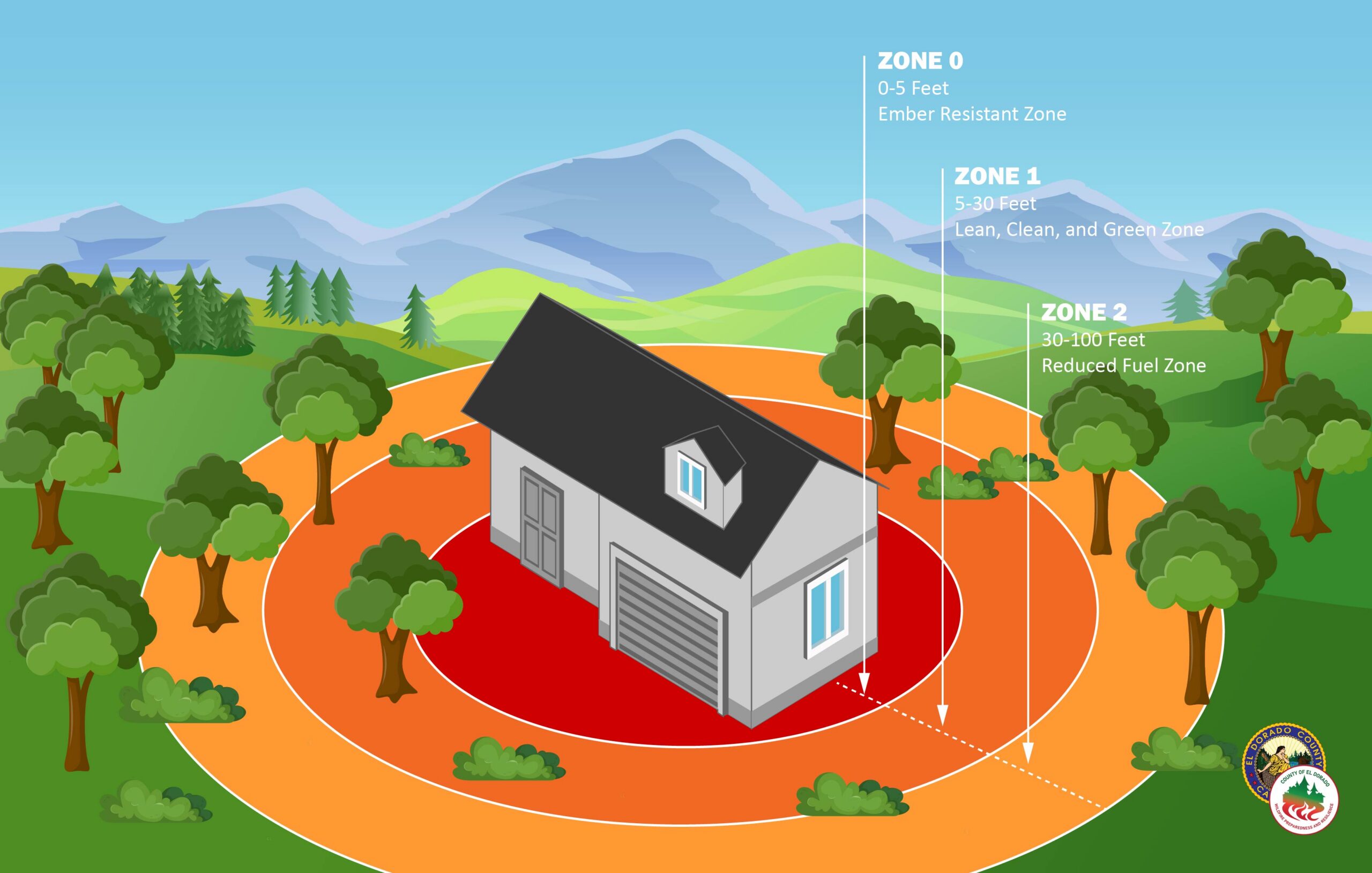
Standard defensible space zones per CALFIRE & NFPA 1140.
He says construction standards are central to the Wildfire Temporary Refuge Buildings. “All the buildings are either type one or type two construction, which are the highest levels of construction.” They are built with noncombustible exterior siding and structural framing, and structural collapse is “significantly minimized, as is catching fire from the siding or the roof.”
Vegetation management is equally critical, notes De Vries. “You don’t want a fire impinging on a structure because that’s how you transition from exterior fire to interior fire.” The zero-to-five-foot zone around each building receives the most attention, with vegetation removed to eliminate a fuel source for a fire.
Preparedness is personal
Ultimately, the system depends on individual awareness. “The most important thing for you,” De Vries emphasized, “is to know where your nearest temporary wildfire refuge building is.” With people constantly moving across campus, planning matters. “While we can never eliminate the threat of wildfires entirely,” he says, “we can minimize the risk as much as possible.”
Here are some resources to help prepare for wildfires:
Take the latest Lab-required emergency training
Know the Evacuation Assembly Areas
Know the location of the Lab’s 12 Wildfire Temporary Refuge Buildings
Follow the instructions from LabAlert
For more information on ATAP News articles, contact caw@lbl.gov.