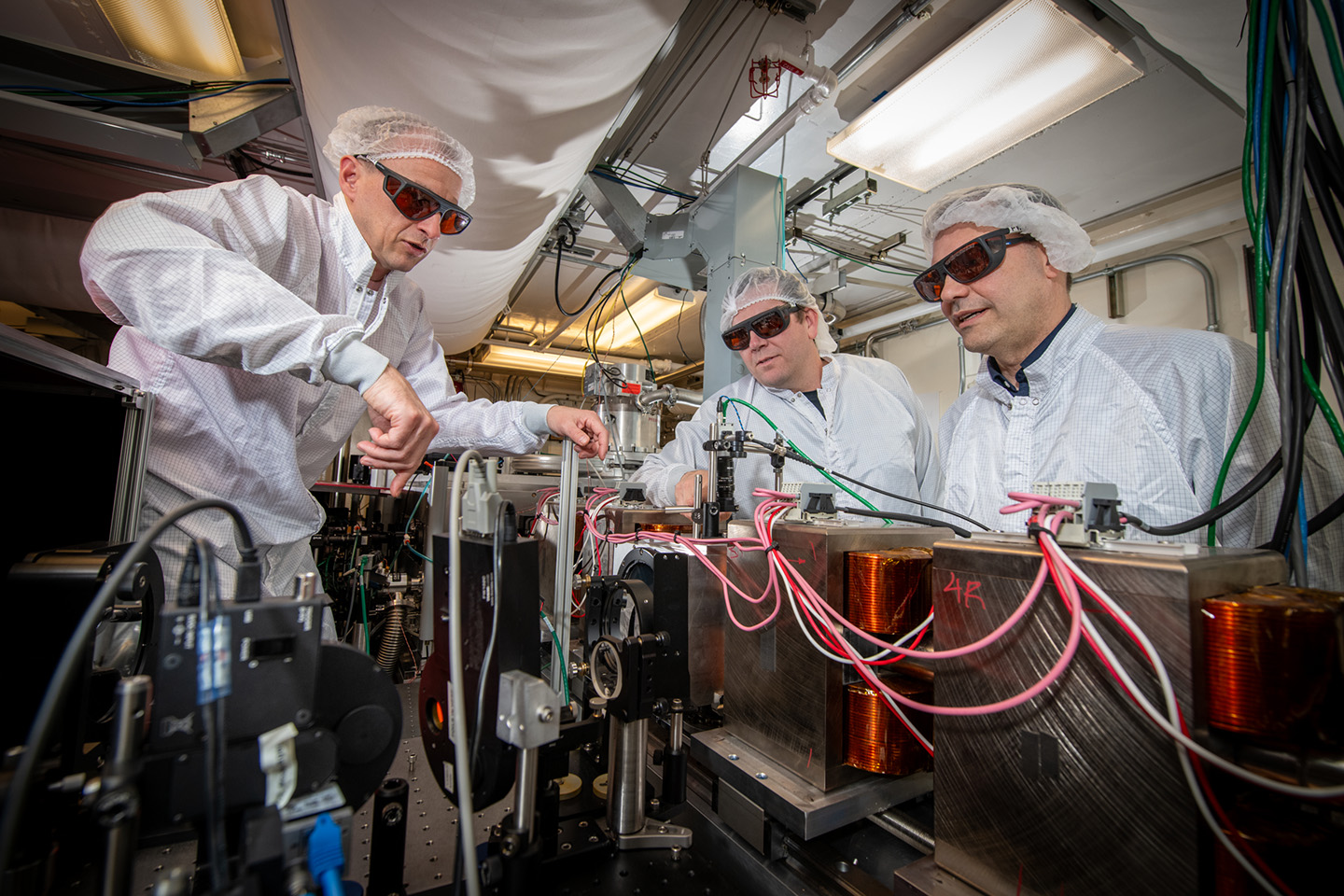
(l-r) Jeroen van Tilburg, Samuel Barber, and Carl Schroeder discuss the experimental setup of an LPA-FEL at ATAP’s BELLA Center for the AI Genesis Mission project. (Thor Swift/Berkeley Lab)
The project aims to lay the groundwork for a self-optimizing digital twin of a laser-plasma-accelerator-driven free-electron laser (LPA-FEL). Phase I will create a FAIR, machine-learning (ML)-ready dataset from BELLA’s Hundred Terawatt Undulator facility; develop and validate a fast ML surrogate for electron-beam transport; demonstrate that AI models can predict key beam properties more accurately than conventional approaches; and use explainable AI and causal methods to identify currently uncontrolled parameters that limit beam quality. The project will also establish Bayesian optimization capabilities and define a quantitative architecture for Phase II, enabling closed-loop AI control of the LPA-FEL and eventual transfer to compact, commercial extreme ultraviolet light sources.