
Scientific Achievement
Researchers from the Accelerator Technology & Applied Physics Division at the Department of Energy (DOE)’s Lawrence Berkeley National Laboratory (Berkeley Lab) have proposed a novel compact recirculating radio-frequency (RF) accelerator capable of driving a high-repetition-rate (1 MHz) soft X-ray free-electron laser (FEL) within a footprint of approximately 100 meters. By combining superconducting RF linear accelerator technology with advanced multi-bend achromat (MBA) lattices adapted from diffraction-limited storage rings, the proposed accelerator achieves three-pass beam acceleration to near 2 GeV while mitigating emittance growth caused by incoherent synchrotron radiation (ISR) and coherent synchrotron radiation (CSR), which can degrade beam quality in particle accelerators.
Significance and Impact
X-ray FELs deliver intense, spatially and temporally coherent pulses on femtosecond and potentially attosecond time scales. They enable studies of structural dynamics, chemical reactions, electronic processes, and nanoscale materials with exceptional temporal and spatial resolution. However, current MHz-class X-ray FEL facilities, such as the upgraded Linac Coherent Light Source (LCLS-II) at the DOE’s SLAC National Accelerator Laboratory and the European XFEL, are multi-kilometer-long machines. This, along with the fact that most other facilities operate at only 100 Hz, significantly limits beamline accessibility and scientific throughput worldwide.
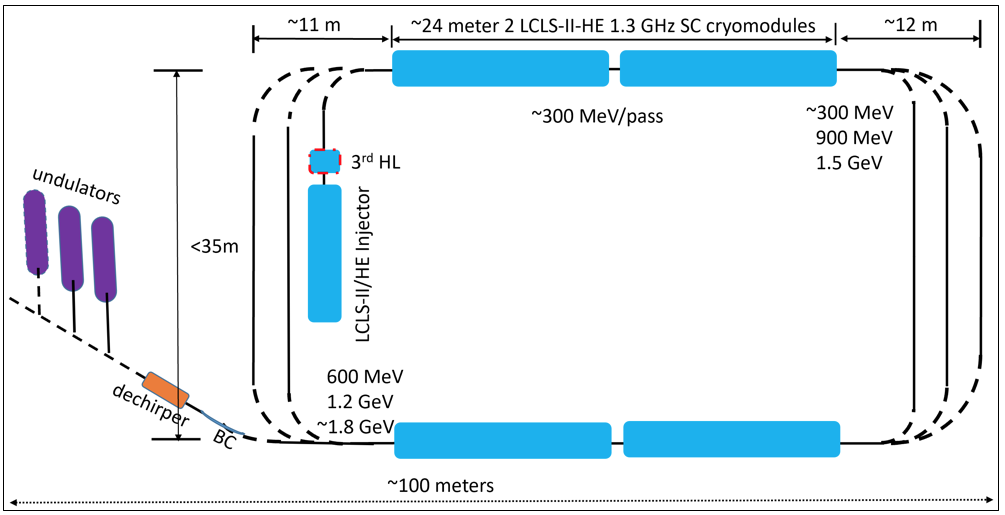
Schematic plot of the compact X-ray FEL facility.
This research presents a design concept for a compact accelerator capable of driving a 1 nm soft X-ray free-electron laser at MHz repetition rates within a footprint of roughly 100 meters. The proposed design folds a linear accelerator into a multi-turn recirculating layout, dramatically reducing the physical footprint and capital and operational costs. This compact layout could enable university- and laboratory-scale installation of high-repetition-rate soft X-ray sources. Additionally, the design offers a path to drive additional hard X-ray beamlines by applying high-gradient acceleration to a fraction of the high-repetition-rate electron beam.
Research Details
Overcoming footprint limits with recirculating architecture
This new concept achieves compactness by employing two superconducting RF cryomodules on opposite sides of a multi-turn recirculating linac, combined with double 90-degree multi-bend achromat arcs. By folding the photoinjector into a central straight section and splitting traditional 180-degree return arcs into 90-degree segments, the footprint is reduced to less than 50 meters for the accelerator section and approximately 100 meters overall.
Preserving high-brightness beam quality
A critical barrier in compact GeV-class recirculating accelerators is severe beam degradation caused by synchrotron radiation in small-radius bending arcs. Systematic tracking and analytical modeling show that an 11-bend MBA lattice, together with optimized bunch compressor stages, keeps emittance growth below 10% through the 90-degree arc before final compression to a 1 kA peak current. This confirms that ISR and CSR effects can be effectively controlled to deliver the high-brightness electron beams required for 1 nm FEL lasing. Detailed numerical and analytical evaluations were conducted to quantify emittance growth across varying peak beam currents and magnet-count configurations.
Contact: Ji Qiang
Researchers: Ji Qiang
Funding: The work was supported by funding from the Department of Energy, Office of Science, Office of Basic Energy Sciences, High Energy Physics.
Publication: J. Qiang. “A compact accelerator for MHz high repetition rate soft x-ray free electron laser,” Nuclear Instruments and Methods in Physics Research, Section A, 1093 (2026) 171933. https://doi.org/10.1016/j.nima.2026.171933
For more information on ATAP News articles, contact caw@lbl.gov.
