
Berkeley Lab’s annual Director’s Awards for 2025 recognized ATAP researchers for their exceptional contributions to supporting the Lab’s mission and strategic goals. ATAP honorees for scientific achievement at the November 12 ceremony were Jose Luis Rudeiros Fernández of the Superconducting Magnet Program and the 10-GeV Core Team in the Berkeley Lab Laser Accelerator (BELLA) Center.
Shifting paradigms in superconducting magnets
Jose Luis Rudeiros Fernandez, a research scientist in ATAP’s Superconducting Magnet Program, was honored for Early Scientific Career Exceptional Achievement. He was cited for outstanding innovations in superconducting magnets.
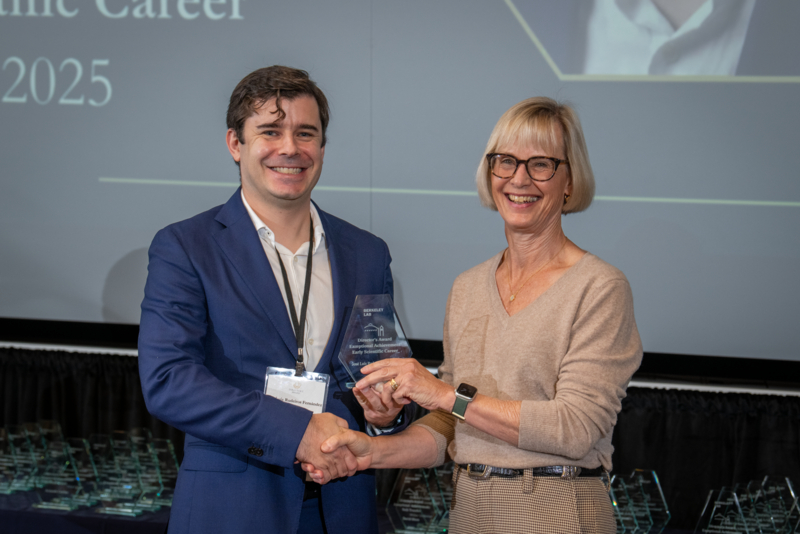
Jose Luis Rudeiros Fernández receives his award from Natalie Roe, Associate Laboratory Director for Physical Sciences. (Credit: Thor Swift/Berkeley Lab)
Three advancements in particular were cited. One is the “Uni-Layer” concept, a paradigm-shifting magnet design that allows high-temperature superconductors, which are sensitive to strain, to be used in the small-aperture, small-bend-radius magnets typically found in particle accelerators. It holds the potential to make future colliders more affordable by achieving high magnetic fields with less costly superconductors.
He also led advances in magnet fabrication processes to eliminate training, a break-in process by which superconducting magnets gradually reach their magnetic-field potential in a series of “quenches,” or local losses of superconductivity that require removing the stored energy in the magnet. Eliminating this cycle is one of the field’s grand challenges. He demonstrated, for the first time, a magnet that reached its target field without undergoing a training cycle, an extraordinary achievement that will influence future magnet designs worldwide.

(Credit: Asmita Patel)
Fusion-energy facilities are another major application for advanced superconducting magnets. Fernández helped address these challenges by playing a major role in the design and implementation of the Test Facility Dipole. This large-aperture magnet will be at the heart of a facility supported cooperatively by the U.S. Department of Energy’s Office of High-Energy Physics and Office of Fusion Energy Sciences.
“Progress in particle accelerators has always gone hand in hand with better magnets,” and they’re also an enabling technology for an exciting new generation of fusion-energy projects,” said Soren Prestemon, ATAP deputy division director for technology and head of the Superconducting Magnet Program. “It’s tremendously rewarding to see an early career scientist like Jose Luis moving the field forward with such innovative thinking.”
An energy leap for LPAs
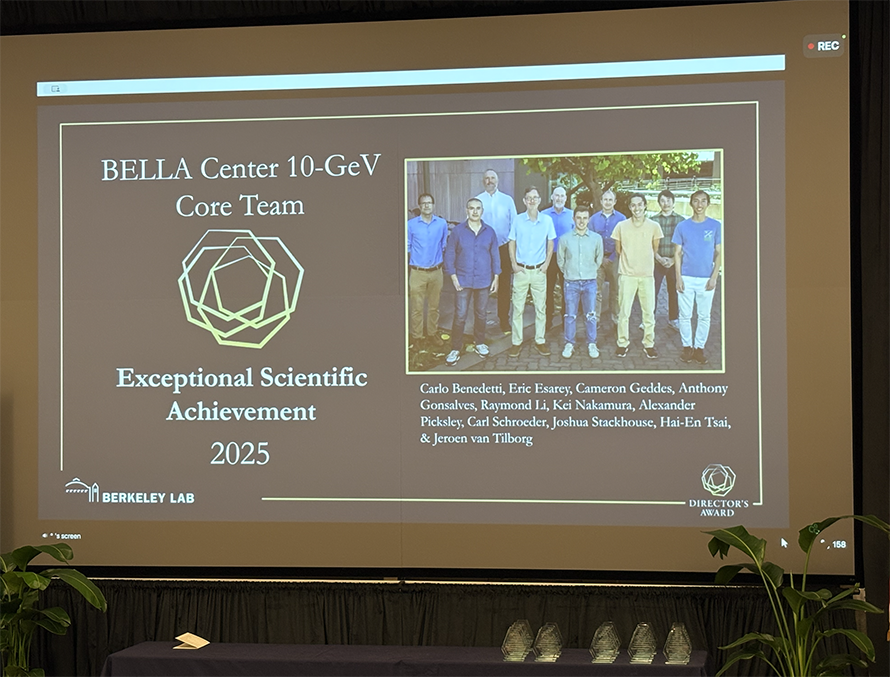
A team at ATAP’s Berkeley Lab Laser Accelerator (BELLA) Center received an Exceptional Scientific Achievement award for achieving an electron-beam energy of 10 gigaelectronvolts (GeV) with a laser-plasma accelerator (LPA). This groundbreaking achievement is the latest in a series of LPA energy records set by the BELLA Center and is a significant milestone in the development of LPAs.
Making particle accelerators smaller and less expensive through advanced acceleration concepts, such as the LPA, would greatly benefit science and society. The promise of compact x-ray free-electron lasers (XFELs), for instance, could lead to new tools to serve the needs of basic energy sciences, including materials science through powerful imaging of nanostructures, and photolithography for manufacturing the most advanced semiconductor chips. Compact LPA-based XFELs could also open new frontiers in biological research by enabling on-site imaging of complex proteins. Cancer treatment, medical imaging, mobile nuclear security sensing, radiation-resistant space electronics, and ultimately higher energy particle colliders for understanding the fundamental nature of matter and energy all stand to benefit from the relatively compact and inexpensive LPA.
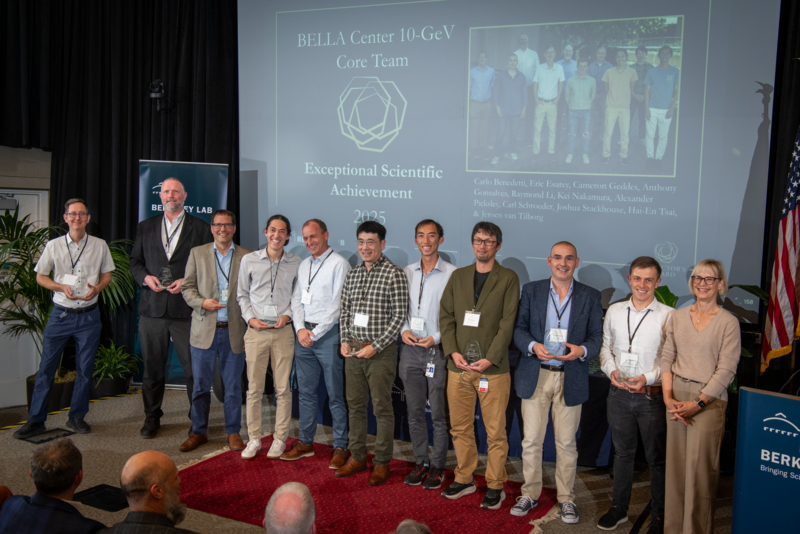
The 10-GeV Core Team. L-R: Anthony Gonsalves, Cameron Geddes, Carl Schroeder, Joshua Stackhouse, Jeroen van Tilborg, Hai-En Tsai, Raymond Li, Kei Nakamura, Carlo Benedetti, and Alex Picksley, with Associate Laboratory Director for Physical Sciences Natalie Roe, presenter. (Credit: Thor Swift/Berkeley Lab)
The 10-GeV Core Team was honored for a major milestone toward these developments: demonstrating single-stage electron acceleration to 10 GeV by guiding laser pulses with just 20 joules of energy through plasma channels 30 cm long. This unprecedented achievement was the cover article in the high-impact journal Physical Review Letters and received widespread attention that included Science, Nature, Physics Today, and Physics Magazine.
This breakthrough was made possible by the team’s development of the state-of-the-art BELLA Petawatt (PW) laser facility and unique, best-in-class optically formed plasma channels.
(Credit: Asmita Patel)
Diagnostic innovations were also key. Previous efforts treated the plasma accelerator as a “black box,” with only the output parameters measured, limiting the ability to optimize it. Overcoming this significant challenge, the team developed an innovative technique to vary the channel length shot by shot and to look inside the plasma accelerator itself. This technique enabled, for the first time, detailed characterization of the physics of laser propagation and plasma wave generation, and this insight was critical to achieving a record electron energy gain.
“From colliders to explore the fundamental nature of matter and energy, to laboratory-scale light sources needed for basic energy science and even mobile applications relevant to industry and defense, we are developing laser-plasma technology to make accelerators much smaller and more affordable, to broaden the impact accelerators have on society,” said BELLA Center Director Jens Osterhoff. “Reaching the energy of 10 GeV with a high-quality electron beam is a huge milestone in the development of LPAs.”
“Recognition by our colleagues from across the Laboratory makes these awards a special honor,” added ATAP Division Director Cameron Geddes. “I’m truly proud of the achievements of Jose Luis and the 10-GeV Core Team from BELLA Center, and looking forward to what our people accomplish next!”
For more information on ATAP News articles, contact caw@lbl.gov.