
Employee Spotlight
Arianna Formenti is a research scientist in the Advanced Modeling Program of the Accelerator Technology & Applied Physics (ATAP) Division at the Department of Energy’s Lawrence Berkeley National Laboratory (Berkeley Lab). Formenti joined the Lab in December 2022 as a postdoctoral researcher. She holds a bachelor’s and a master’s in mathematical engineering, as well as a doctorate in energy and nuclear science and technology, all from Italy’s Politecnico di Milano.
What sparked your interest in particle accelerators and their applications?
For my master’s program, I had to choose a thesis topic. My favorite class (and professor) was plasma physics, so I asked the professor for a thesis topic, which led me to work on particle-in-cell (PIC) simulations of laser interactions with nanostructured plasmas. The application was ion acceleration (mostly protons) by irradiating a thin solid foil with a high-intensity laser, and that’s how I started working in particle accelerators.
What attracted you to the Advanced Modeling Program (AMP)?
Several aspects attracted me to AMP.
I have always considered ATAP’s AMP among the best in the field of high-performance PIC simulations of laser-plasma acceleration, which was what I was doing in Milan (my colleagues at AMP, Jean-Luc Vay, Remi Lehe, and Axel Huebl, are world experts on the topic!). I wanted to work with the best.
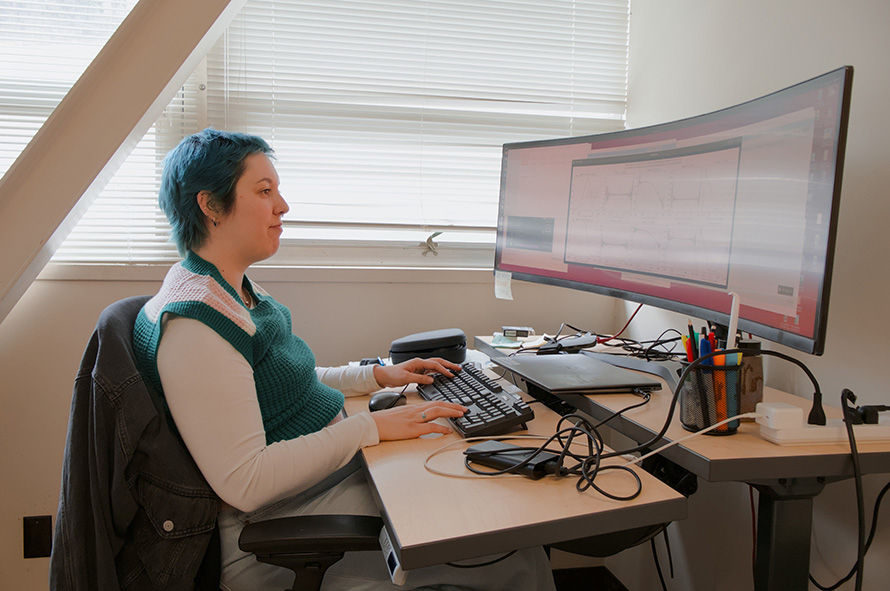 In general, I am interested in the group for its mix of numerical algorithms and plasma, beam, accelerator, and fusion physics, high-performance computing, and strong connections with experimentalists, including those at ATAP’s BELLA and the Lab’s Advanced Light Source. I want to be able to jump back and forth between code development and modeling studies, depending on the physics questions at hand.
Lastly, I care deeply about open, collaborative team science, which is central to AMP’s research, including the development of open-source codes. I also enjoy collaborating with groups across the Lab and other labs and institutions. Overall, AMP does exciting, cutting-edge work that is very stimulating.
How have you found working at the Lab, and what research are you conducting?
I enjoy working at the Lab for its open, collaborative, cutting-edge, multidisciplinary science. I work with many great people on diverse projects. My primary focus has been simulating the interaction point of future colliders, the region where the accelerated beams collide, where new physics is expected to occur. This work has led me to collaborate with people at SLAC National Laboratory, Massachusetts Institute of Technology, CERN, and other institutions, as well as to work with and support many students, from high schoolers to undergrads and grad students. I care deeply about mentoring the next generation; they are the future, and I want to help them. I also study specific numerical effects that can arise in PIC simulations of fusion-relevant plasmas and am working on a project to produce Super Intelligence-ready data for inertial confinement fusion studies.
A special and heartfelt mention to the Lab’s Academic Learning Internships and Faculty Training Office, which organizes many K-12 educational and outreach activities. Their work is highly valuable, and I am happy to contribute and help.
For more information on ATAP News articles, contact caw@lbl.gov.
