Jared De Chant is a postdoctoral researcher in the Advanced Light Source (ALS) Accelerator Physics Program in Berkeley Lab’s Accelerator Technology & Applied Physics (ATAP) Division and the ALS Upgrade (ALS-U) Project. De Chant’s work focuses on developing and implementing beam diagnostics for both the existing ALS and its future upgrade. He first joined the Lab in 2019 as a Science Undergraduate Laboratory Internship (SULI) student. As an intern, he was introduced to the field of accelerator physics, working on a prototype beam transport system for laser-accelerated ions in ATAP’s BELLA Center. He continued this work at BELLA while completing his Ph.D. in accelerator physics at Michigan State University. De Chant joined the ALS team in August 2025.
What fueled your interest in particle accelerators and their applications?
A consistent theme throughout my career has been embracing challenges. My first undergraduate physics course was the first time I truly struggled academically. I quickly caught up, but I had to put more effort into it than I would for other subjects. I loved it, though, because of that challenge. I had to really work at it, doing hundreds of problems to prepare for each exam.
After graduating, I wanted to continue studying physics, but I wasn’t sure which field would be a good fit. I applied for the SULI program and was contacted by Qing Ji, head of the Berkeley Accelerator Controls and Instrumentation Program, to work on “a challenging project,” designing a beam transport system for a laser-driven ion accelerator at BELLA. Lacking prior experience in beam dynamics or accelerator physics, I had to work extra hard to catch up on the basics by reading all of Martin Berz’s “Introduction to Beam Physics” textbook before even starting the project. I quickly realized that working on accelerators was both incredibly difficult and complex, but also very rewarding. I never take for granted the ability to work on some of the most complex machines ever created.
 One of the things I grew to love about accelerators is in their application. During my Ph.D. research at BELLA, I participated in a multidisciplinary collaboration exploring ultra-high-dose-rate radiobiology using laser-driven ion accelerators. The experiments explored a novel type of radiation therapy that harnessed the FLASH effect, “one of the most promising innovations over the past decade in the field of radiation oncology.” This application is especially meaningful to me as I’ve had multiple family members undergo radiation therapy as a part of their cancer treatment. Being able to contribute to that field of study, with the potential to improve outcomes for future cancer patients, made me very proud of the work I did.
What attracted you to join the Advanced Light Source Accelerator Physics Program?
I was already very familiar with ALS before starting my postdoc, having toured the facility many times and even working there as a user for my graduate research. I knew that ALS was a world-class light source facility with significant scientific impact. The prospect of working on the ALS-U project was also especially exciting because of the potential challenges involved in building a next-generation light source.
I was also familiar with some of the members of the Advanced Light Source (ALS) Accelerator Physics Program, since I had previously served as a teaching assistant for a course they taught at the U.S. Particle Accelerator School, and knew how great they were to work with.
The hands-on experience I gained during my time at BELLA required close coordination between design, hardware integration, and software development in a multidisciplinary environment. This experience prepared me to contribute meaningfully to the ALS-U as it continues to transition toward commissioning. Before joining the ALS, I was enthusiastic about the opportunity to expand my skills into larger-scale accelerators and to contribute to the successful commissioning of a next-generation light source.
How have you found working at the Lab, and what research are you working on?
Working at the Lab has been the most rewarding and consequential part of my career. I have enjoyed working with many brilliant and talented researchers on incredible projects. The Lab has a wonderfully collaborative and welcoming environment. I will always be grateful to Qing Ji for taking me on as a SULI student and introducing me to the wonders of working at a national lab.
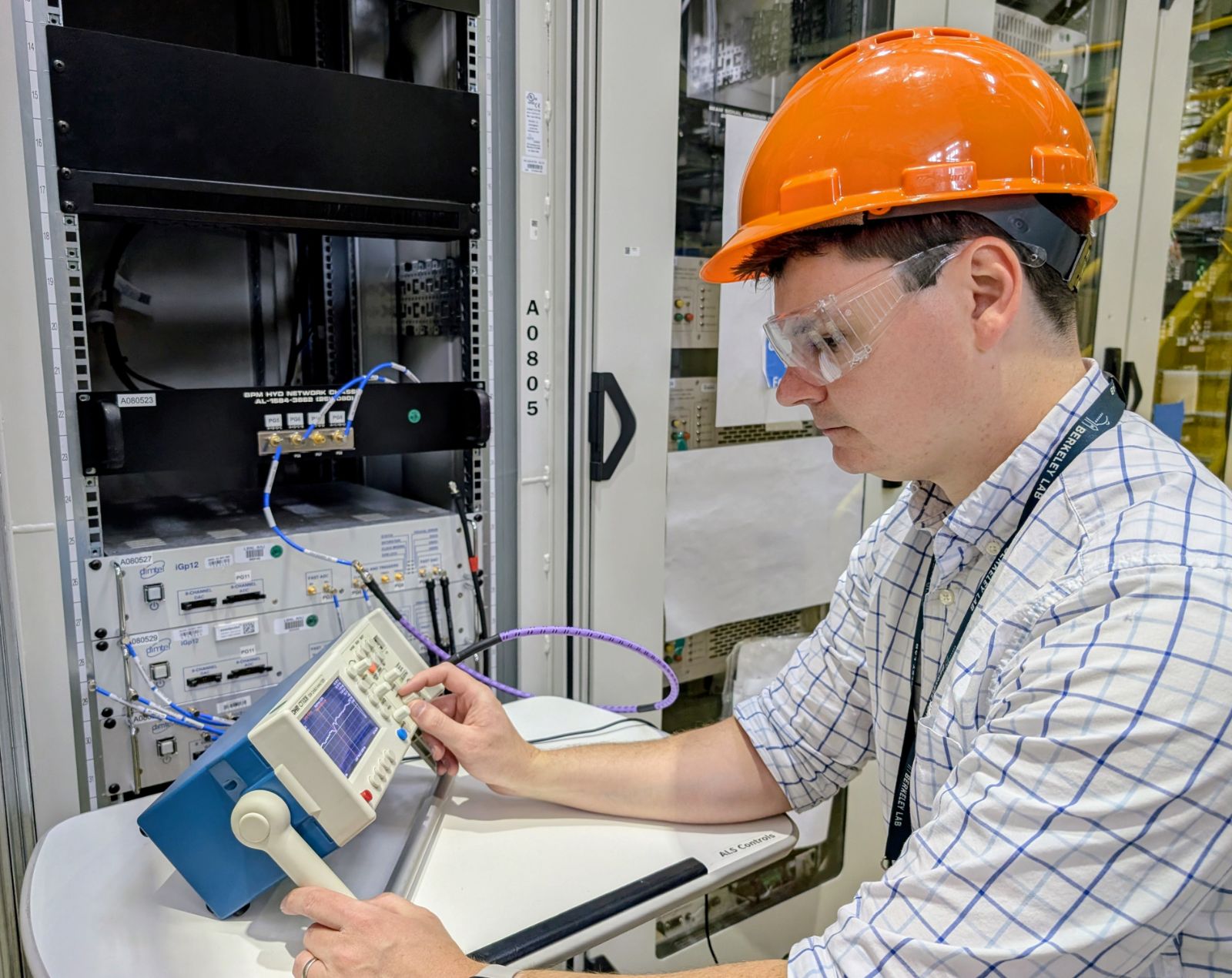
I am currently working with the ALS-U Beam Diagnostics team on the fabrication, testing, and commissioning of various beam diagnostic devices. These include beam position monitors, feedback systems, beam profile monitors, and more. My main project involves commissioning synchrotron radiation monitors for the ALS-U. These monitors will directly measure the beam size in the accelerator rings, a key metric for the ALS-U’s mission.
For more information on ATAP News articles, contact caw@lbl.gov.