Employee Spotlight
Jean-François Croteau is a research scientist in the Superconducting Magnet Program of the Accelerator Technology & Applied Physics (ATAP) Division at the Department of Energy’s Lawrence Berkeley National Laboratory (Berkeley Lab). Croteau joined Berkeley Lab as a postdoctoral scholar in April 2022 and became a research scientist in March 2024. Originally from Canada, he holds a bachelor’s degree in mechanical engineering from the University of Ottawa and a Ph.D. in mechanical engineering from the École Nationale Supérieure de Techniques Avancées Bretagne in Brest, France. He conducted his doctoral research at I-Cube Research in Toulouse, France, focusing on the fabrication and characterization of superconducting radiofrequency cavities for CERN.
What fueled your interest in particle accelerators and their applications?
My interest in particle accelerators began as a child, when I watched a national television documentary on the Large Hadron Collider and the search for the Higgs boson. I was fascinated by the project’s scale and by the idea that scientists could build such an extraordinary machine to answer fundamental questions about the universe.
Years later, during my Ph.D., I studied materials for superconducting radiofrequency cavities for CERN’s proposed Future Circular Collider. That experience helped me enter the accelerator field and develop expertise in superconducting materials.
 Big science particle collider projects continue to inspire me because they advance fundamental knowledge while also driving technologies with broader benefits. For example, developments in superconducting materials, such as niobium-titanium, have contributed to technologies such as magnetic resonance imaging, and newer high-temperature superconductors, including rare-earth barium copper oxide (REBCO) tapes, could play an important role in the future of fusion energy. Seeing how research on particle accelerators can advance other fields continues to motivate my work.
What attracted you to join the Superconducting Magnet Program?
After briefly working in financial services, I returned to research as a postdoctoral scholar in ATAP’s Superconducting Magnet Program. The opportunity to join a laboratory with Berkeley Lab’s scientific reputation and to contribute to major international research projects was highly appealing.
Although my doctoral research focused on superconducting radiofrequency cavities rather than superconducting magnets, I was excited to apply my experience to a new class of materials. When I joined the program, I began studying niobium-tin and working under the supervision of ATAP Staff Scientist Ian Pong on Rutherford cables for the U.S. Accelerator Upgrade Project. These cables are used in magnets to be installed at CERN as part of the High-Luminosity upgrade to the Large Hadron Collider.
I was particularly drawn to the combination of mission-driven engineering and fundamental research. I could contribute to a large international accelerator project while exploring emerging research areas, such as applying machine learning to superconducting materials research.
How have you found working at the Lab, and what research are you working on?
Working at Berkeley Lab is both a privilege and a distinctive experience. My colleagues in the Superconducting Magnet Program and the Berkeley Center for Magnet Technology bring diverse backgrounds and expertise to our research. Their knowledge, motivation, and willingness to collaborate help us generate new ideas and tackle challenging scientific problems.
I enjoy learning and tackling complex questions, and Berkeley Lab offers me opportunities to collaborate with both highly experienced scientists and early-career researchers. Senior colleagues offer decades of expertise, while students and interns bring fresh perspectives and challenge us to reconsider established methods.
My current research focuses on elucidating the microscopic structure and performance limits of REBCO tapes, a high-temperature superconducting material that could enable stronger, more compact magnets.
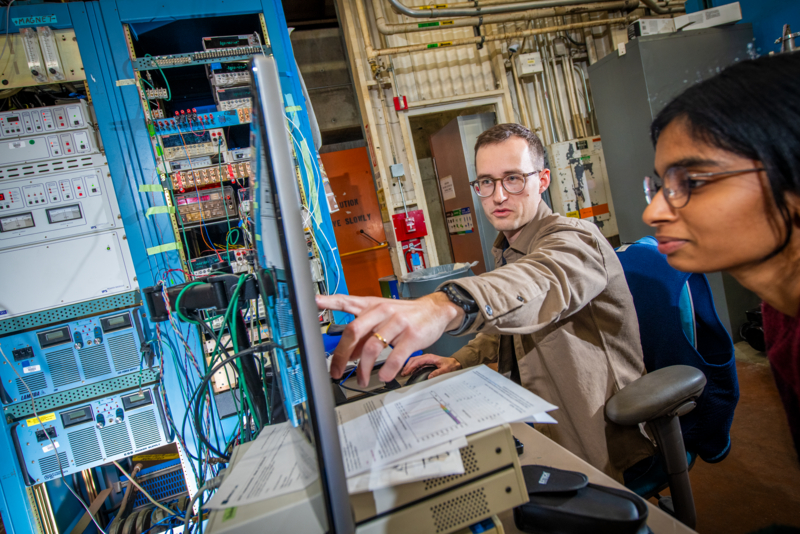
In collaboration with ATAP postdoctoral scholar Nandana Menon, we are using electron microscopy and machine learning to identify and characterize defects in the superconducting layer of these tapes. We are also collaborating with a researcher at The Molecular Foundry to develop new REBCO sample-preparation methods for transmission electron microscopy.
In addition, I co-supervise a Ph.D. student, Jeanne Villar, who is studying how REBCO tapes and cables respond to transverse compressive loads. This work may help identify design limits for high-field magnets and provide manufacturers with information to improve the mechanical strength and reliability of these materials.
For more information on ATAP News articles, contact caw@lbl.gov.