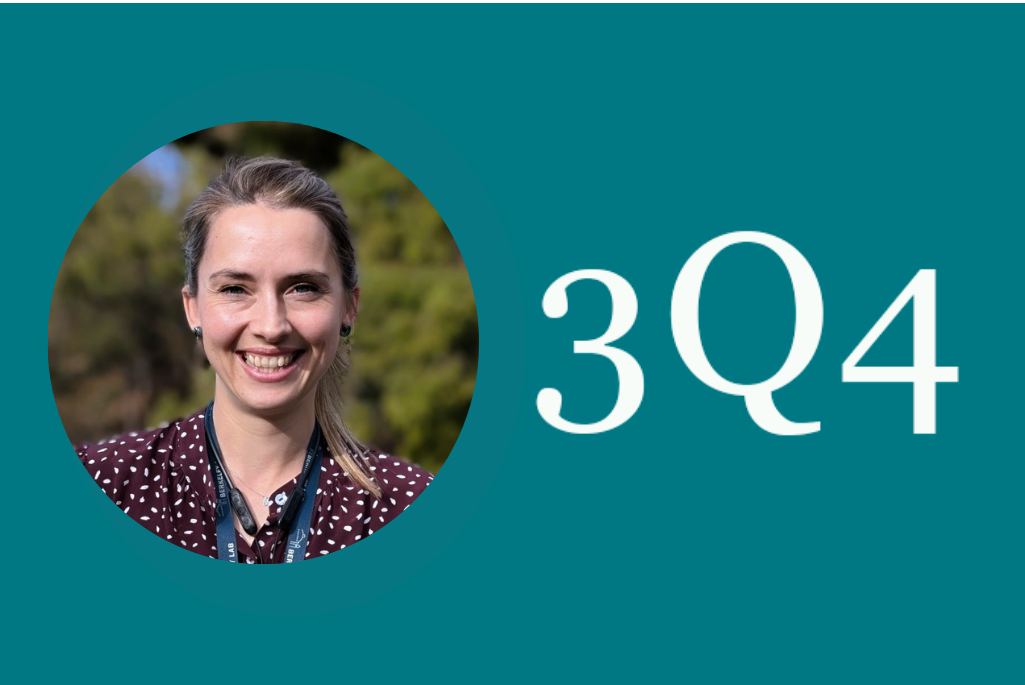
Lieselotte Obst-Huebl is a research scientist in the Accelerator Technology & Applied Physics (ATAP) Division at the U.S. Department of Energy’s Lawrence Berkeley National Laboratory (Berkeley Lab). She first joined Berkeley Lab as a postdoctoral researcher in 2019 and took on her current role in October 2021. Her work focuses on developing advanced laser-plasma accelerators that could create more compact, powerful particle accelerators. She holds a Ph.D. in physics and a Diploma (equivalent to a Master’s degree) in physics from Dresden University of Technology in Germany.
What fueled your interest in particle accelerators and their applications?
I became interested in particle accelerators because of their applications in fundamental particle physics, astrophysics, and dark matter research. My first experience with laser–plasma acceleration was during an internship at Helmholtz-Zentrum Dresden-Rossendorf during my undergraduate studies, where I worked on laser pulse diagnostics. That project introduced me to the complexities of laser pulse characterization and its crucial role in ensuring stable laser–plasma acceleration.
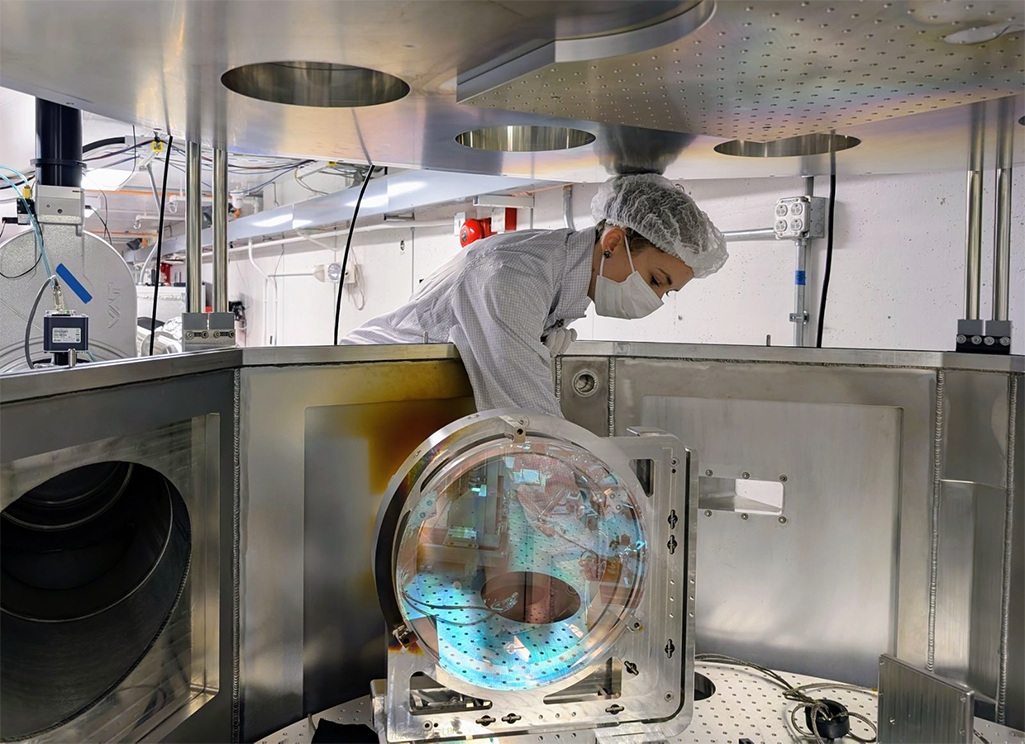
(Credit: Matthew Fullmer/Berkeley Lab)
The field encompasses a wide range of disciplines, including laser physics and technology, plasma science, and particle steering and detection. I value its multidisciplinary nature, strong teamwork within the community, and broad applications of particle beams and radiation sources, from basic research to medical technologies. Since joining Berkeley Lab, I have increasingly focused on radiobiological applications of accelerators, particularly how they help us better understand radiation interactions with living systems.
What attracted you to join the Berkeley Lab Laser Accelerator (BELLA) Center?
I had heard great things about the center and its research. After talking with several BELLA researchers at conferences and workshops, I saw it was a place where I could grow both professionally and personally. The Lab’s reputation and broad research options confirmed that joining the center was the right choice. BELLA’s welcoming culture, collaborative spirit, and camaraderie have made it one of the most supportive and inspiring environments I have experienced. Additionally, my work constantly provides new learning opportunities, which is one of the aspects I enjoy most about my role.
How have you found working at the Lab, and what research are you working on?
Working at the Lab underscores the importance of multidisciplinary research, the advantages of collaborating with top scientists, and access to state-of-the-art facilities. The experience has significantly enriched me and allowed me to pursue my interest in radiation biology, especially through work on FLASH radiobiology with colleagues from the Lab’s Biological Sciences Area and the Molecular Foundry. I am also collaborating on high-energy-density physics with team members from the BELLA’s theory group and ATAP’s Advanced Modeling Program to develop more effective methods for proton acceleration.
I am actively involved in LaserNetUS, a network that offers access to high-power laser facilities across North America. I also serve as the coordinator for outreach and user engagement for BeamNetUS, which provides access to accelerator test facilities within the United States. These roles closely align with my research, enabling me to foster collaboration, support user engagement, and expand access to specialized tools and expertise that advance progress in accelerator science and applications.
For more information on ATAP News articles, contact caw@lbl.gov.