Employee Spotlight
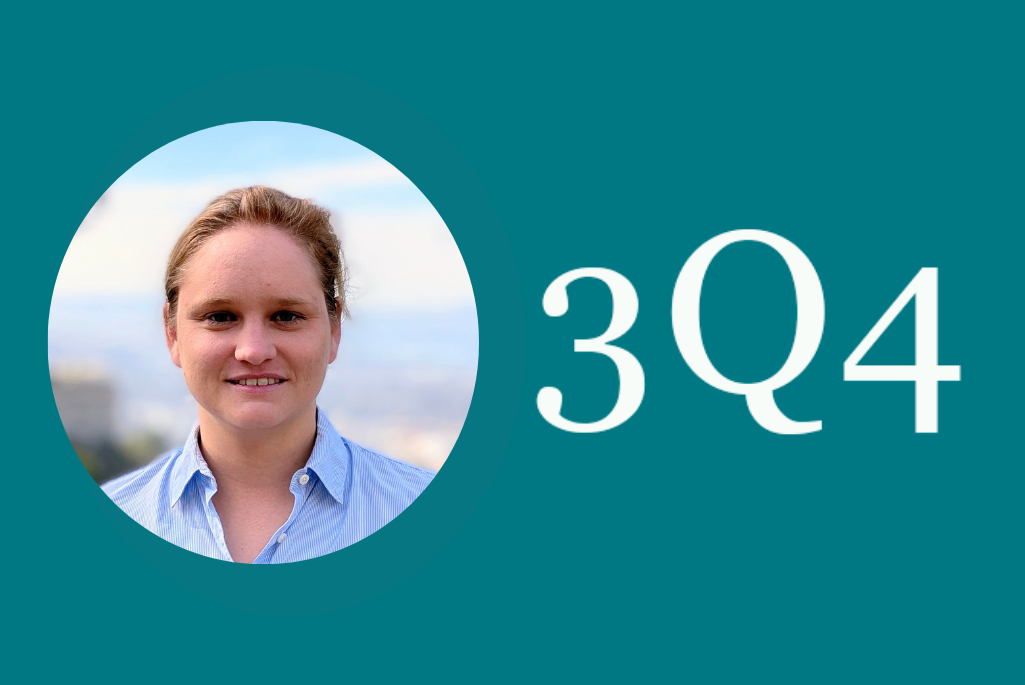
Sarah Schröder is a project scientist at the BELLA Center within the Accelerator Technology & Applied Physics Division at the Department of Energy’s Lawrence Berkeley National Laboratory (Berkeley Lab). Schröder holds a Ph.D. in accelerator physics with distinction from the University of Hamburg, in collaboration with the Deutsches Elektronen-Synchrotron (DESY). Her educational background includes a master’s degree in high-energy physics detectors from the University of Hamburg, complemented by peacebuilding studies, and a bachelor’s degree in semiconductor physics from the University of Stuttgart. Before joining BELLA in 2023, Schröder was a postdoctoral fellow at DESY, where she served as principal investigator for the demonstration of megahertz-repetition-rate beam-driven plasma wakefield acceleration at the FLASHForward facility.
What fueled your interest in particle accelerators and their applications?
My passion for advanced particle accelerator research stems from its inherently interdisciplinary nature. I am fascinated by the need for seamless collaboration and knowledge integration across disciplines—including particle beam dynamics, plasma physics, diagnostics and instrumentation, optics, high-performance computing, and engineering.
Beyond the physics of the machines themselves, it is deeply compelling to gain a broader perspective on the diverse scientific fields these accelerators advance. The vast potential applications of compact plasma accelerators, which yield tangible societal benefits, motivate me.
What attracted you to join the BELLA Center?
BELLA is a world-leading hub for advanced acceleration concepts. After focusing on beam-driven plasma wakefields since my Ph.D., I saw an opportunity to transition to laser-driven plasma acceleration, a complementary, comprehensive approach to the field. BELLA’s dual focus on fundamental science and the development of targeted practical applications is compelling.
 Given the exceptionally tight tolerances in plasma accelerators, smart optimization and operational techniques are critical to achieving top performance. With the Advanced Modeling Program just next door—home to leading experts in plasma accelerator code development—alongside NERSC’s computational infrastructure, Berkeley Lab provides an outstanding ecosystem where next-generation accelerators can thrive.
How have you found working at the Lab, and what research are you working on?
Working at Berkeley Lab is exceptionally rewarding; the institutional support and technical collaborations across groups are unparalleled. The Lab’s mentoring initiatives, dedicated student programs, and the cultural offices’ active leadership foster a highly collaborative and inclusive ecosystem.
My current focus is on developing innovative designs and operational methodologies to enable early-stage opportunities for plasma accelerators—leveraging their unique advantages while acknowledging their current performance limits. In particular, I am leading the effort to develop a testbed for radiation-hardened microelectronics design testing, a unique opportunity to synthesize my background and network across semiconductor, detector, and advanced accelerator science. It is an exciting, integrative role spanning the entire operational chain, from conceptualization to experimental execution, diagnostic development, and modeling.
As an accelerator physicist, it is an extraordinary privilege to build tomorrow’s accelerators at such a historic site—the cradle of accelerators—an opportunity approached with humility and gratitude.
For more information on ATAP News articles, contact caw@lbl.gov.