

Yilun Xu is a research scientist in the Accelerator Technology & Applied Physics (ATAP) Division at the U.S. Department of Energy’s Lawrence Berkeley National Laboratory (Berkeley Lab). He took on this role in 2021, after being a postdoctoral researcher at Berkeley Lab starting in 2018, and has worked on QubiC, the world’s first open-source control system for superconducting qubits. His initial experience with the Lab was as a visiting student during his doctoral studies from 2015 to 2017. Xu earned both a bachelor’s and a Ph.D. in Engineering Physics from Tsinghua University in China.
What fueled your interest in particle accelerators and their applications?
As an undergraduate, I became fascinated by control technologies that automate particle accelerator systems. I especially enjoyed working hands-on with control hardware, which sparked my long-term interest in accelerator science.
What attracted you to join the Berkeley Accelerator Controls & Instrumentation (BACI) Program?
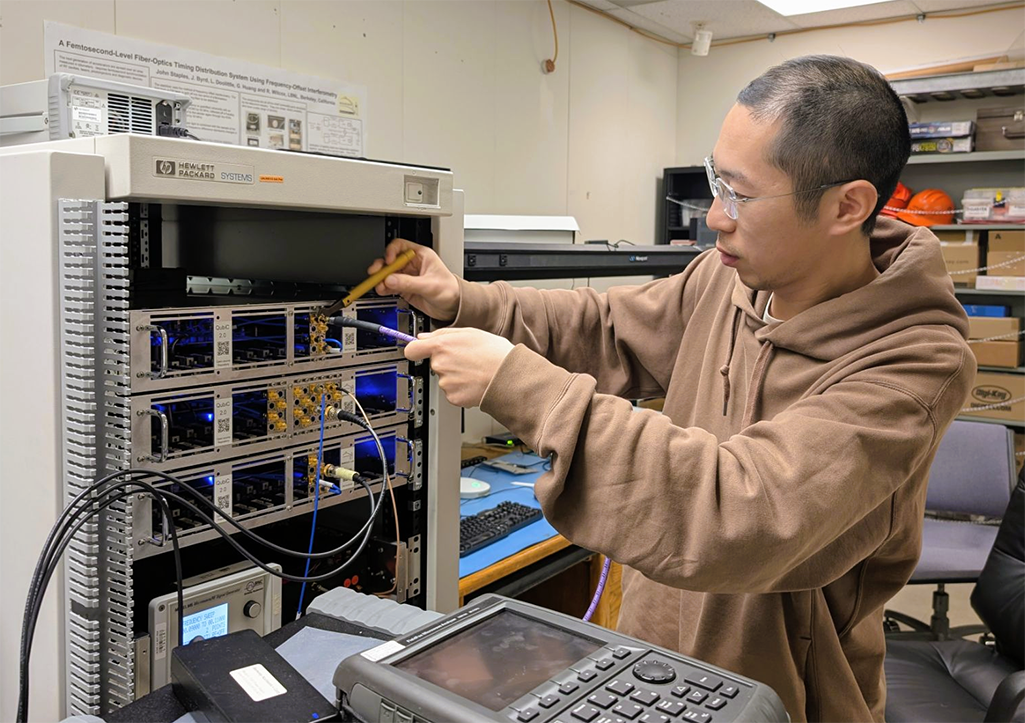
(Credit: Matthew Fullmer/Berkeley Lab)
During my time as a visiting student at Berkeley Lab, I was deeply impressed by the world-leading particle control and timing technologies developed there. The researchers were not only exceptionally talented but also passionate about their work and highly collaborative. At that time, they focused on developing an advanced low-level control system for RF timing and synchronization designed for large particle accelerators and laser facilities. I was honored to contribute to their efforts by creating an optical-cavity phase-stabilization method using field-programmable gate arrays (FPGAs) for coherent pulse stacking, as well as a high-precision phase-detection technique for a femtosecond timing and synchronization system. This environment greatly motivated me to join the BACI Program.
How have you found working at the Lab, and what research are you working on?
Working at the Lab remains exciting because it offers opportunities to contribute to cutting-edge science. Since 2018, as a co-inventor of QubiC, I have been developing a full-stack control system. QubiC includes hardware electronics, FPGA gateware, and engineering software, all focused on controlling and reading out quantum processors. A major focus of my recent work has been pioneering the use of artificial intelligence (AI) and machine learning in quantum control, especially by implementing machine learning on FPGAs for real-time applications.
The interdisciplinary expertise I have developed in hardware and software co-design for these systems closely aligns with the challenges faced in particle accelerators and laser control systems. I am eager to use this experience to help develop next-generation, AI-driven control systems for accelerator and laser facilities.
I am thankful for the Lab’s strong support of our quantum control development efforts, and I am motivated by the goal of delivering innovative “quantum control solutions” to the world.
For more information on ATAP News articles, contact caw@lbl.gov.