
Scientific Achievement
Researchers have developed a novel, fast, and computationally efficient method for detecting chaotic particle motion in circular particle accelerators. The key innovation is the use of the “norm of the tangent map”—a mathematical measure of how sensitive a particle’s path is to tiny changes in its starting point—computed via automatic differentiation, which computes the exact derivatives of a mathematical function defined by a computer program.
Because this measure can be calculated in just one or a few turns around the accelerator, rather than thousands, it dramatically accelerates a critical, traditionally time-consuming step in accelerator design. The work, led by scientists in the Department of Energy’s Lawrence Berkeley National Laboratory (Berkeley Lab) Accelerator Technology & Applied Physics (ATAP) Division and conducted in collaboration with colleagues from Michigan State University and Stanford University, demonstrated the method by optimizing the dynamic aperture (DA) of Berkeley Lab’s Advanced Light Source Upgrade (ALS-U), a next-generation synchrotron light source.
Significance and Impact
In circular accelerators, charged particles must travel stably around the ring millions of times without drifting off course and being lost. The DA defines the region where particles remain stable and is a critical performance parameter for designing and operating circular accelerators. Traditional “brute-force” methods for determining and optimizing the DA require tracking large numbers of particles over thousands of turns, a time-consuming and computationally expensive process.
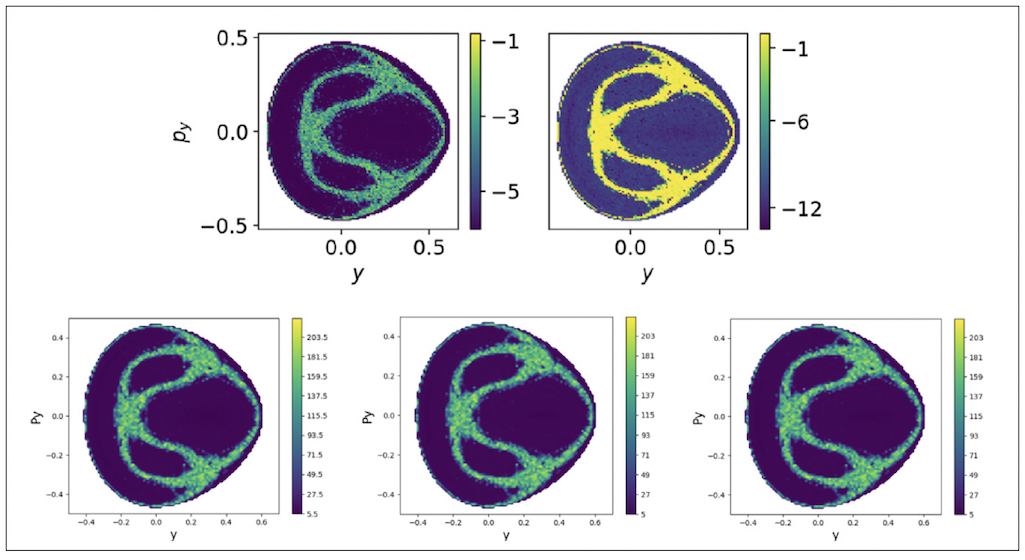
Dynamic aperture in the 𝑦–𝑝𝑦 plane obtained using FMA (top left) and REM (top right) indicators [16], and using the 𝑝 = 1 (bottom left), 𝑝 = ∞ (bottom middle), and Frobenius (bottom right) norms of the tangent map computed via differentiable tracking.
The new tangent map norm overcomes these challenges by rapidly identifying chaotic boundaries. Chaotic trajectories are exponentially sensitive to initial conditions, so two particles starting nearly side by side diverge exponentially. The tangent map norm captures this sensitivity. Because chaotic behavior reveals itself early, a single-turn or few-turn calculation is often sufficient to flag an unstable region. This reduces computational requirements by orders of magnitude while preserving accuracy, providing accelerator scientists with a powerful tool for rapidly exploring and refining machine designs. The approach is broadly applicable to nonlinear beam dynamics studies and to the design of future light sources and particle colliders.
Research Details
A faster way to compute sensitivities
The method’s success hinges on automatic differentiation, a computational technique that computes exact derivatives of complex functions to machine precision—without the approximation errors of numerical methods. The team built a streamlined AD module based on Truncated Power Series Algebra, but deliberately limited it to first-order derivatives. This is equivalent to the “dual-number” approach widely used in machine learning. By avoiding the heavy memory and computational demands of full higher-order frameworks, the technique is orders of magnitude faster while remaining simple to implement. In practice, the particle’s coordinates are stored using a special data type so that, as the simulation tracks each particle, it automatically computes both the trajectory and its derivatives.
Turning derivatives into a chaos detector
As a particle circulates, the derivatives of its final position with respect to its starting position form a matrix called the tangent map. For stable trajectories, small initial differences grow only gradually. For chaotic trajectories, they grow exponentially. The team showed mathematically that the “norm” of the tangent map—a single number summarizing the matrix’s size—grows exponentially precisely when motion becomes chaotic. This makes the norm a natural and reliable early-warning signal for instability.
Rigorous chaos boundary validation
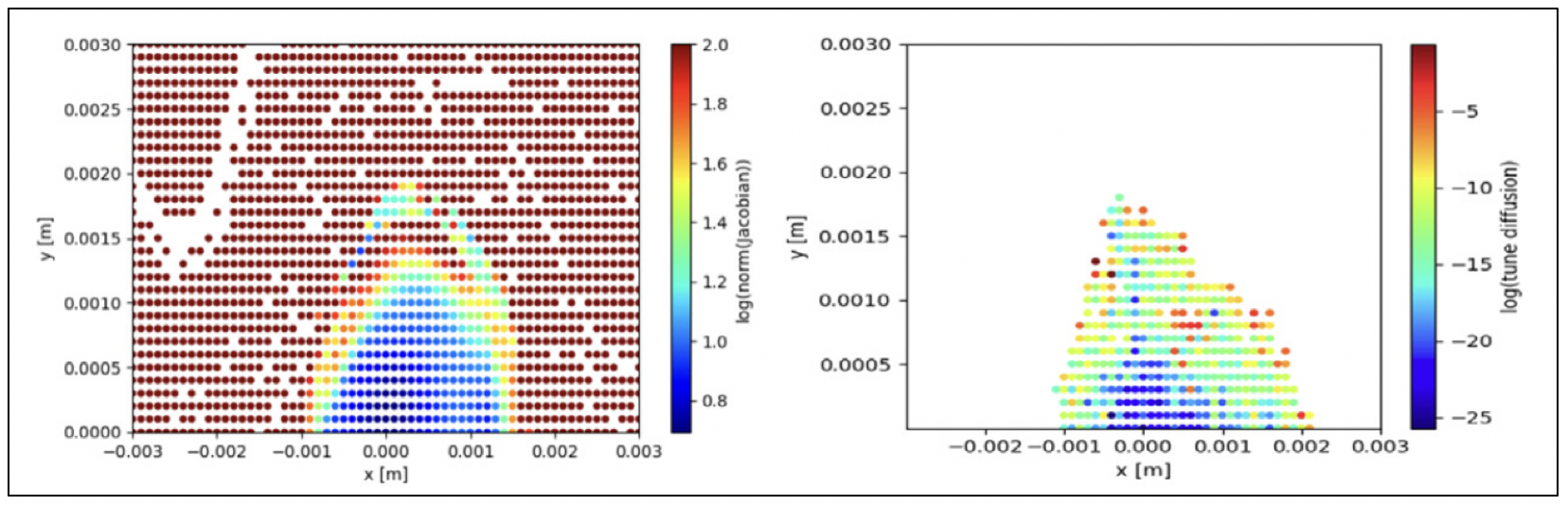
(l) Spatial distribution of the log Frobenius norm of the tangent map after one-turn differentiable tracking. (r) log tune diffusion rate from FMA, both for the optimized ALS-U lattice with zero momentum deviation.
To verify the reliability of the tangent map norm as a rapid chaos indicator, the framework was benchmarked against a classical Hénon–Heiles potential system, a mathematical model long used to study chaos. The results showed that the growth of the tangent map norm reliably separates stable, regular trajectories from exponentially growing chaotic ones.
Application to an ALS-U lattice design optimization
The fast chaos indicator was successfully tested in a practical engineering context to optimize the DA of a circular lattice design for the ALS-U. By replacing the traditional brute-force, thousands-of-turns particle-tracking survival test with a fast, one-turn tangent map norm evaluation, the optimization engine could evaluate and reject unstable lattice candidates almost instantly. This drastically compressed the optimization feedback loop, demonstrating the method’s ability to efficiently navigate complex, high-dimensional parameter spaces in real-world accelerator design.
Contact: Ji Qiang
Researchers: Ji Qiang (ATAP); Jingyu Wan and Yue Hao (Michigan State University); and Allen Qiang (Stanford University)
Funding: This work was supported by the U.S. Department of Energy and used computer resources at Berkeley Lab’s National Energy Research Scientific Computing Center.
Publication: J. Qiang, J. Wan, A. Qiang, and Y. Hao. “Fast chaos indicator from auto-differentiation for dynamic aperture optimization,” Nuclear Instruments & Methods in Physics Research A 1087, 171427 (2026). https://doi.org/10.1016/j.nima.2026.171427
For more information on ATAP News articles, contact caw@lbl.gov.