Scientific Achievement
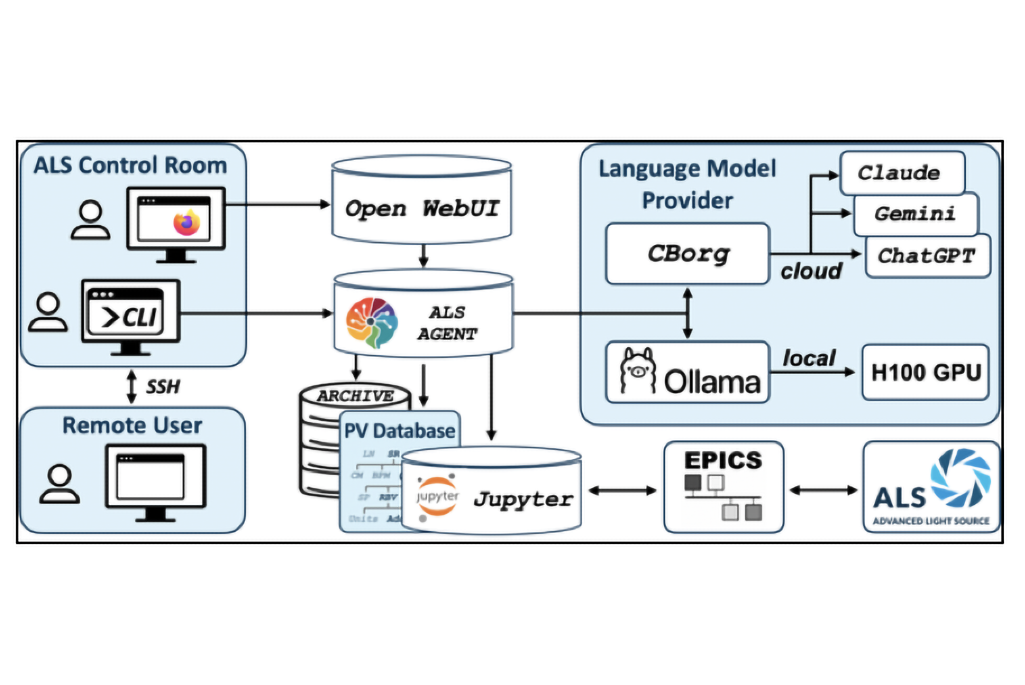
Researchers at the Department of Energy’s Lawrence Berkeley National Laboratory (Berkeley Lab) have deployed the Accelerator Assistant, the first AI system based on large language models capable of autonomously conducting multi-stage physics experiments at a production synchrotron, the Advanced Light Source (ALS) at Berkeley Lab. The system allows accelerator physicists to describe complex experimental or diagnostic tasks in natural language and automatically translate them into executable workflows.
These workflows include identifying relevant machine signals, retrieving historical data, generating analysis scripts, interacting with the accelerator control system, and producing results. Tasks that once took hours of manual scripting and expert knowledge can now be completed in minutes.
Significance and Impact
Diagnosing and optimizing accelerator performance is often time-critical and technically complex. Experts must identify relevant signals from over 230,000 process variables, extract archived data, and develop custom analysis code—often under operational pressure.
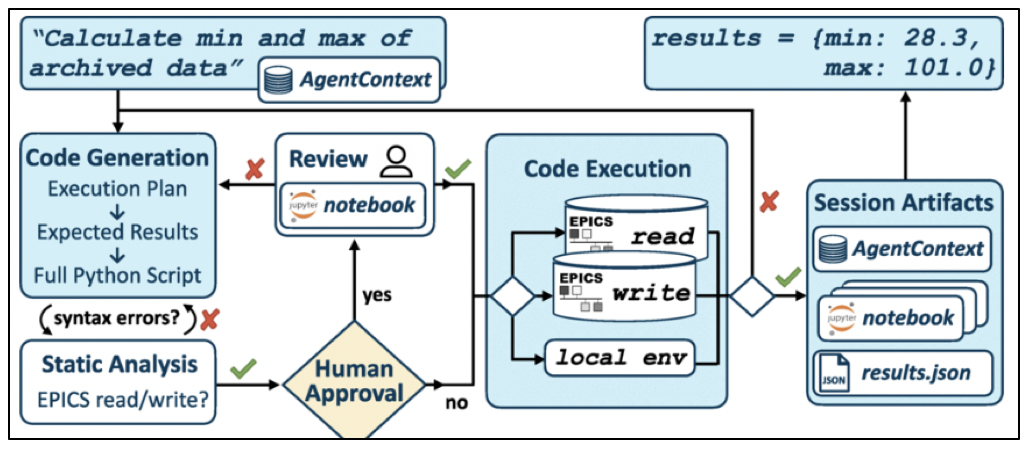
Pipeline for controlled Python code execution in the Accelerator Assistant. Natural language tasks are translated into a plan, results schema, and then Python code, which can dynamically access the agent context, is statically analyzed, and may be reviewed by a human operator. Execution is typically confined to containerized Jupyter kernels with strict read/write policies, and every run produces session artifacts (context, notebooks, json) for full reproducibility.
The Accelerator Assistant offers a natural-language interface that lowers this barrier while maintaining the safety and reliability needed for a user facility operating 24/7. In typical machine-physics use cases, the time required to prepare analysis workflows was reduced by roughly two orders of magnitude compared to traditional manual approaches.
Research Details
Plan-First Orchestration
The system is built on the Osprey Framework, a platform designed specifically for deploying AI systems in safety-critical control environments. Instead of executing actions immediately, Osprey uses a plan-first approach: the AI first generates a complete, structured execution plan that clearly lists each step and its dependencies.
These plans can be reviewed before any interaction with accelerator hardware, ensuring transparency and an additional layer of operational safety.
Safety and Tool Access
Osprey is designed to address challenges specific to large scientific facilities. These challenges include managing very large control-system namespaces, clearly identifying and constraining hardware write operations, and integrating with existing control infrastructures such as an Experimental Physics and Industrial Control System.
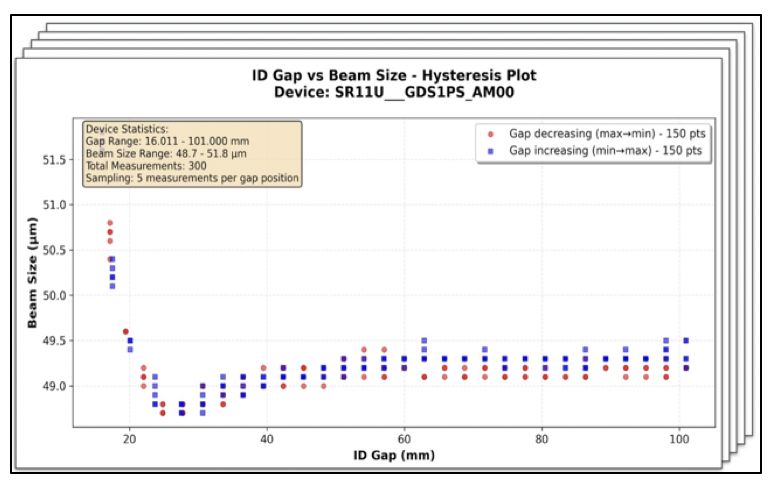
Example output of the Accelerator Assistant: hysteresis measurement of ID gap vs vertical beam size at the ALS. The execution plan generated by the agent combined historical range extraction, automated script generation, and real-time machine control. The agent performed a 30-point bidirectional gap sweep with five repeated measurements per point, producing the plot shown here for one device. This figure illustrates the final output of the agentic workflow, where every step, from parsing natural language to data retrieval, machine control, and plotting, was generated and executed automatically
To maintain safety and reproducibility, all generated code runs within controlled, containerized environments. This ensures that interactions with the machine are traceable and that accidental or unintended operations are prevented.
Hybrid Inference
The Accelerator Assistant enables flexible deployment of AI models. Inference can run locally on dedicated GPU resources within the control network or be routed to external, state-of-the-art models through secure gateways. This hybrid approach allows facilities to balance performance, security, and resource availability.
Following its initial deployment at the ALS, the Osprey framework is now being adopted by other particle accelerators, fusion research facilities, and major astronomical observatories.
Contact: Thorsten Hellert
Researchers: Thorsten Hellert, Drew Bertwistle, Simon C. Leemann, Antonin Sulc, and Marco Venturini (Berkeley Lab)
Funding: Department of Energy Office of Science
Publications:
Thorsten Hellert, Drew Bertwistle, Simon C. Leemann, Antonin Sulc, and Marco Venturini. “Agentic artificial intelligence for multistage physics experiments at a large-scale user facility particle accelerator,” Physical Review Research 8, L012017 (2026). https://doi.org/10.1103/jtqy-9jz1
Thorsten Hellert, Joao Montenegro, and Antonin Sulc. “Osprey: A Scalable Framework for the Orchestration of Agentic Systems,” 2025. https://arxiv.org/html/2508.15066v2
For more information on ATAP News articles, contact caw@lbl.gov.