Particle accelerators have transformed modern science. They have enabled discoveries ranging from the structure of proteins to the fundamental particles that make up our universe, and have supported advances in medical diagnosis and treatment, as well as the development of new materials. Yet universities rarely teach accelerator science, and the specialized expertise the field requires takes years to develop. Two researchers from the Accelerator Technology & Applied Physics (ATAP) Division at Berkeley Lab are working to ensure the next generation of accelerator scientists and engineers is ready to take the reins.
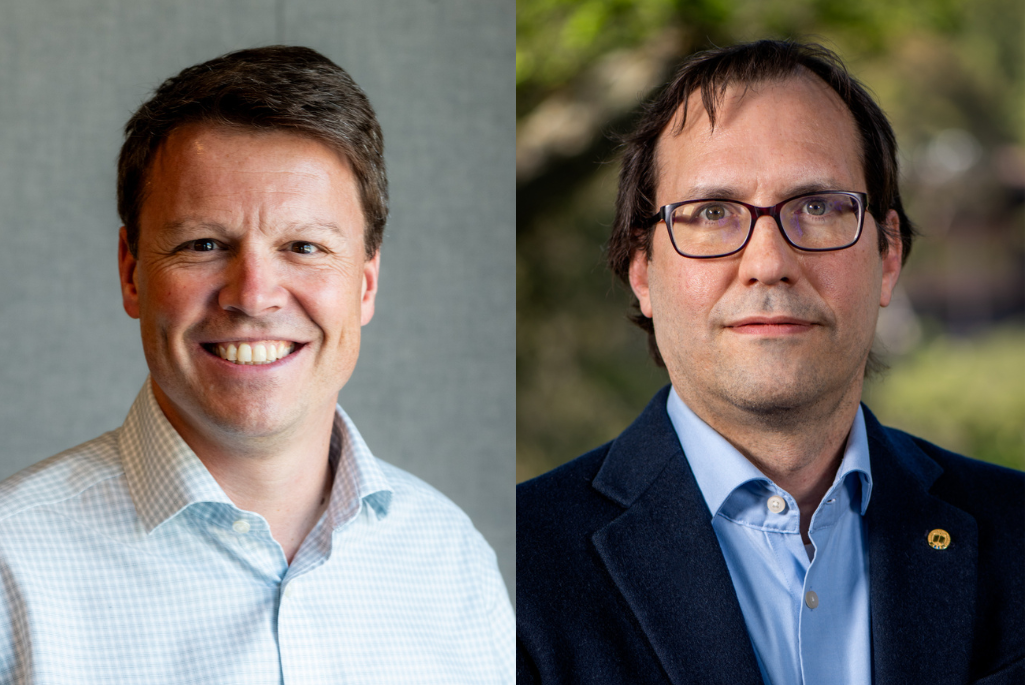
This spring, Simon Leemann, a staff scientist and deputy head of ATAP’s Advanced Light Source Accelerator Physics Program, and Carl Schroeder, a senior scientist at ATAP’s BELLA Center, descended the steep slope from the Lab to the University of California, Berkeley, campus to teach “Particle Accelerator Technology and Beam Physics.”
The 14-week graduate-level course, offered through the university’s Department of Nuclear Engineering, has become a cornerstone of ATAP’s commitment to workforce development and a critical element in sustaining the talent pipeline for Berkeley Lab and the broader Department of Energy (DOE) national laboratory complex. The course also includes a guided tour of Berkeley Lab’s Advanced Light Source (ALS), a state-of-the-art synchrotron user facility—a circular particle accelerator that produces ultra-bright X-rays for research—supported by the DOE’s Basic Energy Sciences Program and serving nearly 1,700 users each year in the physical and life sciences.
“The course is part of ATAP’s commitment to workforce development,” explains Schroeder. “Accelerator technology is a specialized field of study typically not offered at most universities.” He adds that the course serves a purpose similar to ATAP’s strong involvement with the U.S. Particle Accelerator School (USPAS), another key training ground for the field. Indeed, Leemann leads a team that regularly teaches the undergraduate-level course “Fundamentals of Accelerator Physics and Technology with Simulations and Measurements Lab” at USPAS.
Schroeder completed his PhD in Physics at UC Berkeley in 1999 and joined Berkeley Lab in 2001 after a postdoctoral fellowship at SLAC National Accelerator Laboratory. Since 2000, he has held an Adjunct Faculty appointment in the UC Berkeley Department of Nuclear Engineering and has taught the course five times. Before his tenure as instructor, the course was taught by other researchers in ATAP and its predecessor, the Accelerator and Fusion Research Division.
Leemann, his co-instructor, views the course as a strategic investment. “Through the class and the ALS tour, we strengthen connections with bright young people—ideally, we’ll welcome them back later as doctoral students or fellow researchers.” Leemann brings complementary expertise to the classroom. He earned his PhD in Physics from École Polytechnique Fédérale de Lausanne in 2007. After a postdoctoral fellowship at the Swiss Light Source, he led the Accelerator Development group at Sweden’s MAX IV Laboratory before joining Berkeley Lab in 2017.
The class meets twice weekly and covers 26 lectures spanning the full breadth of the field. Students begin with foundational topics—an introduction to accelerators and their applications, followed by cyclotrons—and then move into the mathematics underpinning beam generation and control. The syllabus then covers accelerating structures, including radio-frequency (RF) cavities and standing- and traveling-wave systems; longitudinal beam dynamics; and accelerator modeling using high-performance computing.
Later weeks introduce students to particle sources, synchrotron light sources, free-electron lasers, superconducting magnet technology, advanced accelerator concepts, and other topics. This blend of analytical problem-solving and culminating synthesis was designed to translate “knowing accelerator physics” into “using accelerator physics.”
“The class was extremely useful for quantifying how we can manipulate particle beams to achieve the properties required for a given experiment,” says Joe Henderson, a second-year doctoral student in the Department of Nuclear Engineering whose research primarily focuses on gamma-ray production cross sections for 14-MeV fusion-energy neutrons, a key area for designing future fusion reactors.
“I think Simon and Carl both have a knack for teaching. Their explanations were thorough yet digestible. They were always available to meet, either virtually or in person, to clear up misunderstandings. I quite enjoyed the class, and I’m glad UC Berkeley allows practicing professionals to teach courses grounded in their real-world expertise.”
Pierce Thompson, another second-year doctoral student in the Department of Nuclear Engineering, says, “I took this course in particular because my experiences with the 88-Inch Cyclotron at Berkeley Lab sparked my interest in how accelerator design determines the range of experiments accessible to a facility, and vice versa, during the design phase of a user facility such as the ALS.”
By the end of the semester, students understand the fundamental physical principles of charged-particle accelerators and apply them to design beamlines for real-world applications. This year’s enrollment reflected strong interest: 27 students, 25 of whom took the course for a letter grade.
“This was the largest class we’ve had so far, and it’s great to see students’ interest in and enthusiasm for the field,” Schroeder says.
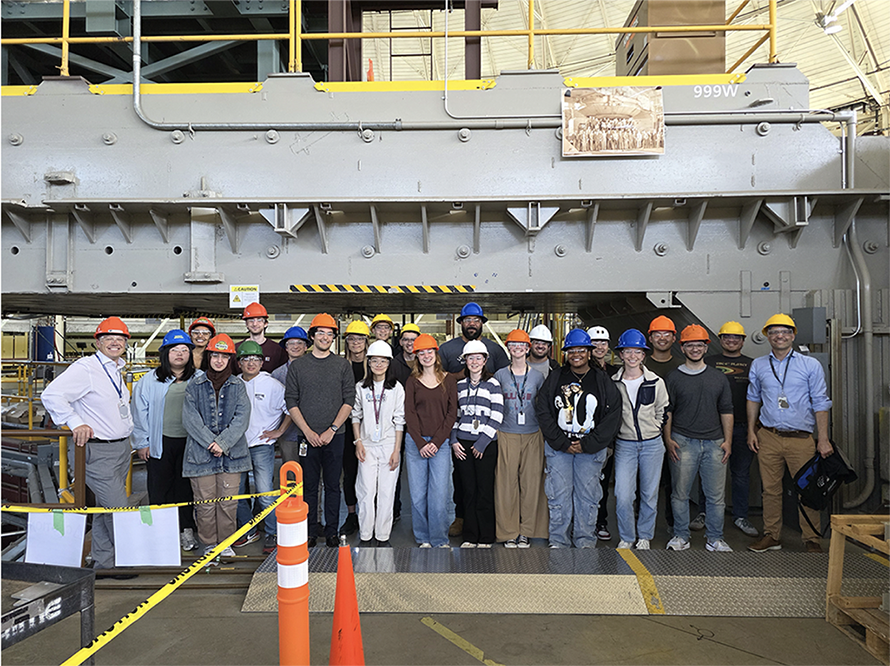
During the ALS tour, students visited the gun/linac bunker and entered the storage ring tunnel. There, they saw RF cavities, magnets, the injection area, and an in-vacuum undulator. The tour also included a look at the nearly completed ALS-U Accumulator Ring, which illustrates the direction of future fourth-generation storage ring technology and on-axis injection.
Conducted by Leemann and Schroeder, with assistance from ATAP postdocs Gianluca Martino and Jared De Chant and student assistant Andrea Zabala, and timed to coincide with the end of scheduled maintenance at the ALS, the tour allowed the group to venture behind the shield wall and up to the accelerators.
“Tours like this are a great opportunity to spark excitement about accelerator physics, especially synchrotrons,” says Leemann. “These are incredibly large and complex facilities that the public funds but rarely gets to see.”
Schroeder agreed that the tour is a highlight of the course. “Throughout the course, students learn about many of the accelerator components visible on the tour—I think it is great for them to see the principles applied in practice.”
Student responses confirmed the impact, with Leemann recalling “a lot of oohs and aahs” as the group entered the tunnels, “as well as extensive photographs and probing technical questions.”
While students in the class are already interested in these topics, he says that “only once you get to see such a facility up close do you develop a sense for just how spectacular these instruments are,” adding that “Students’ imagination lights up as they see how all these theoretical concepts come together to form real instruments that enable cutting-edge experiments.”
“The ALS tour was amazing,” says Henderson. “It was refreshing to actually see the septums, quadrupoles, undulators, and other components we had spent so long discussing in class. In particular, it was very refreshing to learn how physicists correct for errors arising from limitations in the accuracy of component assembly. Not many classes examine the efforts that go into making experiments happen.”
Thompson says, “I thoroughly enjoyed the ALS tour. It was extremely satisfying to see the bending and focusing magnets, RF accelerating structures, and sources we had discussed all semester, in person and operating. It puts into perspective the cost, physical scale, and engineering required not only to keep such a facility operational but also to upgrade it as users demand brighter, more coherent beams.”
Teaching classroom courses and leading guided tours of the Lab’s facilities are essential to the long-term health of Berkeley Lab and the DOE national laboratory complex. Accelerators underpin DOE’s missions across basic energy sciences, high-energy physics, nuclear physics, and isotope production, and they support applications in medicine, industry, and national security. Sustaining and advancing these capabilities requires a steady influx of trained scientists and engineers. This pipeline depends on outreach and education programs, including the course taught by Schroeder and Leemann.
For more information on ATAP News articles, contact caw@lbl.gov.