
Scientific Achievement
High-fidelity quantum circuits are the cornerstone of reliable and scalable quantum computing. These circuits, comprising qubits and quantum gates, must operate with minimal errors and are essential for running complex algorithms and implementing quantum error correction, which protects quantum information from noise and decoherence. However, in the current noisy intermediate-scale quantum era, high decoherence (loss of quantum state) and gate errors severely limit the performance of scaling quantum circuits.
To overcome these limitations, researchers from the Accelerator Technology & Applied Physics Division at the Department of Energy’s Lawrence Berkeley National Laboratory (Berkeley Lab) have developed a novel approach called Differentiable Logical Programming (DLP). DLP uses standard classical gradient descent to simultaneously discover circuit structure and optimize gate parameters. It can autonomously adapt to hardware noise and failures, improving the fidelity of quantum circuits.
Significance and Impact
Currently, designing high-fidelity circuits relies on a wide spectrum of methods, ranging from classical rule-based compilers and variational algorithms to heuristic machine-learning approaches such as reinforcement learning and differentiable quantum circuits, but these often struggle to prioritize physical constraints, such as hardware robustness.
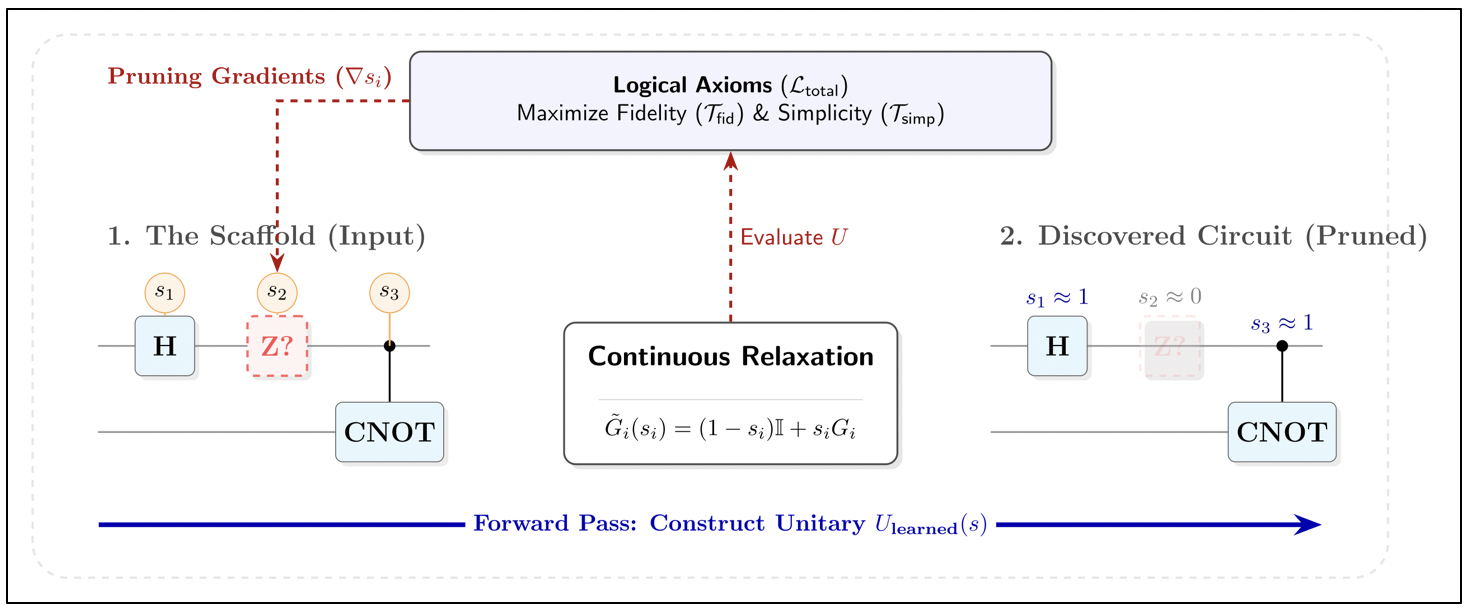
Conceptual overview of the Differentiable Logical Programming framework for quantum circuit design. The entire process, from the logical axioms to the circuit structure, is connected by differentiable operations, enabling end-to-end optimization with standard gradient-based methods. This workflow unifies discrete structural search and continuous parameter optimization.
The DLP framework addresses these bottlenecks by reframing discrete circuit design as a continuous, differentiable optimization process. Crucially, this approach allows specific design criteria to be imposed directly into the optimization. By defining customizable mathematical rules, the model can be trained to prioritize properties such as logical correctness, gate simplicity, and resilience to hardware noise. This shift enables the problem to be solved using standard differentiable optimization tools, opening the door to principled automated circuit design at scale and improved control over quantum logic gates. The research also aligns with the Lab’s Berkeley Accelerator Control & Instrumentation Program’s work on the Quantum Bit Controller.
The framework proves its versatility by discovering algorithms from scratch, such as the Quantum Fourier Transform—crucial for applications like phase estimation—and by scaling to larger systems through Hierarchical Synthesis, a top-down approach that reduces complex systems into smaller, manageable subsystems or modules. Experimental results on the 133-qubit IBM Torino processor demonstrate that the model can autonomously adapt to hardware noise and failures, improving overall circuit fidelity. When we simulated a hardware failure, the adaptive DLP model autonomously rerouted a GHZ state preparation circuit away from the degraded path within just two calibration cycles.
This quick adaptation helped the system recover to 97.5% fidelity, whereas a standard, static baseline dropped to 38.2%—yielding a 59.3% point improvement. The researchers observed a selection process as the optimizer essentially learned to identify and lock onto the more robust hardware path before the failures fully manifested. In practice, this serves as an online form of adaptive compilation that current rule-based compilers cannot easily provide.
Research Details
The DLP framework assigns each candidate gate in a scaffold a learnable parameter, which is then mapped to a continuous switch using a sigmoid function. This enables each gate to “relax” into a weighted interpolation between the identity matrix and the gate itself, making the entire circuit construction fully differentiable. The model pieces together the total sequence of these relaxed gates and trains to minimize a combined loss based on our chosen logical axioms, such as fidelity, simplicity, entanglement, and noise robustness.
To validate the framework’s versatility, the researchers conducted a series of diverse experiments. The model successfully discovered a 2nd-order Trotter-Suzuki decomposition, effectively breaking down complex physical simulations into manageable quantum machine code, and extracted a 4-qubit Quantum Fourier Transform from highly polluted circuit scaffolds (i.e., those containing valid gates mixed with distractors). When benchmarked against existing methods, such as Quantum DARTS, on a simulation of the lithium hydride molecule, the DLP approach exhibited greater stability and noise resilience.
Contact: Antonin Sulc
Researchers: Antonin Sulc
Funding: U.S. Department of Energy, Office of Science
Publication: Antonin Sulc. “Differentiable Logical Programming for Quantum Circuit Discovery and Optimization,” arXiv:2602.08880v1 [quant-ph] (9 Feb 2026). https://doi/10.48550/arXiv.2602.0880
For more information on ATAP News articles, contact caw@lbl.gov.