
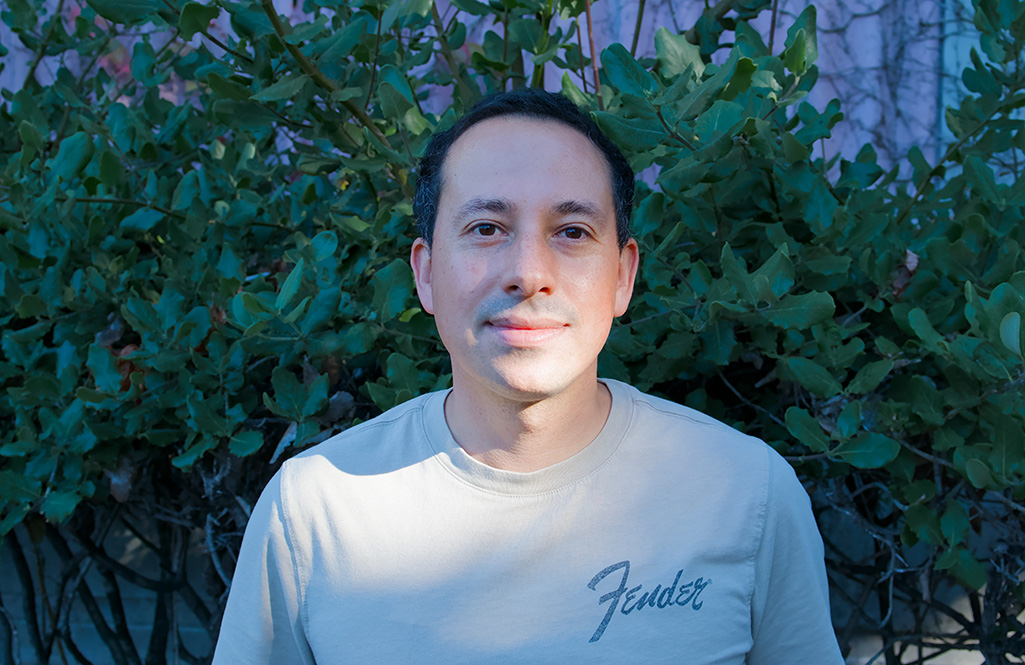
Mauricio Ayllon Unzueta from the Accelerator Technology & Applied Physics (ATAP) Division at the Department of Energy’s Lawrence Berkeley National Laboratory (Berkeley Lab)has received a prestigious NASA Planetary Science Early Career Award. Ayllon Unzueta is one of five recipients of this highly competitive award, which helps promising early-career scientists take on a greater role in the planetary science community and pursue professional development.
“Receiving the award is a proud highlight of my career,” says Ayllon Unzueta, a research scientist in ATAP’s Fusion Science & Ion Beam Technology (FS&IBT) Program. “It enables me to develop and maintain vital software tools for the planetary science and nuclear physics communities and to elevate Berkeley Lab’s visibility and impact in planetary science.”
With this three-year award, Ayllon Unzueta is developing Wara, an open-source toolkit for analyzing and visualizing gamma-ray and neutron spectroscopy data from NASA missions, as well as experimental and simulated data. He says the platform “serves two key roles: enabling planetary scientists to analyze mission data and plan future exploration, and providing advanced analysis tools for researchers, engineers, and students learning about radiation detection at the intersection of planetary science and nuclear engineering.”
“We’re thrilled for Mauricio,” says Arun Persaud, a senior scientist and head of FS&IBT. “His work links our program’s expertise in nuclear detection and ion beam technology to some of NASA’s most exciting exploration goals.”
Born in Bolivia, Ayllon Unzueta holds a Ph.D. in nuclear engineering from the University of California, Berkeley, where he conducted most of his doctoral research at Berkeley Lab. After earning his doctorate, he received a NASA Postdoctoral Program fellowship and spent three years in the Solar System Exploration Division at NASA Goddard Space Flight Center, developing planetary nuclear spectrometers. During this period, his research focused on instrumentation development and supported the design of the Dragonfly Gamma Ray and Neutron Spectrometer, which will soon launch to Titan, Saturn’s largest moon.
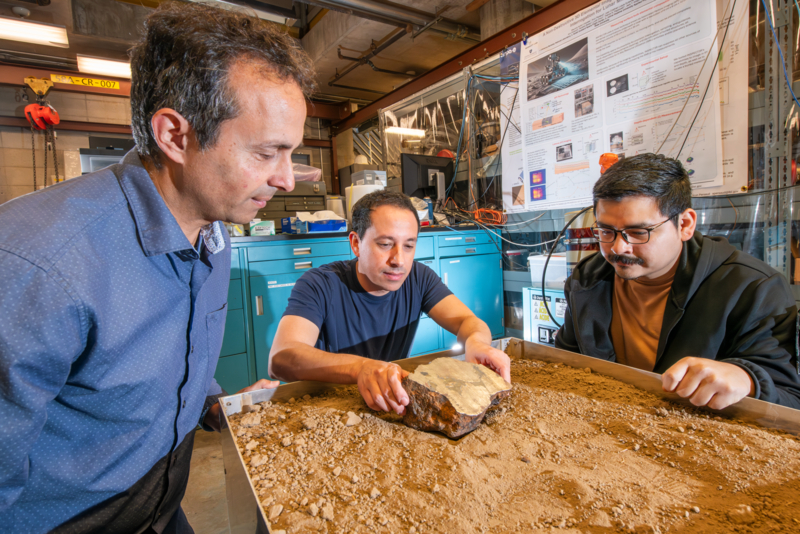
(l-r) Fusion Science & Ion Beam Technology Program Head Arun Persaud, Research Scientist Mauricio Ayllon Unzueta, and graduate student Juan Cristhian Luque Gutierrez place a portion of a meteorite onto a soil box. The team used the INSPECT3R imager to scan the meteorite at different soil depths. (Credit: Robinson Kuntz/Berkeley Lab)
He joined FS&IBT in May 2024 and says, “The program is an intellectually stimulating environment where I collaborate with exceptional scientists and engineers and am actively encouraged to pursue my own innovative research. I feel fully supported at every level, from leadership and my immediate supervisor to technical staff and colleagues.”
While at FS&IBT, Ayllon Unzueta has been developing the next generation of planetary nuclear spectrometers to address scientific questions about the origin and evolution of our solar system and to map lunar resources for an eventual permanent human base on the Moon. One such instrument is the In-Situ Nuclear Spectrometer with 3D Resolution (INSPECT3R), an advanced imaging technology that can produce accurate, detailed 3D geochemical maps of a planet’s subsurface, potentially transforming how we explore other worlds, asteroids, and our own planet. This new instrument could deepen our understanding of the geochemical wealth of the Moon, Mars, and other planets and asteroids, and help us search for signs of life. It could also enhance our understanding of terrestrial soil geochemistry, helping improve land management here on Earth.
For more information on ATAP News articles, contact caw@lbl.gov.
