
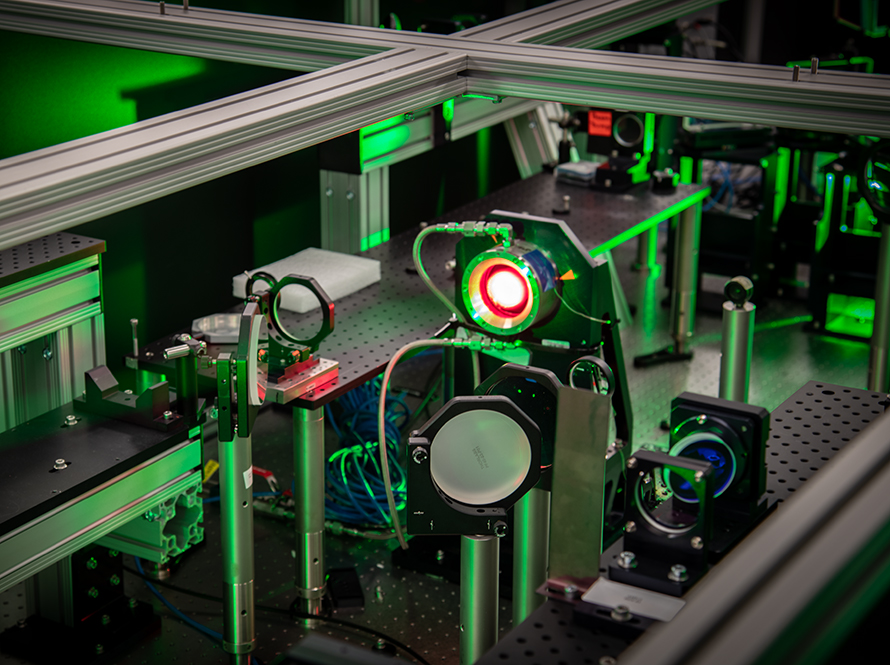
The first BeamNetUS user experiment at the Berkeley Lab Accelerator Laser (BELLA) Center, a leading laser facility at the Department of Energy (DOE)’s Lawrence Berkeley National Laboratory (Berkeley Lab), has been completed. BeamNetUS is a network of facilities dedicated to advancing particle accelerator research and technology by providing access to beam test facilities within the U.S. DOE’s national laboratories. It enables users to perform exploratory tests and develop new collaborations.
The experiment, led by Rob Shalloo, a staff scientist in the Plasma Accelerators group at the Deutsches Elektronen-Synchrotron (DESY) National Laboratory in Hamburg, Germany, and involving two graduate students from the same group, used BELLA’s Hundred Terawatt Thomson facility to characterize Hydrodynamic Optical-Field-Ionized waveguides. These waveguides are a critical technology for maximizing both electron energy and beam quality in laser-plasma accelerators (LPAs). They have supported recent results at the BELLA Petawatt laser, and understanding how these work could support advances in LPAs.
LPAs could provide more compact, cost-effective particle colliders and novel light sources, enabling exploration of matter at atomic and molecular scales. They could support new scientific discoveries and advance fields such as high-energy physics, medicine, materials science, and fusion.
“BeamNetUS has enabled us to establish a collaborative effort toward solving shared challenges in developing plasma-based accelerators,” says Shalloo. “The experiment was very successful and provided a great opportunity for our students to engage with a new environment and work with leading experts in the field.”
Leading the work from BELLA, Alex Picksley, a research scientist in the Accelerator Technology & Applied Physics Division at Berkeley Lab, says the team collected about 10 terabytes of data, which they are now analyzing.
“I am very pleased to have welcomed the team from DESY to BELLA to complete the first BeamNetUS campaign at the BELLA Center,” adds Picksley. “It was a great opportunity for everyone involved, and we look forward to more campaigns in the future.”
For more information on ATAP News articles, contact caw@lbl.gov.