On November 5, 2025, students and teachers from Skyline, Richmond, and Kennedy High Schools, along with Envisions Academy, participated in guided tours of the Magnet Assembly Area in the Accelerator Technology & Applied Physics (ATAP) Division and the Advanced Light Source (ALS) at Lawrence Berkeley National Laboratory (Berkeley Lab). It also included classroom lectures about how the Lab uses artificial intelligence (AI) in particle accelerator research. The students also learned about career opportunities in particle accelerator science from Berkeley Lab staff and researchers at a career networking luncheon.
The visit was part of the High School STEM Days, which brings high school students to the Lab. The theme of this day was “Particle Accelerators for Science and Society.” A total of 72 students and nine teachers attended the day, along with chaperones from the Lab’s Academic Learning Internships and Faculty Training Office (A-LIFT) and ATAP. Asmita Patel, ATAP’s deputy division director of operations, led efforts to organize the day in collaboration with the A-LIFT office.
The High School STEM Days “encourage high school students to learn more about STEM careers and inform them about our high school internship opportunities at Berkeley Lab,” says Special Programs and Volunteer Manager Elina Dluger Rios, who works on the K-12 STEM Education Programs as part of the Office of Government and Community Relations at the Lab.
“Our main goal is to motivate students to return to the Lab and work with us. Hearing from teachers that they want to come back and explore what else the Lab has to offer is always a compliment to our efforts.”
By sharing what life is like in STEM (Science, Technology, Engineering, and Mathematics) and STEM-adjacent careers, High School STEM Days aim to increase the number of applicants to K-12 summer programs from local school districts. The program manages three (one for educators and two for students) of the Office of Science’s Workforce Development for Teachers and Scientists (WDTS) Pathway Summer Science Programs, focusing on quantum technologies, machine learning, and data science.
During a busy day, groups of 30 or more students, teachers, and chaperones attended a lecture on how Berkeley Lab uses AI and ML to advance particle accelerator research, as well as a career networking event with Lab staff and researchers. They also received guided tours (nine in total) of the ALS, a user facility supported by the Department of Energy’s Basic Energy Sciences Program that serves nearly 1,700 users each year in the physical and life sciences, and ATAP’s Magnet Test Facility.
The students “learned about particle accelerators in greater depth,” says Dluger Rios, adding, “It was great to have a day dedicated to ATAP to learn more about AI and ML, how magnets are made and used in a particle accelerator, and then tour the ALS to see how all these components come together and the research involved. I feel like both students and teachers gained a lot in just one day.”

As AI is increasingly used to advance science and foster new discoveries, the students attended an engaging lecture on how Berkeley Lab employs AI to advance particle accelerator research. Led by ATAP Advanced Modeling Program Research Scientist Arianna Formenti, the students learned how the Lab applies AI and machine learning to stabilize lasers for next-generation laser-plasma accelerators, which promise to be more compact and powerful machines, help accelerator operators, and analyze large datasets. The lecture offered insights into how these AI tools, which surpass the capabilities of the AI students are familiar with, support advancements in scientific research.
“The Lab benefits from these activities because they build the future workforce,” says Formenti. “With this event, the younger generations can see how science is done and that it’s built on solid grounds.”
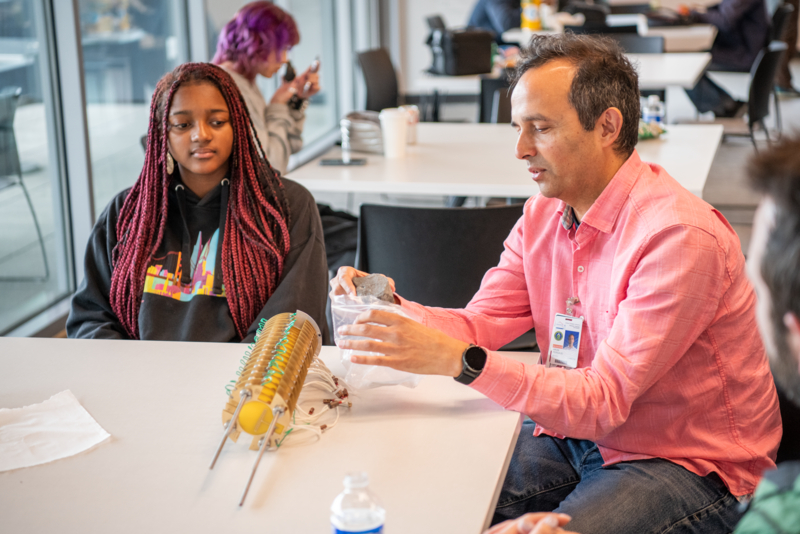
Over lunch, the students mingled with Lab staff and researchers to learn more about career opportunities at the Lab and in the broader STEM field. Those involved included ATAP BELLA Center Senior Scientist and BELLA Director Jens Osterhoff, Senior Scientist and BELLA Deputy Director Jeroen van Tilborg, Staff Scientist (retired) Csaba Toth, Student Intern Lulu Russell, ATAP Fusion Science & Ion Beam Technology Program Scientist and Program Head Arun Persaud, and Senior Scientist Mauricio Ayllon Unzeuta.
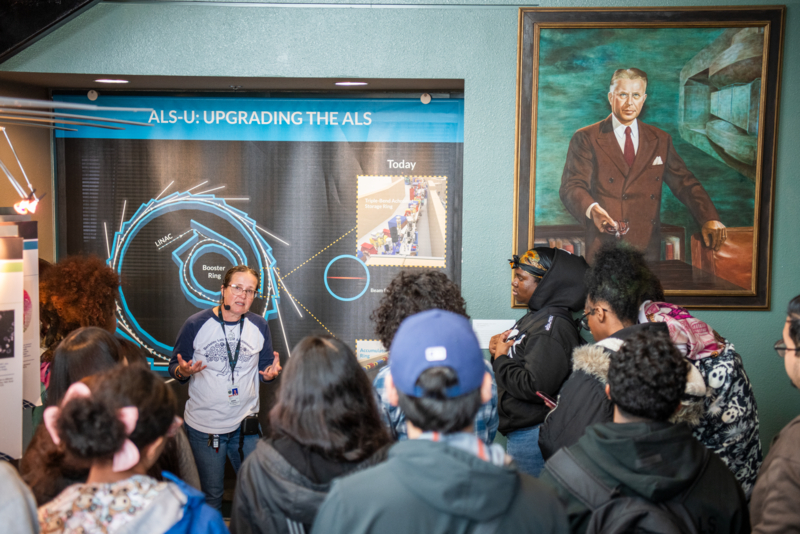
ATAP’s Outreach & Communications Specialist, Ina Reichel, introduced the students to the ALS and was joined by ALS Computing Group postdoctoral student Bowen Zheng, who discussed how the ALS uses artificial intelligence (AI) and machine learning (ML) to process the large volumes of experimental data generated at the facility. Reichel noted that they were “surprised by the amount of data, the equivalent of 1,500 Netflix films per day.”
Reichel then took the students on a tour of the ALS facility, where they learned how the ALS demonstrates team science. “Without a large group of people working together, users would not be able to accomplish all their amazing science,” she says, “and most of it is not basic science but often solutions to real-world problems.”
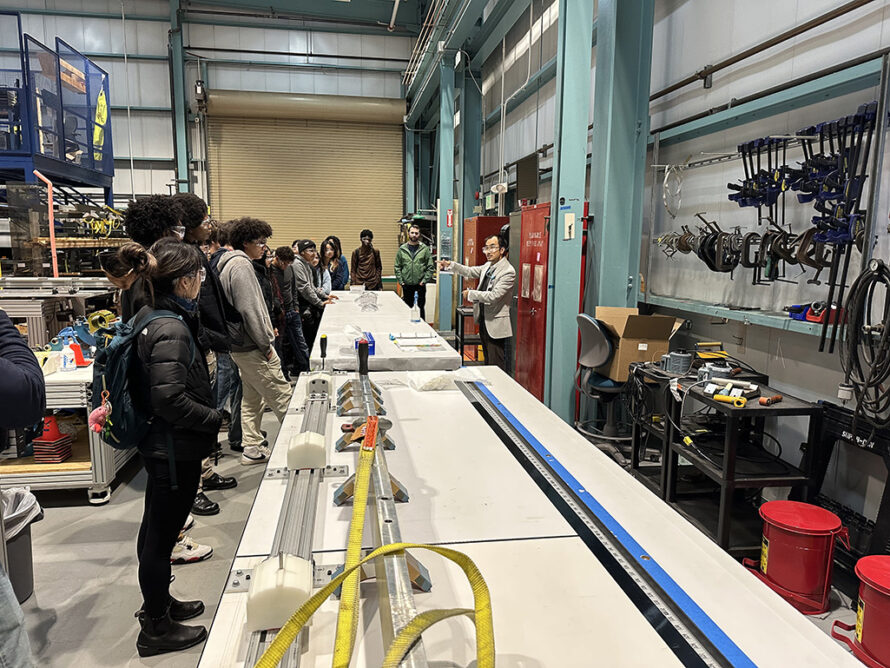
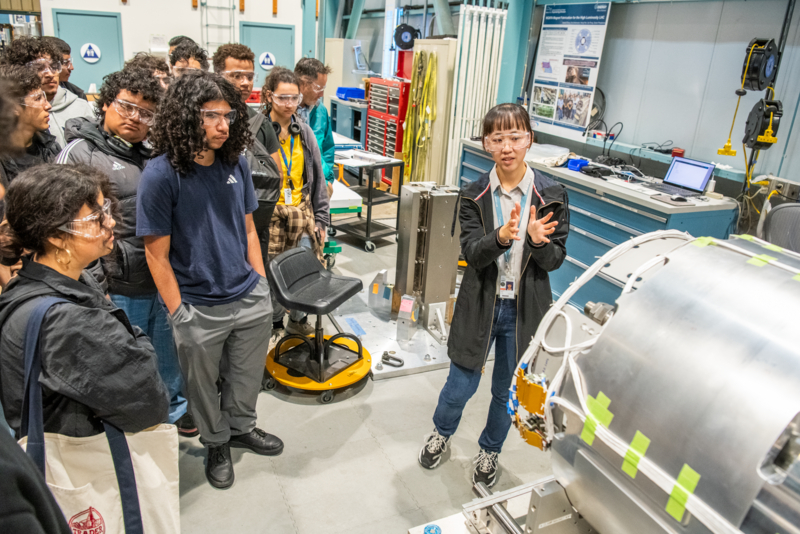
During a tour of the Lab’s Magnet Test Facility, ATAP Superconducting Magnet Program (SMP) Staff Scientist Ian Pong and postdoctoral scholar Yufan Yan explained the theory and uses of superconductivity to the students. Pong also showed the Rutherford cabling facility—one of a handful of such machines in the world—where superconducting wires are turned into cables for magnets. He demonstrated how the Lab’s scientists, engineers, and technicians assemble superconducting magnets for the High Luminosity Large Hadron Collider (LHC) Upgrade Project, which aims to boost the LHC’s luminosity.
“The students responded enthusiastically, and we were able to give them a glimpse of a world they’d never seen before,” says Pong. “So, hopefully, we’ve inspired some future scientists and engineers.”
They were also shown how superconducting magnets are built and assembled from the cables up by SMP senior scientific engineering associate, Michael Naus.
“The students got to see the wide range of activities happening at the Lab, and just how accessible such science can be,” says Naus. “It’s happening right here, effectively in their backyards, and much of what is done here is in collaboration with other world-class labs around the world that they hear about and learn. I think this can motivate them to keep pursuing STEM subjects, as it shows real-world examples of what they learn—from the theoretical to the practical.”
He adds, “Becoming proficient in a STEM field opens doors to work on exciting, real-world science projects, like we do at the Lab, if they choose to pursue it.”
For the final part of the Magnet Test Facility, the students saw a demonstration of the magnetic levitation train. Built by an SMP Science Undergraduate Laboratory Internship student, the maglev train shows the expulsion of a superconductor’s magnetic field as it cools below its critical temperature. The single car, inspired by the Lab’s shuttle buses at the time, contains three high-temperature superconducting pellets.
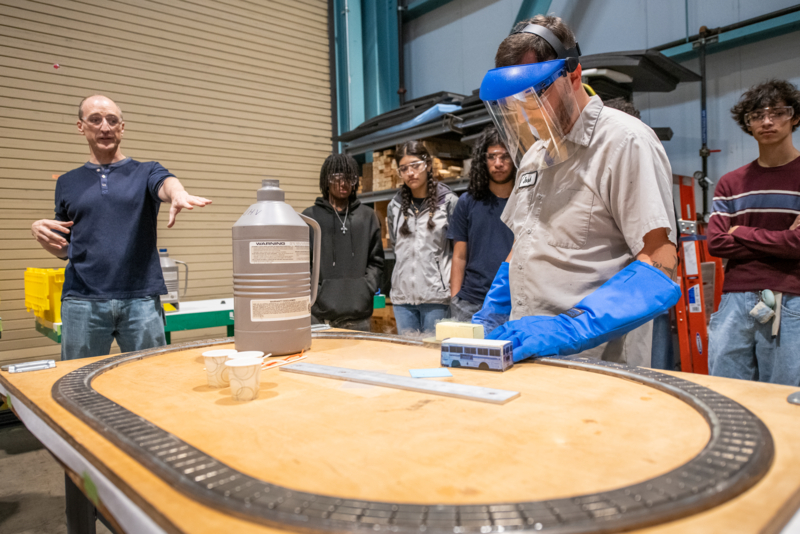

“The track is shaped like a racetrack and contains small permanent magnets,” says Yan. “We pour liquid nitrogen on the superconducting bulks while they sit on a spacer a few millimeters above the track. After the bulks cool down and the spacer is removed, the train remains floating above the track. We can then give the train a push, and it circles around the track while levitating. It’s a fun demonstration of superconductivity’s applications.”
According to Dluger Rios, the Lab received a special thank you from Richmond High School: “Thank you so much for the work you did to coordinate and lead an amazing experience for our students. They’re still talking about all of the mind-blowing things they learned on their trip. Your welcoming staff and friendly researchers have ignited their STEM curiosities. Please extend our gratitude to all staff who were involved in our wonderful tours and learning experiences throughout the day!!”
“Partnering with Divisions like ATAP makes these events truly special and engaging for students,” says Faith Dukes, director of STEM Education and Workforce Programs. “We know our researchers and staff have many competing priorities, so we’re especially grateful for the ongoing support we receive throughout the year. These partnerships strengthen our outreach and recruitment of young people, giving them a firsthand look at what their future in science could hold. We deeply appreciate those who contribute both on event days and behind the scenes. These partnerships allow us to provide accessible content and communicate our complex fields to students. ATAP and the ALS’s dedication to outreach showcases the very best of what the Lab has to offer.”
“A huge thank you to everyone involved in making this event happen,” says Dluger Rios. “It went smoothly thanks to everyone’s support and coordination.”
Outreach and education are vital components of Berkeley Lab, ATAP, and ALS’s stewardship efforts and are crucial to developing the future STEM workforce. High School STEM Days are a team effort, and the organizers want to thank ATAP’s Deputy Division Director, Operations, Asmita Patel, for leading the ATAP organizational efforts in collaboration with the A-LIFT office. They also extend their gratitude to the following Lab staff and researchers who participated in the event. These include ATAP’s Yufan Yan, Ian Pong, Mike Naus, Arianna Formenti, Ina Reichel, Aaron Potash, Jens Osterhoff, Jeroen van Tilborg, Csaba Toth, Lulu Russell, Arun Persaud, Mauricio Ayllon Unzeuta, Matt Fullmer, and Maureen Theate, as well as the Lab’s Engineering Division’s Joshua Herrara, Dan Cheng, and ALS’s Bowen Zheng and the A-LIFT office’s Elina Dluger Rios, Faith Dukes, Jacari Scott, Corbin Shatto, Alisa Bettale, Sage Miller, Minnoli Raghavan, Ernesto Sanchez, Apple Zhu, and Molly Tuholski.
To learn more…
Check out service.lbl.gov to get involved.
For more information on ATAP News articles, contact caw@lbl.gov.