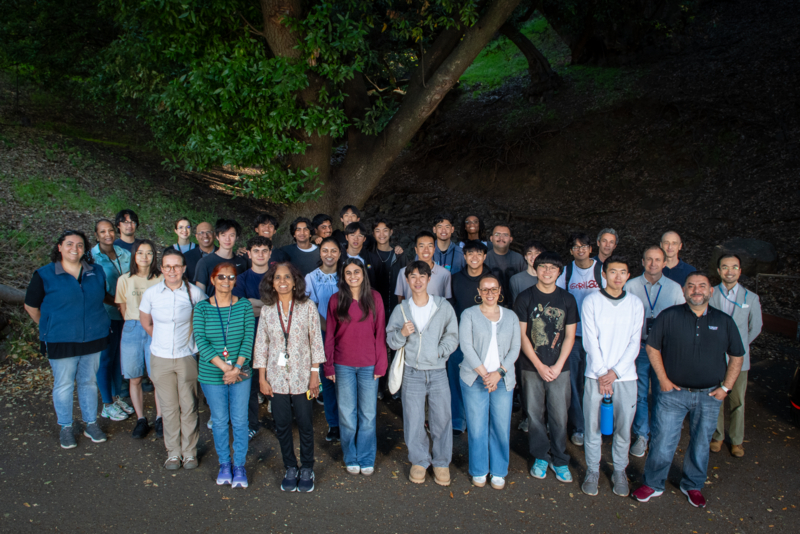
On March 19, 2026, junior and senior students and their teacher from James Logan High School, a public high school in Union City, California, were given guided tours of Berkeley Lab facilities by researchers and operations staff from the Lab’s Accelerator Technology & Applied Physics (ATAP) Division, Advanced Light Source (ALS), and Engineering (EG) Division. ATAP Deputy Division Director of Operations Asmita Patel led the effort to organize the day in collaboration with Special Programs and Volunteer Training Coordinator Elina Dluger Rios from the K-12 STEM Education & Outreach Program, which is part of the Lab’s Academic Learning Internships and Faculty Training Office (A-LIFT).
“One of our main goals at the A-LIFT office is to encourage students who visit to apply to our summer programs, and at least one student let me know they were in the process of applying to our internship program,” says Dluger Rios.
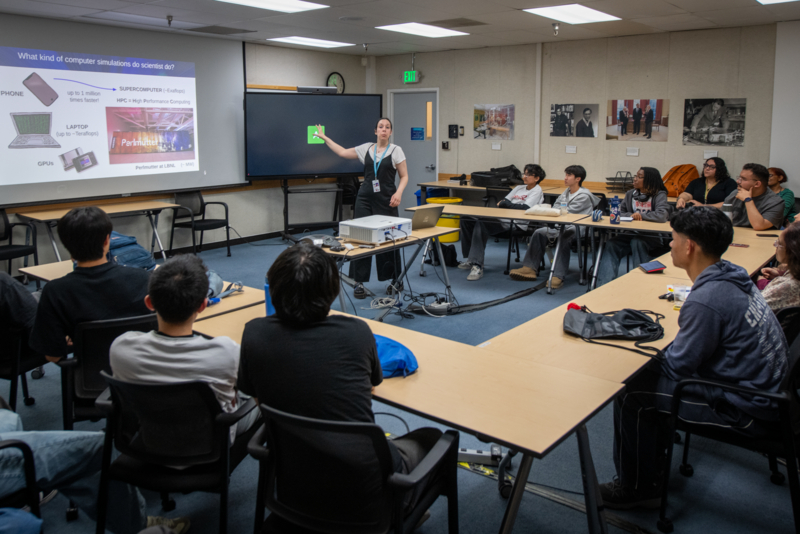
Kicking off the day, the group of 21 students, their teacher, and chaperones attended an engaging talk on how artificial intelligence (AI) and machine learning (ML) are advancing science and fostering new discoveries. Delivered by ATAP Advanced Modeling Program Research Scientist Arianna Formenti, the students learned how the Lab applies AI and machine learning to stabilize lasers for next-generation laser-plasma accelerators, which promise to be more compact and powerful machines, help accelerator operators, and enable analysis of large datasets. The lecture offered insights into how these AI tools, which surpass the capabilities of the AI students are familiar with, support advancements in scientific research.
“My talk focused on the fundamentals of particle accelerators—what they are and what they are for, the concepts underlying neural networks, and how AI/ML are being used in particle accelerator research,” says Formenti.
As a computational physicist, she says AI/ML is increasingly transforming how research is conducted. For example, she noted a recent project in which AI/ML was used to reconstruct a particle beam from experimental data, and another that used AI/ML to model future fusion power plants.
After the talk, the students were divided into two groups. While one group was taken on a guided tour of the Lab’s Advanced Light Source (ALS) facility, a user facility supported by the Department of Energy’s Basic Energy Sciences Program that serves nearly 1,700 users each year in the physical and life sciences, and the other visited ATAP’s BELLA Center, a world-renowned laser facility that houses high-power lasers used to develop laser-driven particle accelerators and many other technologies.
“The Students were very engaged during Arianna’s AI/ML lecture, and one of the teachers came up to me with her enthusiasm for getting to see BELLA for the first time this year,” says Dluger Rios.
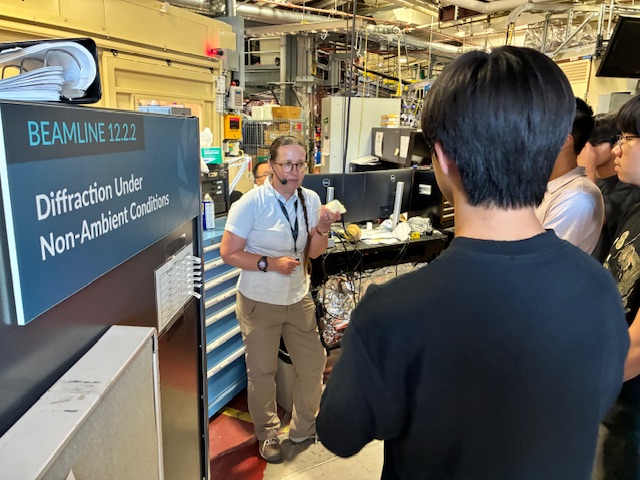
ATAP’s Outreach & Communications Specialist, Ina Reichel, introduced the first group of students to the ALS facility, a specialized particle accelerator that produces bright X-ray beams for scientific research.
“The students were very interested in some of the research happening at the ALS,” says Reichel. The group was well prepared for the visit and already knew more about particle accelerators than your average high school group. They asked many great questions, which made leading the tours very enjoyable.”
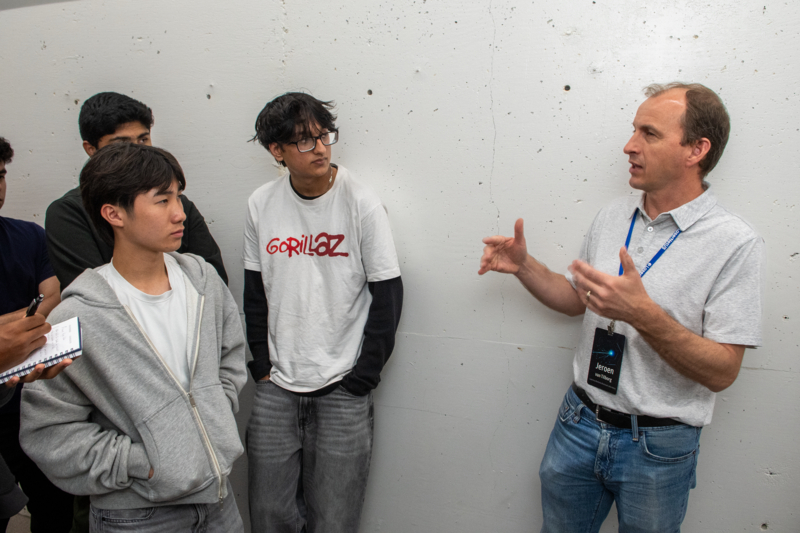
At the same time, the second group visited the BELLA Center, where Senior Scientist and Deputy Director for Experiments at BELLA, Jeroen van Tilborg, demonstrated a laser-plasma accelerator.
“I showed them what a laser-plasma accelerator looks like by holding a sapphire plasma module in my hand,” says van Tilborg. “I went over the physics of laser-plasma acceleration, covering how they work, how a laser is amplified, which then leads to electron acceleration, and how we measure the properties of the laser, plasma, and electrons.”
The students also visited the high-power laser lab, the clean room, mirrors and optics, vacuum chambers, endless computers, and detectors. “I think they understand a bit better what life as a scientist involves: it is a complex environment that requires a solid education followed by on-the-job training,” he says.
He adds that, “It was great to see such a large group of students who were not shy, clearly interested in technology, and eager to pursue careers in fields like lasers and accelerators. This is very motivating for me as a host. It also indicates that this technology will have access to a new generation of college graduates in the coming years.”
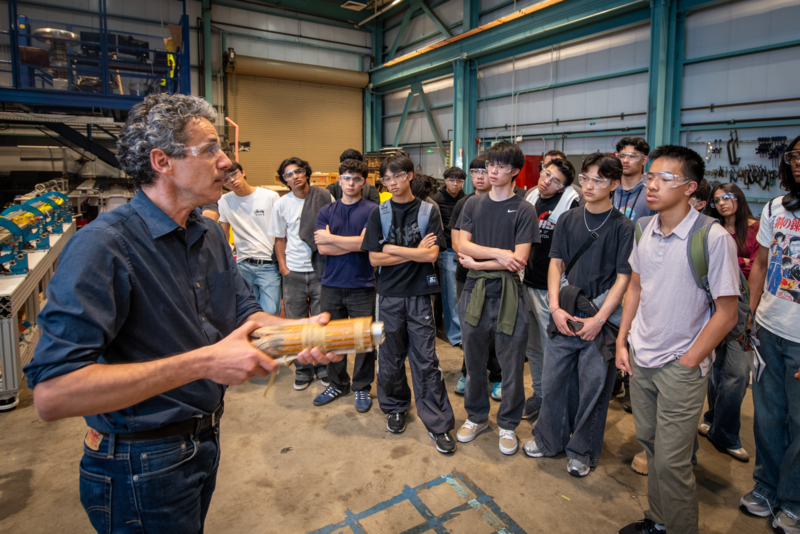
After lunch, the students visited the Lab’s superconducting magnet assembly and testing facilities, where they first listened to a talk by Paolo Ferracin, a senior scientist and deputy head of ATAP’s Superconducting Magnet Program (SMP) and the Berkeley Center for Magnet Technology, a partnership between the ATAP and EG divisions. Ferracin discussed how particle accelerators collide charged particles to study the fundamental properties of matter, emphasizing the crucial roles that superconducting materials and magnets play in these accelerators.
“I wanted to give them a clearer idea of the importance of fundamental research—an activity that may seem abstract and aimless but ultimately has significant implications and results in our daily lives,” he says. “For example, the R&D on superconducting materials we are conducting at the lab, beyond providing a fundamental understanding of these fascinating materials, may also help operate future fusion reactors that aim to produce electricity safely, affordably, and sustainably.”
“As always,” he continued, “I find these experiences fulfilling and personally enriching. Explaining what we do to the younger generation helps raise awareness of the importance of the research conducted at LBNL, and more broadly, at national laboratories. I believe these outreach activities are an investment in the future, benefiting both the lab and society as a whole.”
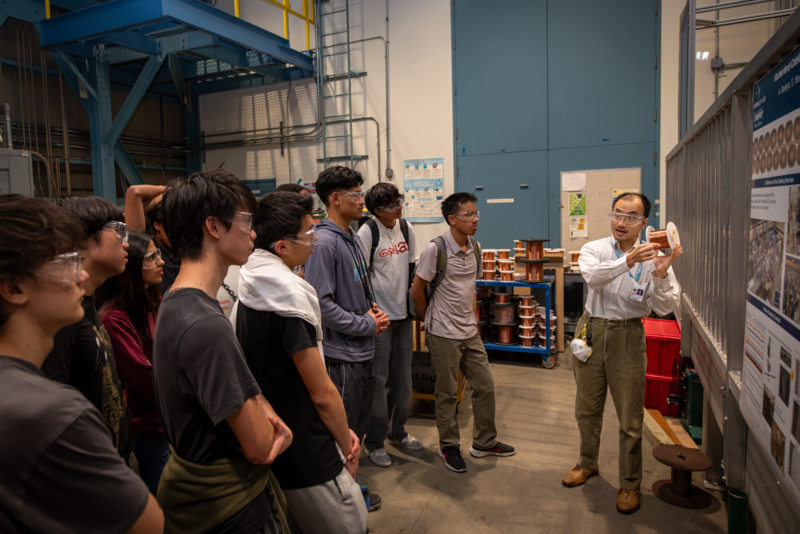
The students were then shown the Lab’s Magnet Test Facility, where SMP Staff Scientist Ian Pong explained the theory and applications of superconductivity. Pong also showed the Rutherford cabling facility—one of a handful of such machines in the world—where superconducting wires are turned into cables for magnets. He demonstrated how the Lab’s scientists, engineers, and technicians assemble the superconducting magnets for the LHC upgrade.
In front of the cabling machine, Pong described the key characteristics of the Rutherford cables produced at the Lab and the technical challenges associated with their fabrication. “The students responded enthusiastically and asked good questions,” says Pong. “Some of these questions led to further explanation of certain details that I normally would not have discussed, such as design considerations involving the interaction between coil, cable, and strand.”
He adds, “I was impressed by the questions the students asked, which showed their interest and knowledge and reflected well on their science teacher. We work in a very specific and admittedly narrow field. Their questions reminded me that it is important to stay connected to broader scientific areas, where we can find inspiration across different disciplines.
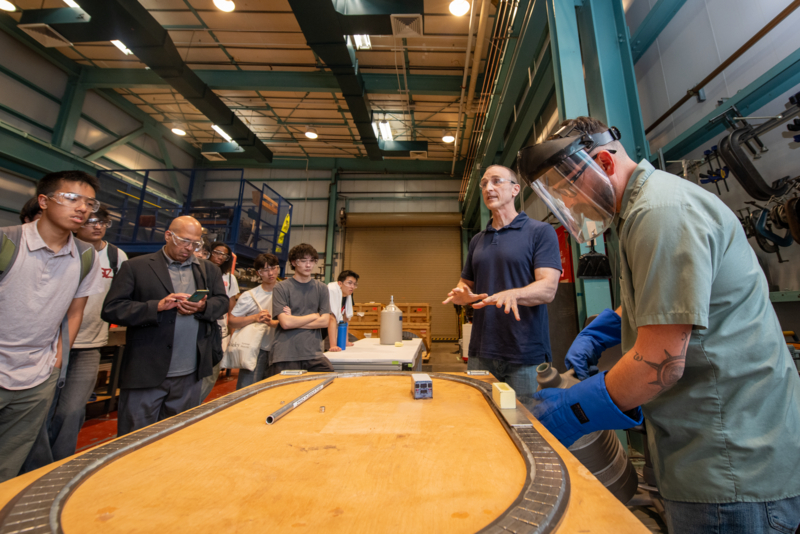
To conclude the day, the students saw a demonstration of the magnetic levitation train by SMP Senior Scientific Associate Michael Naus. Built by an SMP Science Undergraduate Laboratory Internship student, the maglev train shows the expulsion of a superconductor’s magnetic field as it cools below its critical temperature. The single car, inspired by the Lab’s shuttle buses at the time, contains three high-temperature superconducting pellets.
“The students were definitely attentive and thought it was pretty cool—which is the typical response,” says Naus. “I think it is a good example of ‘science-in-action,’ but with the addition that it appears the car is defying gravity, which adds the ‘coolness’ factor. It’s always fun to hear the gasps from kids who haven’t even seen videos of such things.”
The students, he adds, learned more about the magnetic properties of superconductors, that there are different types of superconductors, and that modern-day superconductors need to be very cold to actually be superconductors. “Those are the basics, I hope they remember. More generally, I hope they get a sense of the really neat things we get to do here at the Lab or any science lab.”
Ambika Sekar, a physics teacher at James Logan High School who accompanied the students, says, “What makes these visits so beneficial is the opportunity to see what real scientists do on a day-to-day basis. Students can talk with them directly, ask questions to their heart’s content, and let their curiosity run wild. Many students also requested more hands-on activities, demonstrations, and labs for next time, even if it requires returning another day.”
Sekar adds, “On a personal note, it is very inspiring to see how the scientists and everyone involved work with so much perseverance, passion, and focus—all of us felt that. I hope that many of my students will feel inspired to pursue careers that positively contribute to our society.”
“A huge thank you to everyone involved with the day,” says Dluger Rios. “This was my first visit to BELLA, and I was very impressed to learn more about the work done there and how it relates to and differs from the ALS.”
Other Berkeley Lab staff members who took part in the visit included ATAP Deputy Director of Operations Asmita Patel, A-LIFT Administrative Assistant Jacari Scott, BELLA Staff Scientist Kei Nakamura, BELLA graduate student Eugene Park, and Lead Technologist Joshua Herrera from the Lab’s Engineering Division, who helped Naus with the maglev train demonstration.
To learn more
For more information on ATAP News articles, contact caw@lbl.gov.