
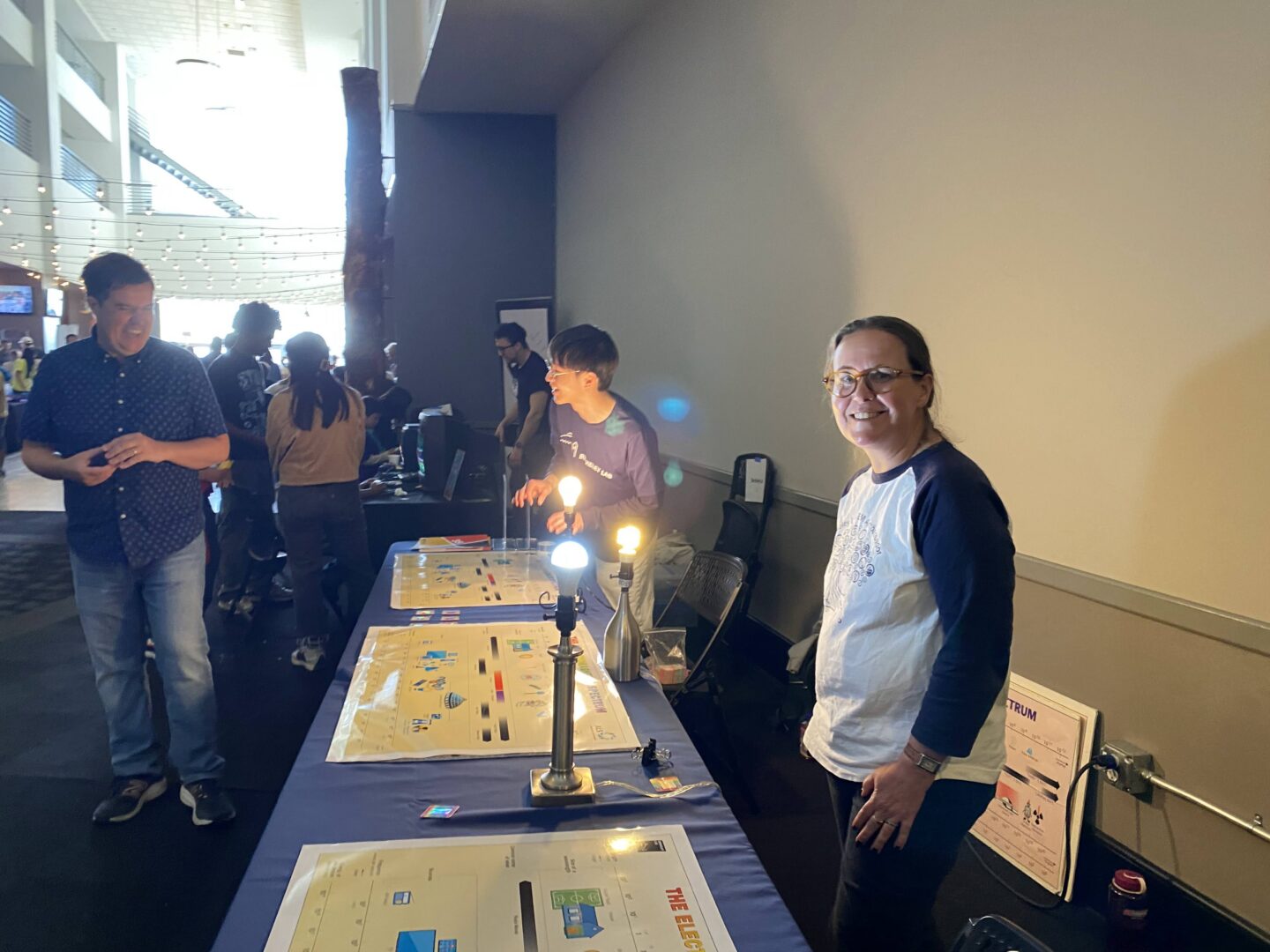
Oakland Unified School District (OUSD) annually hosts a large science fair where winners from all participating schools present their projects. To make this event more interesting, the district invites its STEM partners (including Berkeley Lab) to set up a table with a short, hands-on science activity. The Lab’s participation has been coordinated for a long time by Ina Reichel (Senior Scientific Engineering Associate, ALS/ATAP) using a kit from the Academic Learning Internships and Faculty Training Office (A-LIFT, formerly K-12) Office.
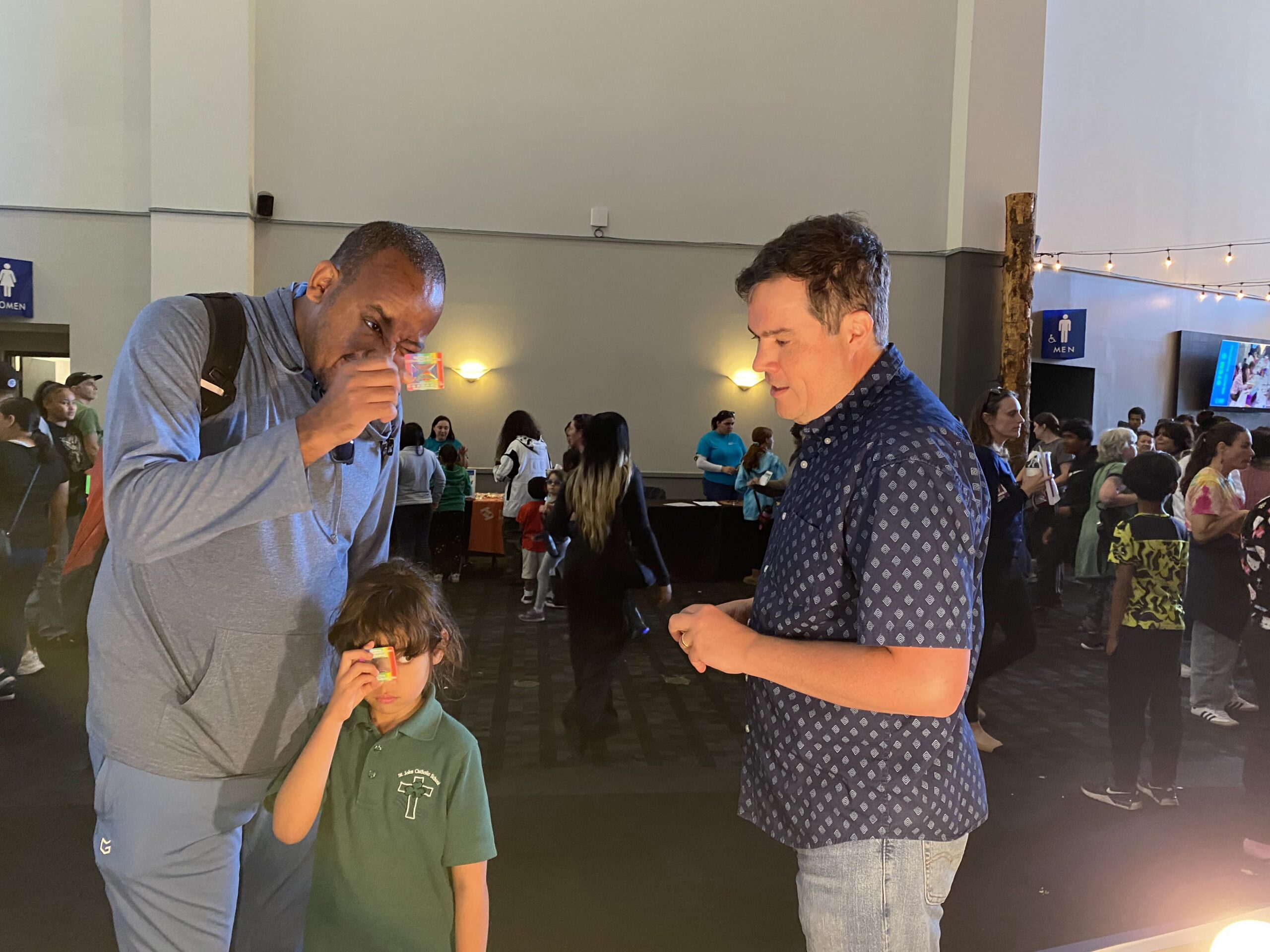
Walan Grizolli interacting with attendees. (Credit: Ina Reichel/Berkeley Lab)
In recent years, OUSD has sought to make the event more attractive by adding more science-related activities and renaming it the OUSD STEM Fair. And this year, for the first time, the event was held at the Oakland Coliseum, mostly on the main (indoor) concourse.
The activity at our table was looking at three different types of light bulbs (incandescent, fluorescent, and LED) through a small diffraction grating. “At the OUSD STEM Fair, the audience is mixed; from excited students to borderline apathetic siblings, with parents and caregivers in tow,” explains Ian Lacey (Principal Scientific Engineering Associate, ALS). “At our table, we tempted folks with visions of rainbows as they walked past. It was fun to see the expressions of the visitors change when they actually peered through the grating samples we were handing out.”
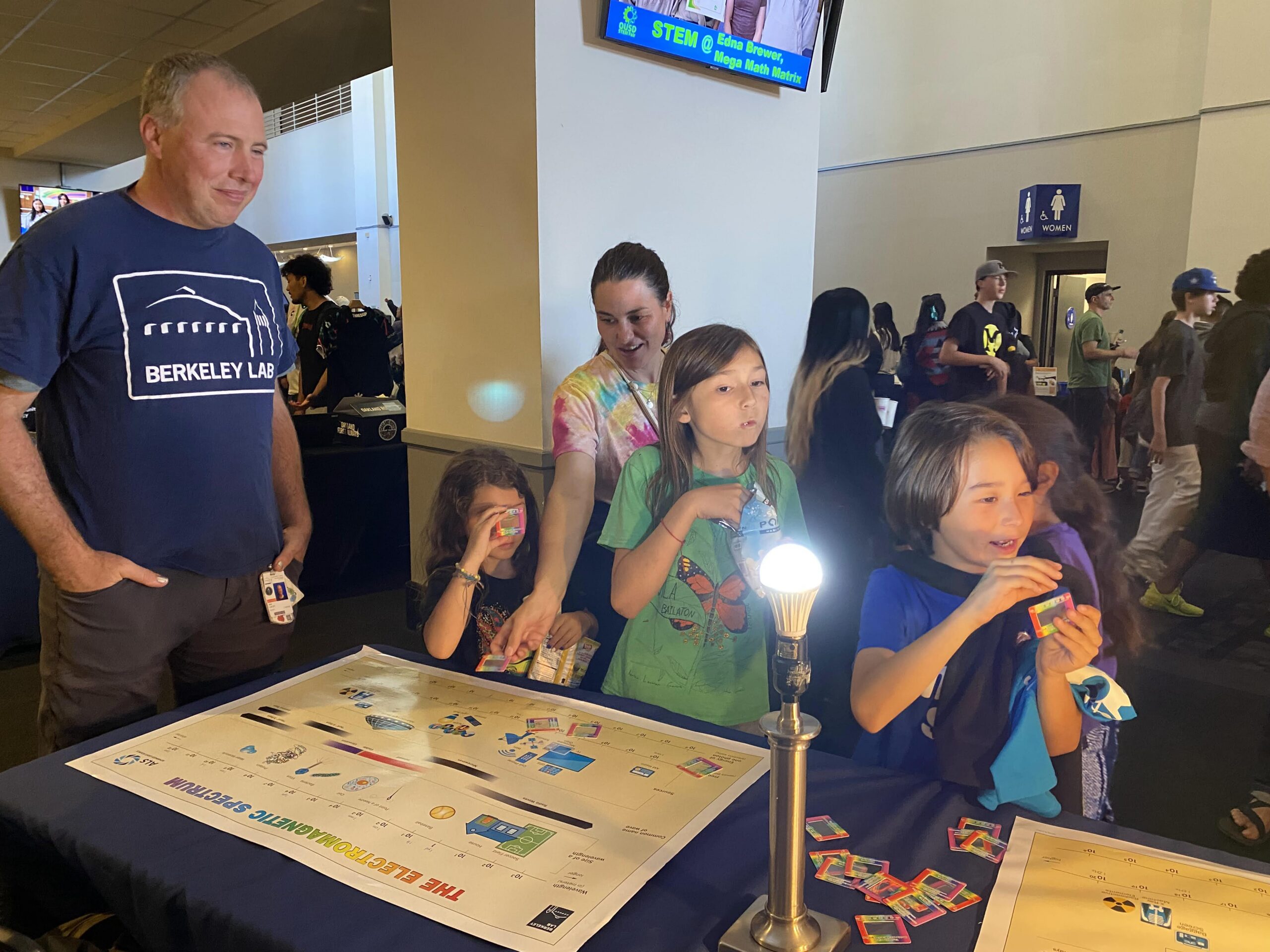
Ian Lacey watches as children participate in the activity. (Credit: Ina Reichel/Berkeley Lab)
“With small plastic 2D grating windows, which look like the simplest possible demo,” Wei He (Affiliate Student Intern, ALS) was struck by “how much physics could be conveyed through them, and how amazed the kids and even adults were when seeing the scattered “rainbows” from our toys. Nature’s laws are worth investigating for sure, but nature’s beauty is more worth appreciating—I often forget the latter as I dive deeper into my research.”
Olga Shapoval (Research Scientist, ATAP) was one of the judges for the fair. “This is my third time volunteering at the OUSD STEM Fair, and I genuinely enjoy it,” she says. “I really appreciate the atmosphere created for the young scientists—the kids are always so excited and engaged while explaining their projects. I especially value that even elementary school students can participate in the STEM Fair in such a supportive environment without excessive pressure. At such an early age, it is important to naturally nurture curiosity and scientific thinking rather than focus only on competition.”
Elham Ghanem explaining the activity. (Credit: Ina Reichel/Berkeley Lab)
“For me, these are great opportunities to share our passion for science and how we can use it to better understand the world—not just as scientists, but as anyone interested in science,” says Walan Grizolli (Research Scientist, ALS) as he summarizes his experience at the event. “I try to foster people’s curiosity and often let it lead the conversation, which sometimes takes us down paths I never expected, and I end up with new perspectives on the very topic I was trying to teach them. It’s a reminder that collaborative thinking is really at the heart of science.”
“It was incredible to see students’ curiosity ignite and ask thoughtful questions about the electromagnetic spectrum,” says Elham Ghanem (Accelerator & Floor Operator Trainee, ALS). “Grateful to have been a part of this experience that sparked conversations and hopefully inspired the next generation of scientists and problem-solvers.”
Republished from ALS News. Click here to read the original article.
For more information on ATAP News articles, contact caw@lbl.gov.