
Scientific Achievement
Researchers from the Department of Energy’s Lawrence Berkeley National Laboratory (Berkeley Lab) Accelerator Technology & Applied Physics (ATAP) Division and The Ohio State University have developed and tested a rotating “windmill” system that repeatedly produces ultrathin liquid-crystal films for use as plasma mirrors in high-power laser experiments
The technology can support multistage laser-plasma accelerators (LPAs), in which an electron bunch produced in the first LPA stage is injected into a second stage and further accelerated by a coupled drive laser pulse. In this application, the ultrathin film allows the accelerated electron bunch to pass through with minimal scattering while, once ionized, coupling a second drive laser pulse for delivery to the next LPA stage
The team identified operating conditions that reliably produce smooth liquid-crystal films at hertz-class repetition rates using 4-octyl-4’-cyanobiphenyl (8CB), a common liquid crystal in materials science and liquid-crystal display research. They characterized the films’ performance at ATAP’s BELLA Center Petawatt laser facility and found that they remained optically uniform, could be automatically regenerated, and continued to form reliably after exposure to laser fluences up to 214 J/cm². This approach addressed the limited surface flatness, shot-to-shot pointing stability, and replenishment reliability of previously tested plasma mirrors (for example, tape-based plasma mirrors). The demonstrated thin, optically uniform films operated in a high-fluence, repeatable regime relevant to LPA staging, where stable laser coupling and minimal electron-bunch scattering are critical.
Significance and Impact
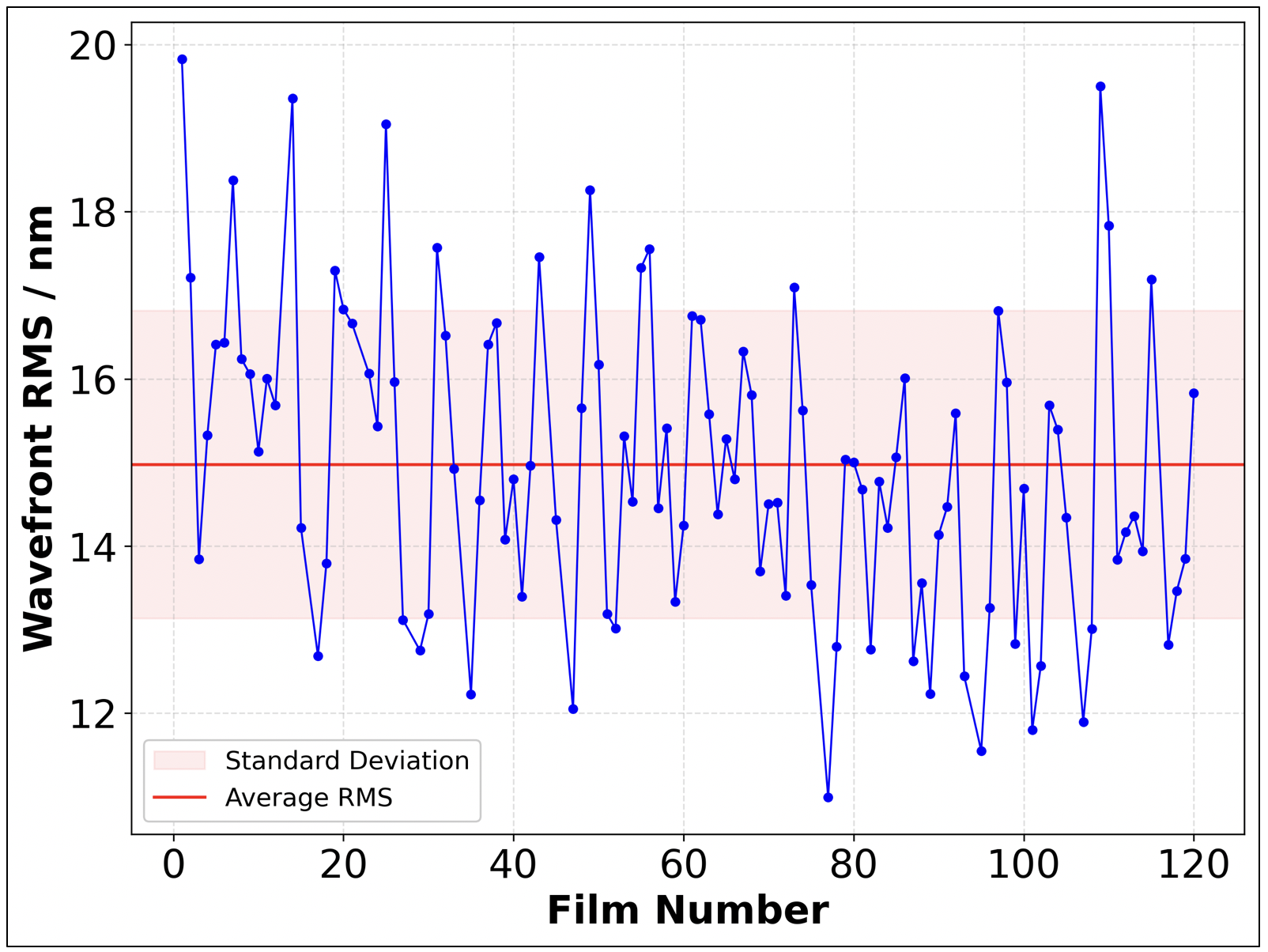
Example wavefront RMS fluctuation for a windmill surface temperature of 21-22 °C and wiping speed of 5.4 mm/s (corresponding to an effective film formation frequency of 0.11 Hz and 0.22 Hz for 6 and 12 wipers, respectively).
The liquid-crystal films were tested at the BELLA Petawatt laser beamline under conditions relevant to plasma-mirror operation. As laser fluence increased, the films transmitted substantially less light, consistent with their conversion into a reflective plasma surface during the main pulse. At the highest tested fluence, 214 J/cm², transmission dropped to about 4%. After a series of high-power shots, the windmill device continued to form films reliably, and the researchers observed no visible debris buildup in the target chamber.
The work defines practical operating conditions for producing renewable, thin plasma mirrors that combine high formation reliability and low debris production with the beam quality required for precise, high-power laser experiments. These thin, renewable plasma mirrors could enable more efficient multistage laser-plasma acceleration, the development of ultrafast light sources, and other experiments that require clean, high-intensity laser pulses.
Research Details
Testing a renewable liquid-crystal plasma-mirror platform
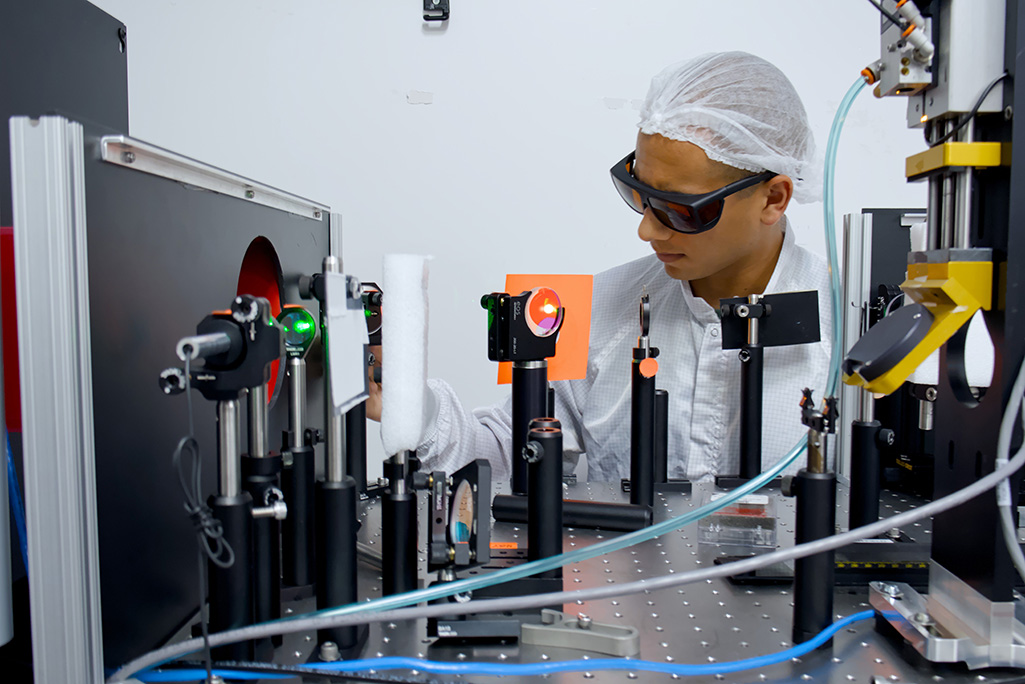
The researchers evaluated a rotating “windmill” device designed to create replenishable, freestanding liquid-crystal films for renewable plasma mirrors. The apparatus consisted of a temperature-controlled aluminum surface with a fixed 10 mm aperture and a motor-driven rotating assembly. Six wiper arms, each holding 10 X 12 mm lens tissue, swept a small volume of 8CB liquid crystal across the aperture to draw a thin film; the modular design can accommodate additional arms to increase the film-refresh rate. A conditioning procedure ensured that the wipers were sufficiently wetted and that excess liquid crystal was removed before measurements. The team varied the liquid-crystal temperature and wiper speed, recording how often the system produced intact films, thereby establishing conditions that balance reliable film formation with rapid replacement between measurements.
Measuring film smoothness and high-power performance
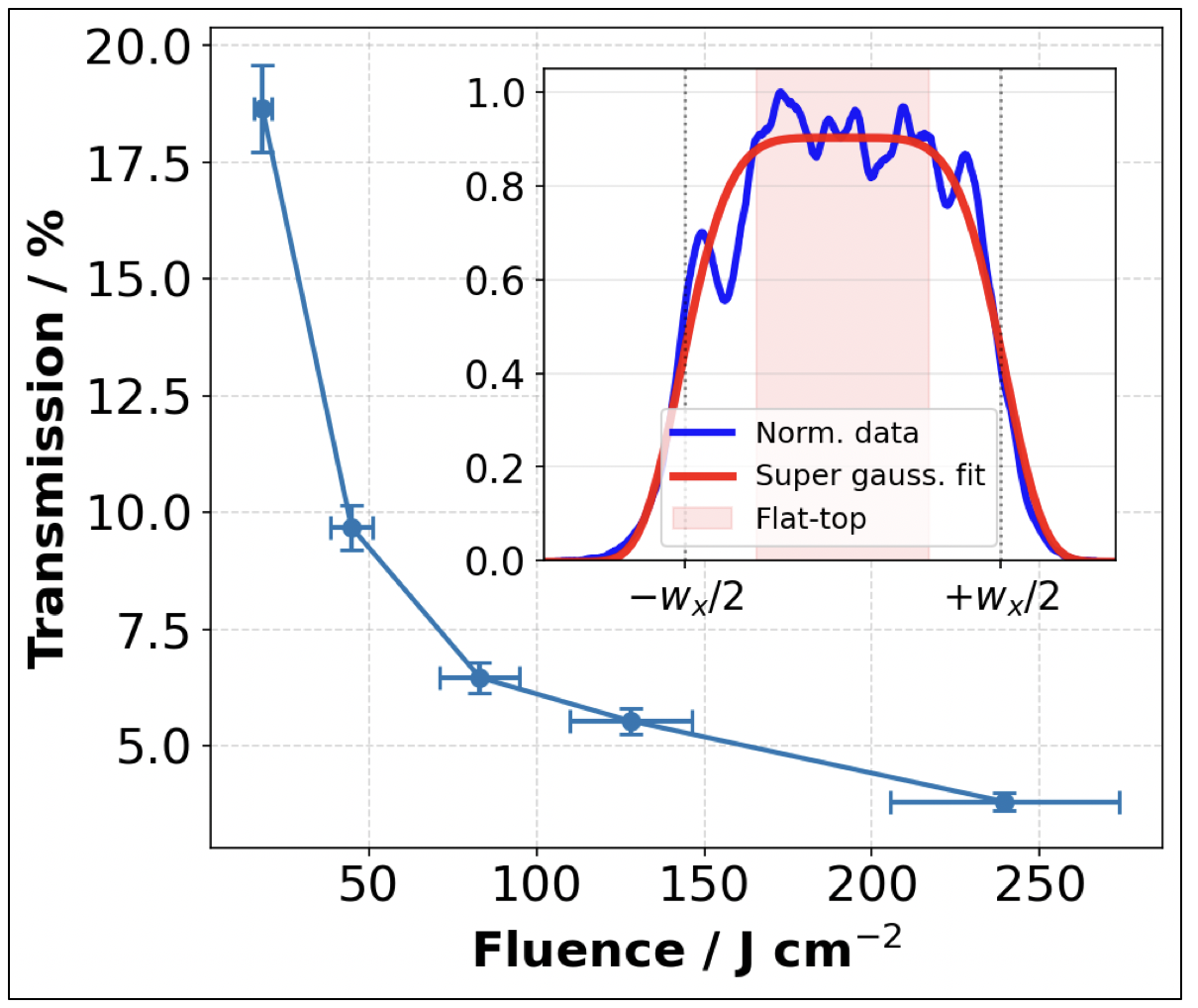
Measured transmission as a function of laser fluence for free-standing 8CB liquid crystal (LC) films, using the BELLA PW laser at selected pulse energies. Liquid crystal films were produced across a 10 mm aperture using the windmill device, and exposed to laser pulses with an incident beam diameter of wx = 1.9 mm and wy = 2.0 mm (full width at half maximum, FWHM) at the film plane. The inset shows a normalized horizontal lineout of the incident beam profile on the films, measured ≈1 cm downstream of the LC film, along with a super-Gaussian fit. Dotted lines indicate the FWHM. The transmission error bars include the laser pulse energy fluctuation shot-to-shot (standard deviation) and the measurement uncertainty of the transmission diagnostic. The fluence error bars include uncertainties of the energy fluctuation shot-to-shot (standard deviation) and the fluence fluctuation (standard deviation) across the flat-top region of the beam profile incident on the films (within red shaded region of the inset).
To assess whether the films could serve as precision plasma mirrors, the team characterized their optical quality in vacuum with a 532 nm continuous-wave diagnostic laser. The beam reflected off each film at a shallow angle and was then relayed through imaging optics to a wavefront sensor. A calibrated reference mirror provided a baseline, allowing the researchers to separate distortions introduced by the liquid-crystal film from those produced by the diagnostic system. Using the wavefront sensor, they also measured angular (pointing) fluctuations across films. Wavefront measurements were evaluated over 2-, 3-, and 4-mm-diameter central regions—the portions most relevant for an intense laser beam focused near the middle of the film—to determine wavefront error, tilt, and stability as functions of temperature and wiping speed.
The windmill device was then installed in the BELLA Petawatt laser target area to test its performance under high-power conditions. The researchers exposed the films to laser pulses with increasing fluence and measured the transmitted light as the films transitioned into plasma mirrors. They also evaluated whether the device could reliably generate fresh films after irradiation and checked the target chamber for debris. These measurements linked low-power optical diagnostics to high-power plasma-mirror behavior and assessed the device’s potential for renewable operation in high-intensity, high-repetition-rate laser experiments.
Future work will focus on improving beam-pointing stability, increasing the refresh rate to 1 Hz, and integrating the technology for sustained use in multistage laser-plasma acceleration.
Contact: Anthony Vazquez
Researchers: Anthony Vazquez, Anya Jewell, Morgan Cole, Abdikarim Abdi, Thien Kim Le, Aodhan McIlvenny, Lulu Russell, Alex Picksley, Anthony J. Gonsalves, Kei Nakamura, Zachary Eisentraut, Federico Mazzini, Carl B. Schroeder, Jeroen van Tilborg, Jens Osterhoff, Eric Esarey, and Lieselotte Obst-Huebl (Berkeley Lab), and Nicholas Czapla and Douglass W. Schumacher (The Ohio State University)
Funding: This work was supported by the Department of Energy Office of Science, Office of High Energy Physics.
Publication: Anthony Vazquez, Anya Jewell, Morgan Cole, Abdikarim Abdi, Thien Kim Le, Aodhan McIlvenny, Nicholas Czapla, Lulu Russell, Alex Picksley, Anthony J. Gonsalves, Kei Nakamura, Douglass W. Schumacher, Zachary Eisentraut, Federico Mazzini, Carl B. Schroeder, Jeroen van Tilborg, Jens Osterhoff, Eric Esarey, and Lieselotte Obst-Huebl. “Stability and optical quality of ‘windmill’-formed 8CB liquid crystal films for replenishable plasma mirrors,” 2026. https://arxiv.org/abs/2509.18448
For more information on ATAP News articles, contact caw@lbl.gov.
