
Key Takeaways
- Measurements taken at several distinct positions along a 40-cm-long laser-plasma accelerator (LPA), together with more than 150 simulations, produced a model that researchers can use to better guide future LPA design.
- The validated model predicts that a 65–70 cm LPA could accelerate electrons to approximately 15-20 GeV.
- The research provides a comprehensive set of measurements and simulations that will help train future particle accelerator models as part of the Department of Energy’s Genesis Mission.
A team of researchers from the Department of Energy (DOE)’s Lawrence Berkeley National Laboratory (Berkeley Lab) and the University of California, Berkeley, has used detailed experimental measurements of laser and electron-beam properties at multiple distances within a laser-plasma accelerator (LPA) to better understand how these properties evolve during plasma acceleration.
The work, led by scientists at the BELLA Center in the Accelerator Technology & Applied Physics (ATAP) Division at Berkeley Lab, combines experimental data with simulations to gain a deeper understanding of how the laser beam behaves as it propagates through the plasma than previous experiments had, advancing the physics of laser-plasma interactions in LPAs and progressing their development.
“Unlike typical experiments that measure only final outputs at the end of the accelerator, we measured both the electron and laser beam properties as a function of propagation distance across multiple plasma channel lengths,” explains Anthony Gonsalves, a senior scientist at BELLA who led the experiments. Previous experiments, Gonsalves adds, “did not collect enough measurements to fully understand the physics of laser-plasma interactions.”
LPAs use ultra-intense laser pulses to generate a wake in the plasma. Electrons surfing that wake can gain billions of electron volts over centimeters, rather than the kilometer-scale required by radio-frequency accelerators. These advanced accelerators promise compact, high-energy machines that are cheaper to build and operate than current technologies, with applications ranging from future colliders to X-ray free-electron lasers and high-brightness photon sources.
Spot the difference
Although previous studies at BELLA used a combination of measurements and simulations to retrieve plasma channel parameters and found excellent agreement across most parameters, they differed in their estimates of the laser spot size at the plasma channel’s exit.
“As the gas thins over an approximately centimeter-long low-density plasma region near the end of the accelerator, the drive laser expands, and its divergence decreases as it enters the region, so the calculated exit laser spot size remains too small,” says Carlo Benedetti, a BELLA staff scientist who led the modeling.
When the laser enters this “plasma exit ramp,” it expands, increasing the beam’s spot size. According to Gonsalves, the “weakened” plasma channel in the downramp causes laser diffraction, which increases the beam’s spot size and spreads the beam before measurement. After accounting for that expansion, the simulations showed that the spot size inside the channel was about 15 micrometers smaller than the downstream measurement indicated.
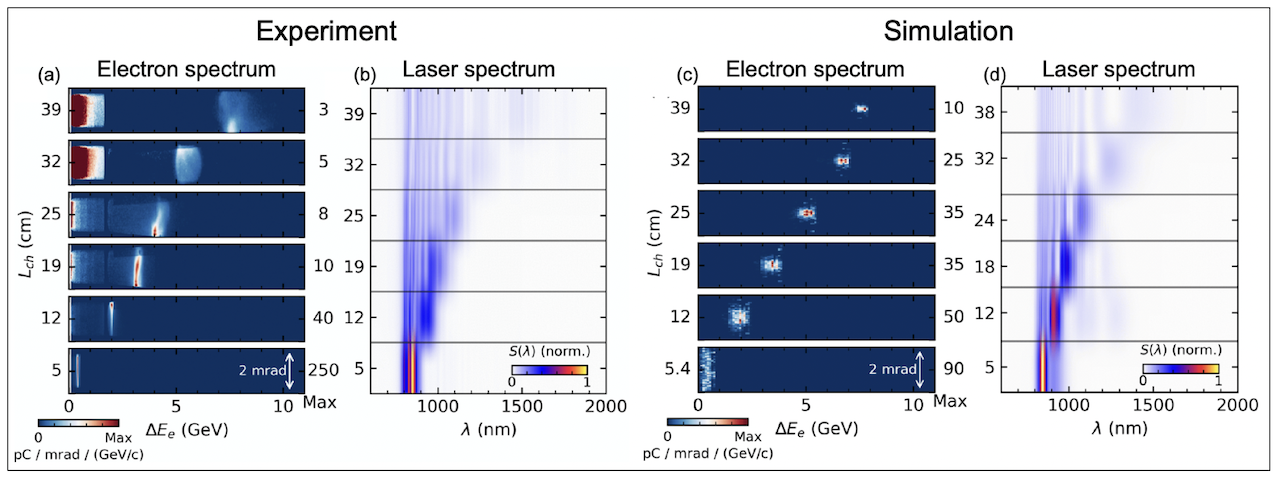
Measured evolution of the accelerated electron bunch spectrum (a) and laser spectrum (b) as a function of channel length, compared with the simulated electron spectrum (c) and laser spectrum (d) for the calibrated case.
To better understand the laser’s behavior as it travels through the plasma exit ramp, the researchers measured the laser redshift—the laser’s gradual shift toward longer wavelengths as it moves through the plasma channel—and the electron-energy spectrum at six positions along a 40-cm LPA. They then combined these experimental data with simulations using a particle-in-cell (PIC) code that models laser-plasma interactions during electron beam acceleration by tracking electromagnetic fields and charged particles.
“While the experimentalists run physical trials and collect diagnostic data, the modeling team uses these results to test, calibrate, and benchmark our simulation code,” explains Benedetti. He describes the relationship between experimentation and computational modeling as a “virtuous cycle” fueled by close, continuous collaboration between the experimental and modeling teams at BELLA.
The researchers ran more than 150 simulations at Berkeley Lab’s National Energy Research Scientific Computing Center. The simulations produced spot sizes that matched measurements at all six positions, “giving us greater confidence in the code’s predictions and underscoring the value of thorough experimental work,” says Benedetti. The simulations used a specialized PIC code called INF&RNO developed by Benedetti and tailored for laser-plasma acceleration.
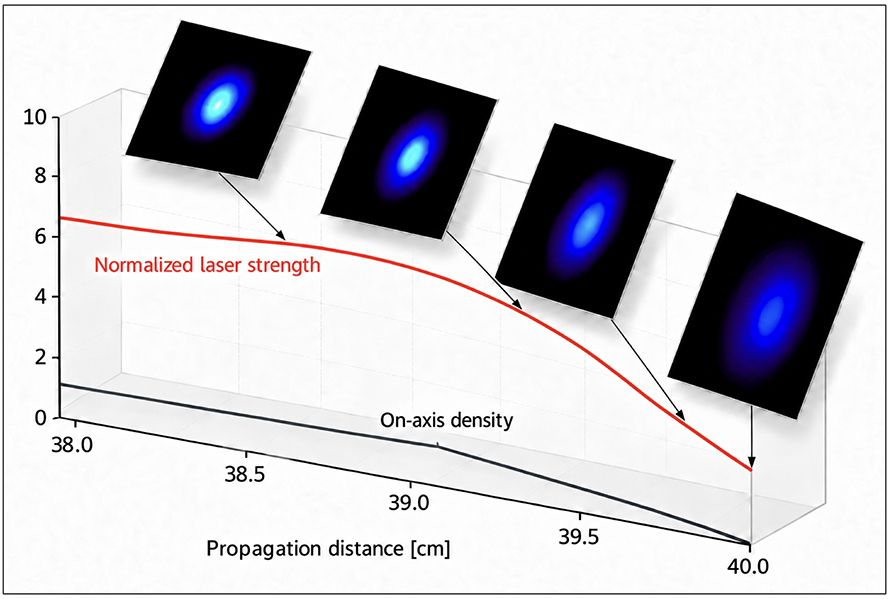
Expansion of the laser mode as the laser propagates through the plasma down-ramp at the exit of the LPA stage.
The team traced the mismatch between the measured and simulated laser spot size to an approximately 1-cm-long, low-density plasma region near the end of the accelerator. Additionally, by simulating an extended plasma channel length of 65 cm, Benedetti says their benchmarked code shows that electrons continue to gain energy at an accelerating gradient of about 30 GV/m, reaching 15 GeV. He adds that establishing these single-stage, high-energy capabilities “could provide the foundation for coupling multiple stages to reach energies well beyond 20 GeV.”
Gonsalves says, “Validating the simulations against a comprehensive set of longitudinal measurements provides a reliable predictive tool.” Without this level of multi-diagnostic validation, he notes, “researchers would be ‘shooting in the dark’ when designing future laser-plasma acceleration experiments.”
The research, he adds, could support future experimental and modeling campaigns to advance LPA development. “The ultimate goal of optimizing the laser mode is not merely chasing peak energy but achieving shot-to-shot control of charge injection, energy spread, and electron beam stability, which is vital for future light sources and multi-stage accelerators.”
Furthermore, the work provides an extensive set of experimental data and simulations to train advanced particle accelerator models as part of the DOE’s Genesis Mission. Genesis aims to deploy artificial intelligence to advance particle accelerator science and applications, accelerate scientific discoveries, strengthen national security, and drive energy innovation.
“The research demonstrates how our experimentalists and modelers work hand in hand to advance accelerators and their applications,” says ATAP Division Director Cameron Geddes. “The next-generation machines developed here provide pathways to new discoveries in fundamental science, new light sources, and breakthroughs across fusion, medicine, materials science, and other areas.”
The Department of Energy’s Office of Science, Office of High Energy Physics, supported the research presented here. The research used the facilities of the National Energy Research Scientific Computing Center at Berkeley Lab.
To learn more…
H. Tang, A. Picksley, C. Benedetti, R. Li, H. E. Tsai, T. Mandal, E. Park, K. Nakamura, J. Stackhouse, D. Terzani, C. B. Schroeder, J. van Tilborg, J. Osterhoff, C. G. R. Geddes, and A. J. Gonsalves. “Revealing Laser and Electron Beam Evolution in 10-GeV-class Laser-Plasma Accelerators,” Phys. Rev. Research 8, 033352 (2026). https://doi.org/10.1103/qqcv-f29q
For more information on ATAP News articles, contact caw@lbl.gov.
