Four projects led by or involving researchers from the Accelerator Technology & Applied Physics (ATAP) Division in the Department of Energy (DOE)’s Lawrence Berkeley National Laboratory (Berkeley Lab) have received funding through the recently announced DOE Artificial Intelligence (AI) Genesis Mission. The AI Genesis Mission aims to create a national, AI-powered scientific platform that combines supercomputing, large datasets, AI systems, and automated laboratories to accelerate scientific discoveries, enhance national security, and advance energy innovation.
Three projects aim to advance particle accelerator science and applications, and a fourth seeks to accelerate the path toward inertial fusion energy (IFE). The work highlights the shared dedication to progressing science and innovation across the broader research community.
AI-driven advancements across the DOE complex
A collaborative effort led by Berkeley Lab, the first project, The Multi-Office Particle Accelerator Team (MOAT), will use AI to enhance the capabilities of DOE’s current and future particle accelerator facilities. Its goal is to transform the design, operation, and optimization of particle accelerators by connecting data, expertise, and innovation through the development and deployment of groundbreaking AI foundation models and intelligent assistants that leverage the collective knowledge and data across DOE’s extensive accelerator complex.
The project includes researchers from Berkeley Lab, Argonne National Laboratory (ANL), Fermi National Accelerator Laboratory (FNAL), Oak Ridge National Laboratory (ORNL), Stanford Linear Accelerator Center (SLAC), Brookhaven National Laboratory (BNL), and Thomas Jefferson National Laboratory (JLab).
“The Genesis Mission offers a unique opportunity to leverage the rapidly expanding power of AI and revolutionize the way that we design and operate particle accelerators,” says Jean-Luc Vay, head of ATAP’s Advanced Modeling Program, who is leading the project.
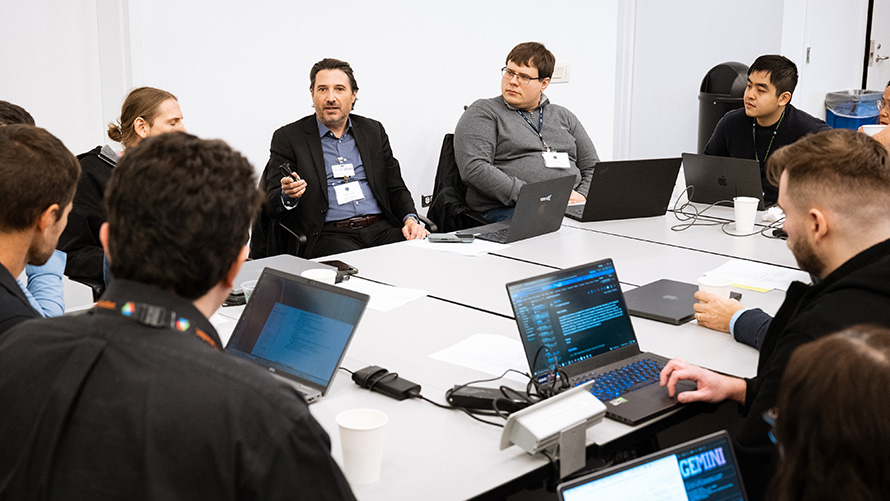
Jean-Luc Vay brainstorming with the MOAT Seed Model Team at a Genesis ModCon All-Hands Meeting at Argonne National Laboratory in December, 2025.
With an interdisciplinary approach involving Basic Energy Science (BES), High-Energy Physics (HEP), and Nuclear Physics (NP) offices, Vay says, “MOAT will channel the innovation and workforce across the DOE national labs complex and maximize the impact of AI for existing and future particle accelerators and their applications.”
The work will establish the technical foundation and collaborative framework for the ongoing AI-powered development of the DOE accelerator complex, maintaining U.S. leadership in accelerator science while developing exportable AI techniques suitable for other complex facilities and industrial systems. It could improve scientific capabilities, reduce costs in designing, building, and operating accelerators, and enable new, significant societal uses of particle accelerators in areas such as fusion, lithography, advanced manufacturing, medical applications, industrial processing, and more.
An early deliverable of the project includes enhancements in the time required to perform data retrieval and analysis tasks compared to expert operators at several DOE particle accelerator facilities.
Multi-lab collaboration on AI-ready data
Led by researchers from ATAP and Berkeley Lab’s Scientific Data Division, the second project, American Science Cloud (AmSC)/BES/HEP/NP Scientific User Facilities Infrastructure Partnership, aims to develop the platform infrastructure to host and distribute AI models and scientific data to the broader research community.
In collaboration with colleagues from ANL, FNAL, ORNL, SLAC, BNL, and JLab, the project will create an ecosystem for the DOE’s Basic Energy Science, High Energy Science, and Nuclear Physics user facilities (primarily particle accelerators), including Berkeley Lab’s Advanced Light Source (ALS) and BELLA Center, as well as industry and research partners. The work will develop and apply DOE’s extensive AI-ready scientific data to support critical infrastructure and services for AI, computing, data, instruments, and domain methods.

(Credit: Maureen Thaete)
“Our partnership is helping to address the unique computing challenges and exciting opportunities encountered by experimental scientists across the DOE’s user facilities,” says Paolo Calafiura, a senior scientist in Berkeley Lab’s Scientific Data Division and co-lead on the project.
Collaborating across dozens of projects and seven national laboratories is “both challenging and rewarding,” adds Calafiura. “The teamwork and the opportunity to learn from each other will make it a fun and enriching experience for everyone involved.”
According to Vay, ATAP is contributing to early milestones in deploying and executing particle accelerator workflows integrated with AmSC-federated access Application Programming Interfaces, which allow two different software programs to communicate and exchange data.
The work is a key part of the AmSC project, which is foundational to the AI Genesis platform infrastructure.
An AI-compatible data framework
Led by Jefferson Lab, the third project, Developing AI-Ready Data Framework for DOE NP Particle Accelerators, aims to create a shared “semantic layer” that provides a machine-readable description of accelerator facilities, gives accelerator data a shared meaning, and preserves local practices.
Collaborating with colleagues from JLab, BNL, and Pacific Northwest National Laboratory, researchers from Berkeley Lab will develop a consistent vocabulary for devices, signals, units, and data quality within the Particle Accelerator Lattice Standard, a larger multi-institutional project launched by ATAP and Cornell University in 2024.
They will also provide site-specific profiles and connectors that convert existing archives into this standard. First tested at two DOE accelerator facilities, this innovative approach will then be rolled out at other DOE facilities, demonstrating how standardized data can unlock new opportunities for cross-facility analysis and AI-driven applications, building confidence in future advancements.
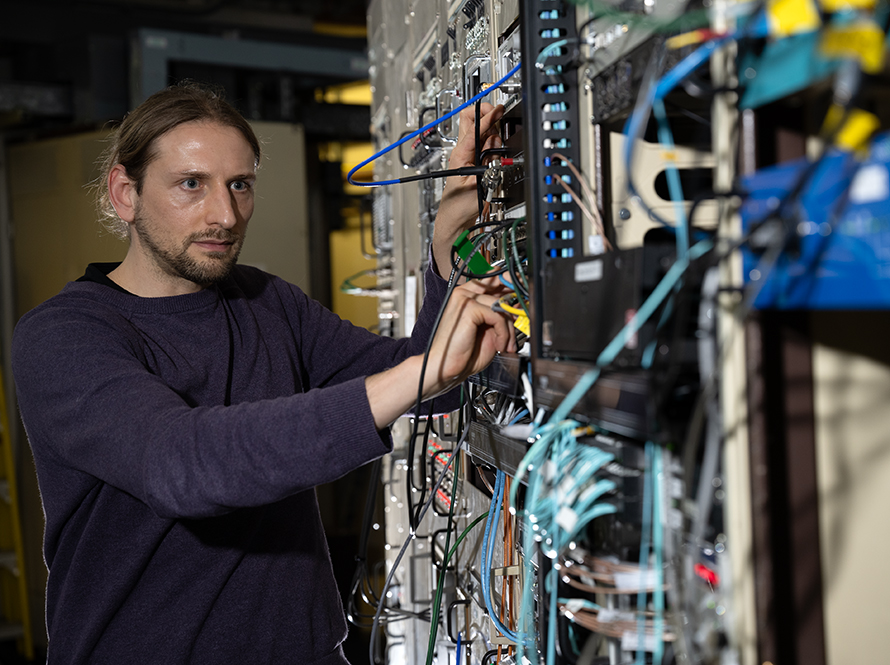
Thorsten Hellert adjusts the settings on one of the controls of the Advanced Light Source at Berkeley Lab. Thor Swift/Berkeley Lab
“Beyond standardizing data, this project creates a machine-readable representation of accelerator facilities that software can reason about,” says Thorsten Hellert, a staff scientist in ATAP’s Advanced Light Source Accelerator Physics Program and Berkeley Lab’s principal investigator for the project. “By defining a shared semantic foundation, we enable tools to be developed once and applied consistently across multiple DOE accelerator facilities.”
The work aims to accelerate the development of AI-powered applications for predictive maintenance, performance optimization, and eventually, more autonomous accelerator control.
An initial and impactful deliverable for the project will be improvements in the time required to complete data retrieval and analysis tasks compared to expert operators at DOE particle accelerator facilities, such as the ALS.
AI-driven Digital Twins for fusion
IFE power plants present a significant scientific and engineering challenge. A project led by Lawrence Livermore National Laboratory, Digital Twins and Data Integration for Accelerated Design and Operation of Inertial Fusion Energy Power Plant Systems, aims to accelerate the design, optimization, and deployment of IFE power plants by leveraging AI-driven digital twins, advanced surrogate modeling, and robust, federated data integration.
The project includes researchers from ORNL, Berkeley Lab, Savannah River National Laboratory, and ANL. Berkeley Lab and ORNL will jointly lead the development of the platform’s data infrastructure. A primary challenge in creating an AI-enabled digital twin platform is seamlessly integrating diverse data sources, including simulations, experimental data, and real-time operational streams into a unified, standardized, and machine-actionable framework.
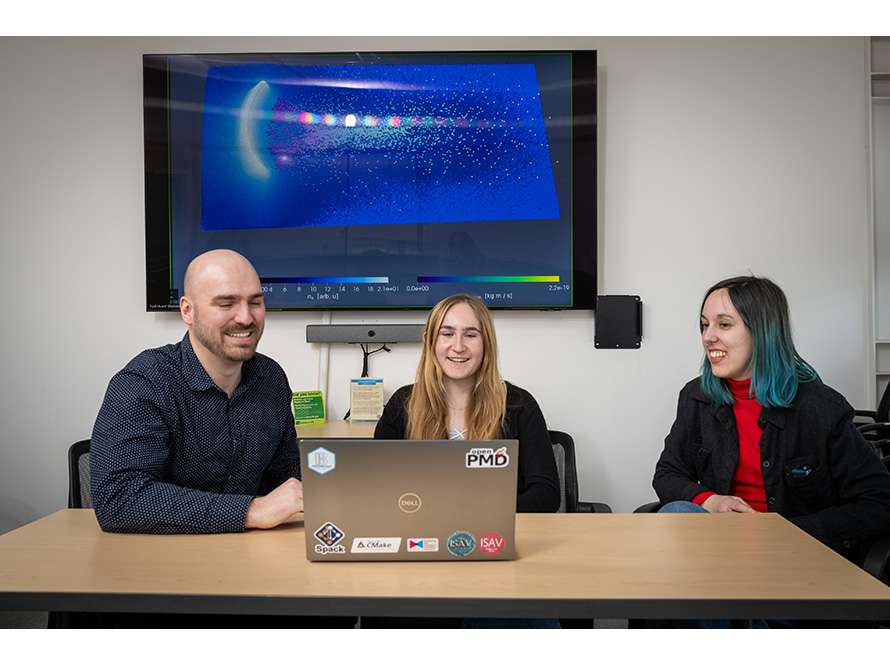
(l-r) Axel Huebl, SULI Student Sarah Vickers, and Research Scientist Arianna Formenti discuss inertial fusion energy simulations. (Credit: Thor Swift/Berkeley Lab)
Addressing this challenge requires establishing strong data standardization protocols that ensure consistent representation, interoperability, and accessibility of scientific data. Axel Huebl, a research scientist in ATAP’s Advanced Modeling Program, will lead data standardization efforts by adopting and expanding the openPMD framework, making sure that simulation and experimental data meet widely recognized community standards.
“These projects will harness the power of AI to rapidly advance the design and operation of current and future particle accelerators and fusion systems,” says ATAP Division Director Cameron Geddes. “These AI-driven improvements promise to transform how accelerators and their applications benefit science and society.”
The U.S. Department of Energy, Office of Science, Office of Advanced Scientific Computing Research, Office of Nuclear Physics, and Office of Fusion Energy Sciences is funding this research.
For more information on ATAP News articles, contact caw@lbl.gov.