In 2024, a multi-divisional OJT self-assessment was conducted at Berkeley Lab. The assessment included surveying OJT instructors and trainees, as well as observing OJT training sessions. In Fall 2025, four divisions at Berkeley Lab—the Accelerator Technology & Applied Physics (ATAP), Nuclear Science, Physics, and Engineering—conducted a self-assessment of EHS aspects of onboarding. This included gathering feedback from learning teams. The findings and discussions from these assessments clearly underscored the importance of OJT tailored to a trainee’s work and to how training is conducted.
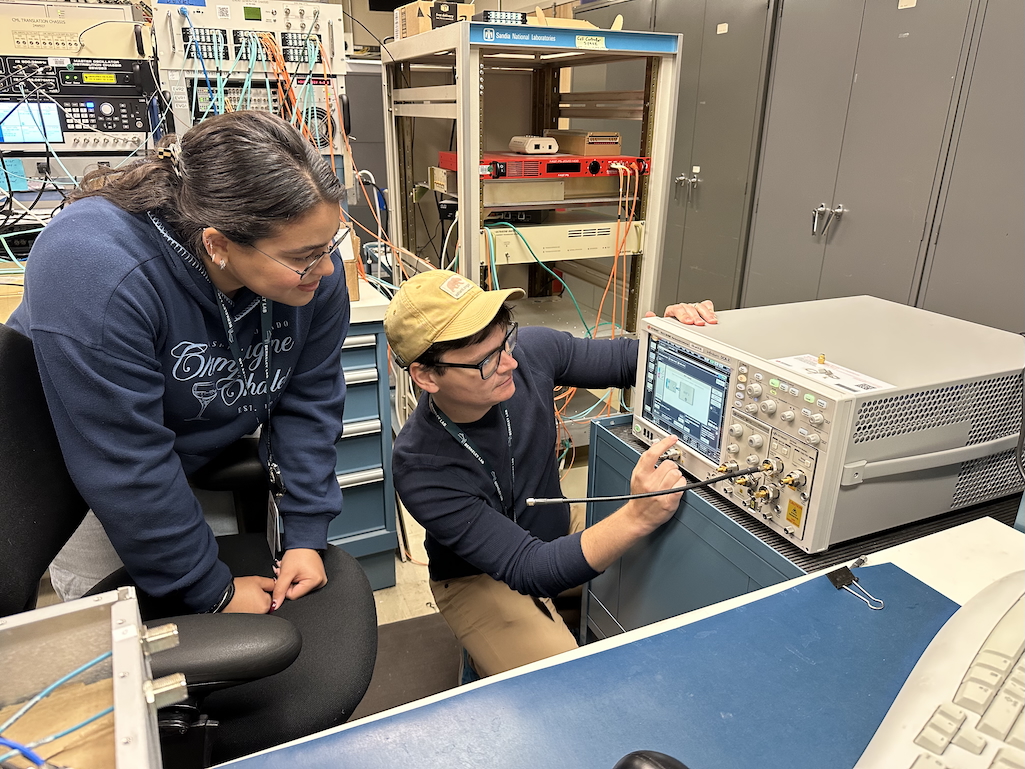
ATAP Postdoctoral Researcher Jared De Chant provides on-the-job training to student intern Andrea Zabala for measuring cable length and performance using a Time Domain Reflectometer. (Credit: Aaron Potash)
Berkeley Lab offers courses that provide a basic understanding of safety concepts, the importance of DOE regulations, and institutional expectations for safety. When a supervisor or experienced colleague guides a new team member through an actual process, it helps those employees better understand how to perform work safely.
Why OJT resonates
The learning teams found that OJT is effective for several reasons that are difficult to replicate online.
- Personal: OJT is typically delivered one-on-one or in small groups and tailored to the individual’s needs.
- Adaptive: OJT naturally adjusts to what a new employee already knows and what they still need to learn.
- Connected to actual work: OJT is directly linked to the specific equipment, hazards, and environment in which the new employee will operate.
OJT is also an ongoing process, not a one-time training.
One new hire shared a quote from their mentor: “If you want to do good science, you have to be safe.”
OJT effectiveness
The learning teams found that the most effective OJT is:
- Personalized: Meeting new employees where they are and accounting for their experience and specific hazards.
- A conversation: Creating space for questions and discussions that might not arise in a larger setting.
- A process: Going beyond the “what” to explain the “why” and helping people understand the reasoning behind safe work practices.
The learning teams highlighted experiential learning as a particularly powerful tool for building understanding by letting people see the work from a different perspective.
For example:
A previous employer provided training in which workers who shared space with forklifts experienced the operator’s viewpoint, gaining firsthand insight into the blind spots and challenges that make safe operations difficult.
In the ATAP Division, OJT is part of the employee onboarding process. The onboarding checklist, developed based on feedback from supervisors and new employees, ensures that OJT is coordinated and that new hires understand expectations.
Planning and resources for OJT
The Training Advisory Committee from Berkeley Lab’s EHS Division gathers feedback and implements approaches to managing high-volume training at the Lab. Our EHS Division also offers several resources for supervisors, new employees, and work leads to help deliver effective OJT. These resources are available at https://training.lbl.gov/OJT/. The site provides guidance on planning, structuring, and documenting OJT effectively. Additionally, with a recent update to the Work Planning and Control system, the WPC can now link to OJT attachments in the format your team needs.
The Berkeley Lab Training Team is available to answer questions about OJT and to develop specific OJT plans for groups and programs. They are eager to better understand how OJT is implemented across the Lab and to develop solutions that meet individual program needs.
Ongoing learning an important aspect of our safety culture
The assessments conducted over the past two years clearly indicate that Lab’s safety strength is not the result of any single training course or system. It comes from the people who share knowledge and prioritize safe operations.
OJT is a critical component of this culture, in which new employees learn to safely perform real work.
For OJT planning resources, visit https://training.lbl.gov/OJT/. For questions or assistance with OJT development, contact the Berkeley Lab Training Team.
For more information on ATAP News articles, contact caw@lbl.gov.