Matthew Fullmer, an administrator on the Operations Team in the Accelerator Technology & Applied Physics (ATAP) Division at Berkeley Lab, delivered a thought-provoking talk titled “Integrity as a core value of Stewardship at ATAP” at our All-to-All meeting on April 27, 2026.
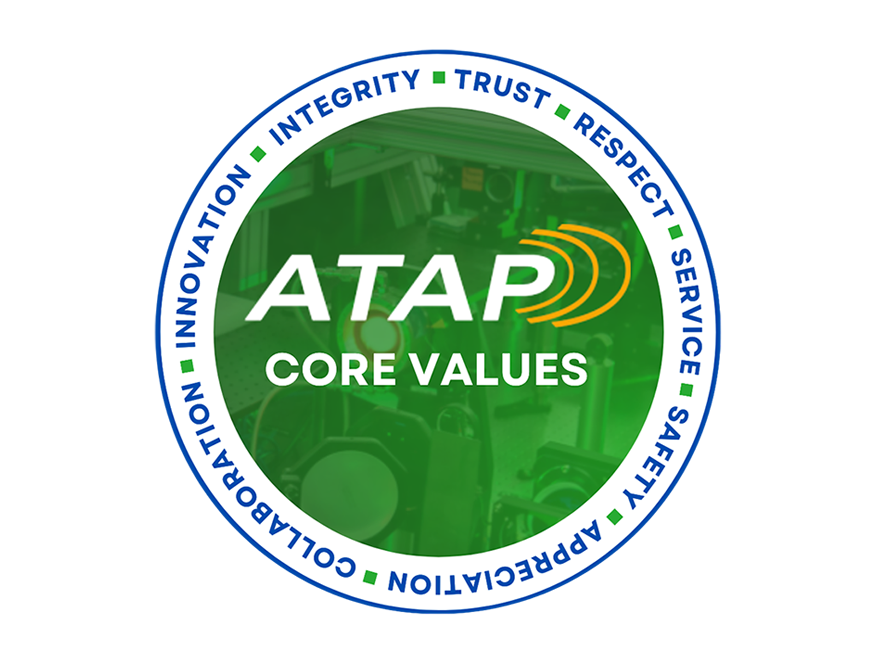
In ATAP, Fullmer said, our success is measured not only by progress in scientific research and new discoveries but also by the character of the people—be they scientists, technicians, operations personnel, or project managers—who help make it happen. While ATAP operates under the broader umbrella of Berkeley Lab’s mission, ATAP has intentionally chosen to augment our guiding principles by adding Integrity, Safety, and Appreciation to the existing core values of Trust, Respect, Service, Collaboration, and Innovation.
“These eight values are the critical components of the system that enable ‘Team Science’ to function at scale,” he notes. “However, among these, Integrity is the primary focus and the most fundamental requirement.”
Moreover, at ATAP, Integrity is not a passive compliance policy or a set of human resources guidelines, but rather the baseline for our work culture, enabling the division to “fulfill our commitments with honesty, transparency, and accountability,” he adds.
To explain why integrity is a core stewardship value for the division, Fullmer traced the word’s etymology: “It comes from Latin words integritas and integer. Integritas: completeness and innocence; and integer being whole.” He adds that this provides a shared, rigorous definition to prevent ethical ambiguity from introducing “noise” into our collective operations.
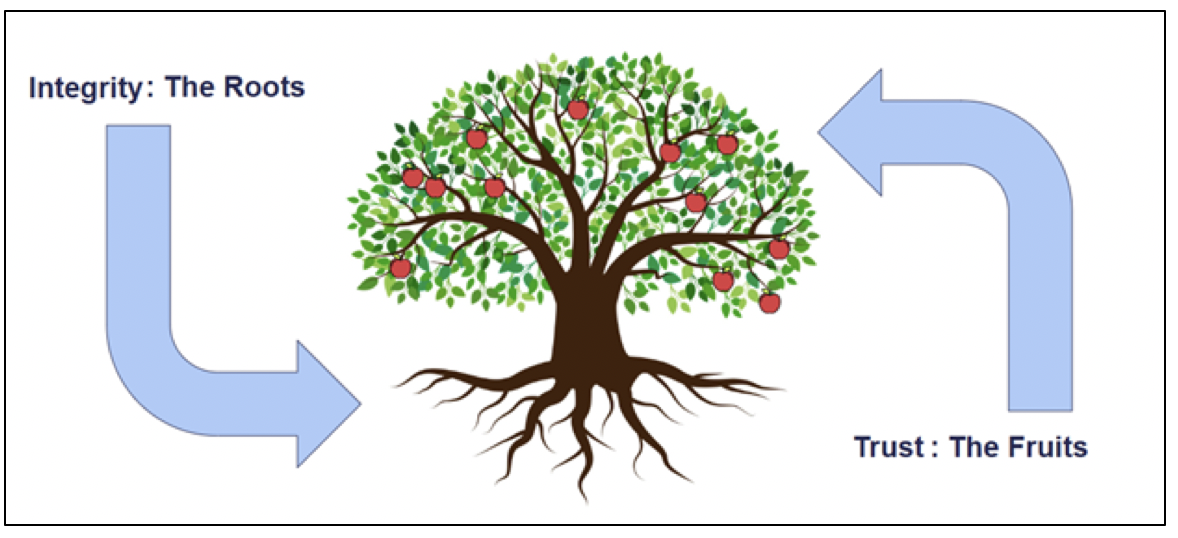 It is also essential, he said, to clearly distinguish between our internal character (Stewardship of the Self) and our external reputation (Scientific Standing). This distinction is the difference between Integrity and Trust. While the two concepts are often used interchangeably in casual conversation, they occupy different positions: integrity is a variable we control, whereas trust is a response granted by others.
To illustrate these differences, Fullmer offered the following summary:
| Integrity | Trust |
| · Delivering on promises with honesty and clear communication. | · Earned through honesty, respect, and effectiveness over time. |
| · Consistency between values, words, and actions (“Walking the talk”). | · The confidence colleagues have in your reliability and judgment. |
| · An internal quality: striving to uphold Stewardship values. | · An external quality: others’ response to integrity and performance. |
| · Strong integrity informs strong Stewardship. | · An asset is often built slowly but can be lost quickly. |
The connection between the two is that Integrity builds the foundation for Trust.
To further illustrate Integrity in action, Fullmer provided the following examples:
- Honesty—Your supervisor compliments a project your team worked on and praises your work on the visuals. Giving credit where it is due, you let your supervisor know that Frank created all the visuals himself.
- Transparency—Quick test: Do you say the same things about people when they are not around
- Accountability—Matt made a mistake. Instead of shifting blame or inventing an excuse (e.g., “technical glitch”), he takes responsibility, informs his supervisor and stakeholders, apologizes, and works to improve.
In conclusion, Integrity is unique among our stewardship values because it is the only one entirely within an individual’s control. While we can strive for innovation or hope for appreciation, we can guarantee our Integrity.
“Integrity means fulfilling our commitment with honesty, transparency, and accountability—even when no one is watching,” says Fullmer.
For more information on ATAP News articles, contact caw@lbl.gov.