
Scientific Achievement
A computational study using the Exascale code WarpX, developed by researchers at the Department of Energy (DOE)’s Lawrence Berkeley National Laboratory (Berkeley Lab), examined the feasibility of a laser-based method to accelerate 100 GeV electrons for muon production. WarpX’s combination of advanced algorithms and efficient Graphics Processing Unit (GPU)-based supercomputing was crucial to the study’s success.
The work was a collaboration among researchers from the Advanced Modeling Program (AMP) within the Accelerator Technology & Applied Physics (ATAP) Division at Berkeley Lab, the Extreme Light Infrastructure (part of the European Research Infrastructure Consortium), Lawrence Livermore National Laboratory, the University of Maryland, and Colorado State University.
Significance and Impact
High-energy muons can penetrate deeply into matter, enabling unique capabilities for radiographing large structures such as pyramids and volcanoes. Although muons are naturally produced by cosmic radiation, their flux is low, limiting their applications. Generating artificial muons for radiography with particle accelerators is highly desirable; however, this has so far required large, expensive machines. Recent research has focused on developing smaller, portable muon sources by leveraging the high accelerating gradients of laser-plasma wakefield accelerators1,2 to generate compact, highly relativistic electron beams and produce muons in a converter target. With such laser-plasma technology, electron and muon beam energies up to 100 GeV are within reach for practical deployment.

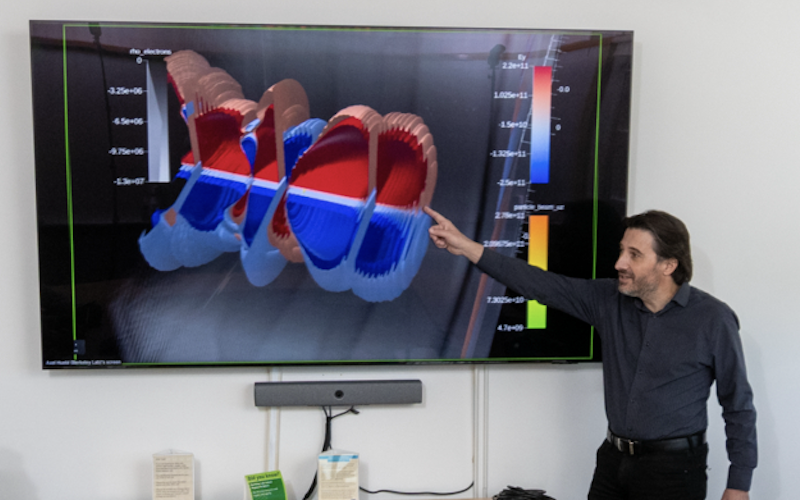
Cross-section of a 3D simulation showing the plasma charge density (x–axis)in units of electron charge per cubic centimeter at time = 667 ps into the simulation. The accelerated electron bunch resulting from localized injection is viable in the back of the first bubble. The laser (not shown) travels from left to right and is primarily contained within the right half of the right-most bubble. This figure is an illustration of a 3D Cartesian simulation of Run 1 in Table 1. The simulation domain was 256 μm times 256 μm x 4096 μm.
The ATAP Division has pursued two approaches to 100-GeV electron acceleration and muon production, both as part of the U.S. Government Defense Advanced Research Projects Agency’s MuS2 program. The first approach is based on a single laser driver focused into a longer plasma channel for one-pass high-energy wakefield acceleration, while the second approach, led by the BELLA Center in ATAP, relies on serializing the acceleration process into multiple 10 GeV stages driven by synchronized laser lines. While the single-stage approach is conceptually simpler, the multi-stage approach is more efficient and can be scaled to deliver higher muon flux.
Recently, 10 GeV electron production in 20-30 cm channels2,3 and associated muon production and characterization4 were experimentally demonstrated. Considering the single-plasma-channel approach, research1 suggests that this geometry requires a six-meter plasma accelerator powered by a future-generation laser system capable of producing tens of femtosecond pulses exceeding 300 J.
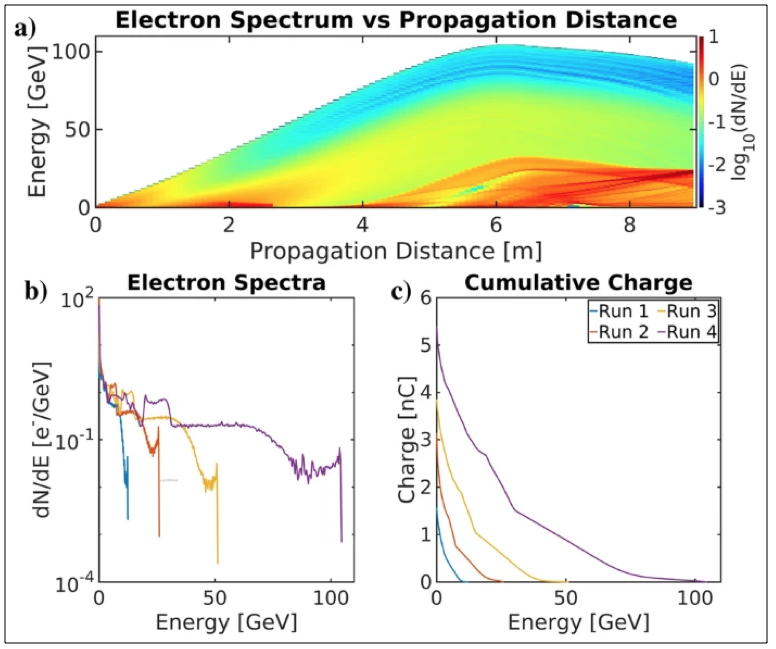
(a) Electron energy spectrum vs laser propagation distance for the 104 GeV simulation “Run 4”. (b) Electron energy spectrum at peak energy for each simulation. The units of dN/dE are electrons/GeV. The line corresponding to “Run 4” is essentially a line-out of panel (a) at 6.12 m. (c) Total accelerated electron charge above the specified energy at peak energy for each simulation.
A major challenge of this longer single-stage method is the need for a self-consistent simulation of beam generation and acceleration across several meters while capturing submicron-scale processes. To achieve this, the researchers used the award-winning WarpX code, which provides advanced features such as numerically stable simulations in a Lorentz-boosted frame and efficient GPU-based supercomputing. WarpX also allows for flexible implementation of less expensive axisymmetric simulations with azimuthal Fourier decomposition for parameter studies, as well as more resource-intensive 3D simulations to verify results from reduced-geometry models.
Research Details
WarpX is an electromagnetic particle-in-cell code that runs efficiently on Central Processing Units and GPUs. It also includes innovative, cutting-edge algorithms that were essential to this study, including the ability to perform simulations in a Lorentz-boosted frame of reference, resulting in much shorter runtimes. The relativistic factors used for the simulations reported in the research1 ranged from 10 to 40, corresponding to speedup factors of 200 to 3,000 compared to simulating in the laboratory frame. These simulations were numerically stable thanks to previous work by the AMP team, carried out in part during the Exascale Computing Project.
Contact: Jean-Luc Vay
Researchers: J.-L. Vay, A. Huebl, and R. Lehe, (Berkeley Lab); A. Cimmino, R. Versaci, S. V. Bulanov, and P. Valenta (The Extreme Light Infrastructure ERIC); J. D. Ludwig, S. C. Wilks, A. J. Kemp, G. J. Williams, N. Lemos, and V. Tang (Lawrence Livermore National Laboratory); E. Rockafellow, B. Miao, J. E. Shrock, H. M. Milchberg, (University of Maryland); and B. A. Reagan (Colorado State University)
Funding: This work was supported by the Defense Advanced Research Program Agency under the Muons for Science and Security Program. This work was performed under the auspices of the Department of Energy (DOE) by Lawrence Livermore National Laboratory. The Lawrence Livermore National Laboratory Institutional Computing Grand Challenge program provided computing support for this work. The Maryland authors acknowledge the DOE and the National Science Foundation. The DOE supported the Berkeley Lab work.
Publications:
- J. D. Ludwig, S. C. Wilks, A. J. Kemp, G. J. Williams, N. Lemos, E. Rockafellow, B. Miao, J. E. Shrock, H. M. Milchberg, J.-L. Vay, A. Huebl, R. Lehe, A. Cimmino, R. Versaci, S. V. Bulanov, P. Valenta, V. Tang, and B. A. Reagan, “Laser based 100 GeV electron acceleration scheme for muon production,” Scientific Reports 15, 25902 (2025). https://doi.org/10.1038/s41598-025-95440-w
- Picksley, A., Stackhouse, J., Benedetti, C., Nakamura, K., Tsai, H. E. Li, R., Miao, B., Shrock, J. E., Rockafellow, E., Milchberg, H. M., Schroeder, C. B., van Tilborg, J., Esarey, E., Geddes, C. G. R., and Gonsalves, A. J. “Matched Guiding and Controlled Injection in Dark-Current-Free, 10-GeV-Class, Channel-Guided Laser-Plasma Accelerators,” Phys. Rev. Lett. 133, 255001 (2024). https://link.aps.org/doi/10.1103/PhysRevLett.133.255001
- E. Rockafellow, B. Miao, J. E. Shrock, A. Sloss, M. S. Le, S. W. Hancock, S. Zahedpour, R. C. Hollinger, S. Wang, J. King, P. Zhang, J. Šišma, G. M. Grittani, R. Versaci, D. F. Gordon, G. J. Williams, B. A. Reagan, J. J. Rocca, and H. M. Milchberg. “Development of a high charge 10 GeV laser electron accelerator,” Phys. Plasmas 32, 053102 (2025). https://doi.org/10.1063/5.0265640
- Davide Terzani, Stanimir Kisyov, Stephen Greenberg, Luc Le Pottier, Maria Mironova, Alex Picksley, Joshua Stackhouse, Hai-En Tsai, Raymond Li, Ela Rockafellow, Bo Miao, Jaron E. Shrock, Timon Heim, Maurice Garcia-Sciveres, Carlo Benedetti, John Valentine, Howard M. Milchberg, Kei Nakamura, Anthony J. Gonsalves, Jeroen van Tilborg, Carl B. Schroeder, Eric Esarey, and Cameron G. R. Geddes. “Measurement of directional muon beams generated at the Berkeley Lab Laser Accelerator,” Phys. Rev. Accel. Beams 28, 103401 (2025). https://doi.org/10.1103/kxjr-h7zs
For more information on ATAP News articles, contact caw@lbl.gov.