
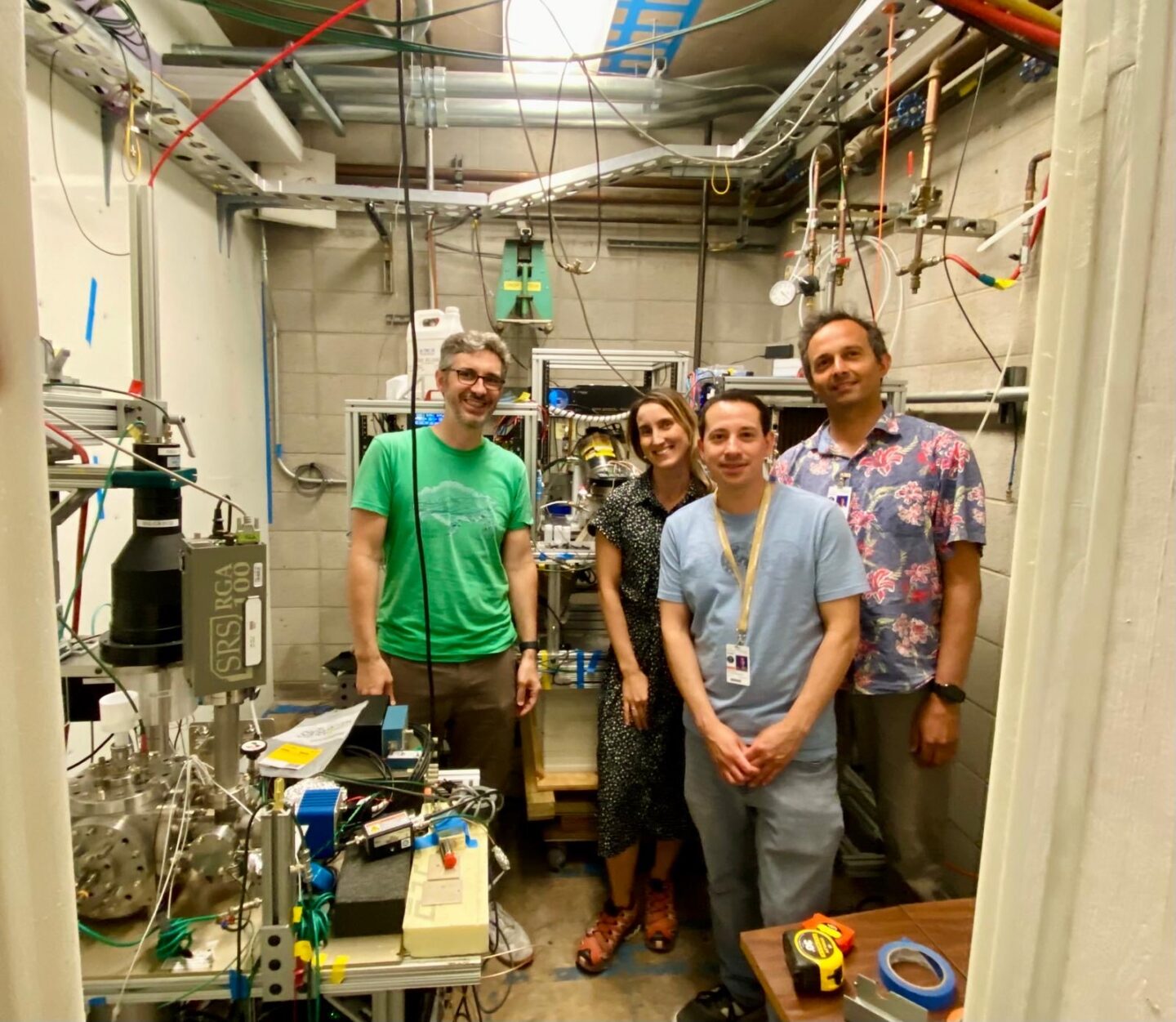
Scientific Achievement
Researchers from the Accelerator Technology & Applied Physics (ATAP) Division at Berkeley Lab, Arizona State University, and the University of Oslo in Norway have demonstrated that Associated Particle Imaging (API) can produce 3D images of hydrogen-rich materials by detecting backscattered neutrons. This technique can be used in future planetary missions to better characterize hydrogen (a water-ice proxy), improve understanding of volatiles in the solar system, and uncover potentially valuable resources.
Significance and Impact
This work advances the frontier of planetary surface characterization by demonstrating, for the first time in a backscatter geometry, that the API technique can spatially resolve hydrogen-rich materials using fast neutrons. Hydrogen is a critical proxy for water ice and other hydrogen-bearing volatiles, central to understanding volatile inventories across the solar system and to enabling In Situ Resource Utilization (ISRU) on future human and robotic missions to the Moon, Mars, and beyond.
Bridging a Gap in Planetary Nuclear Spectroscopy
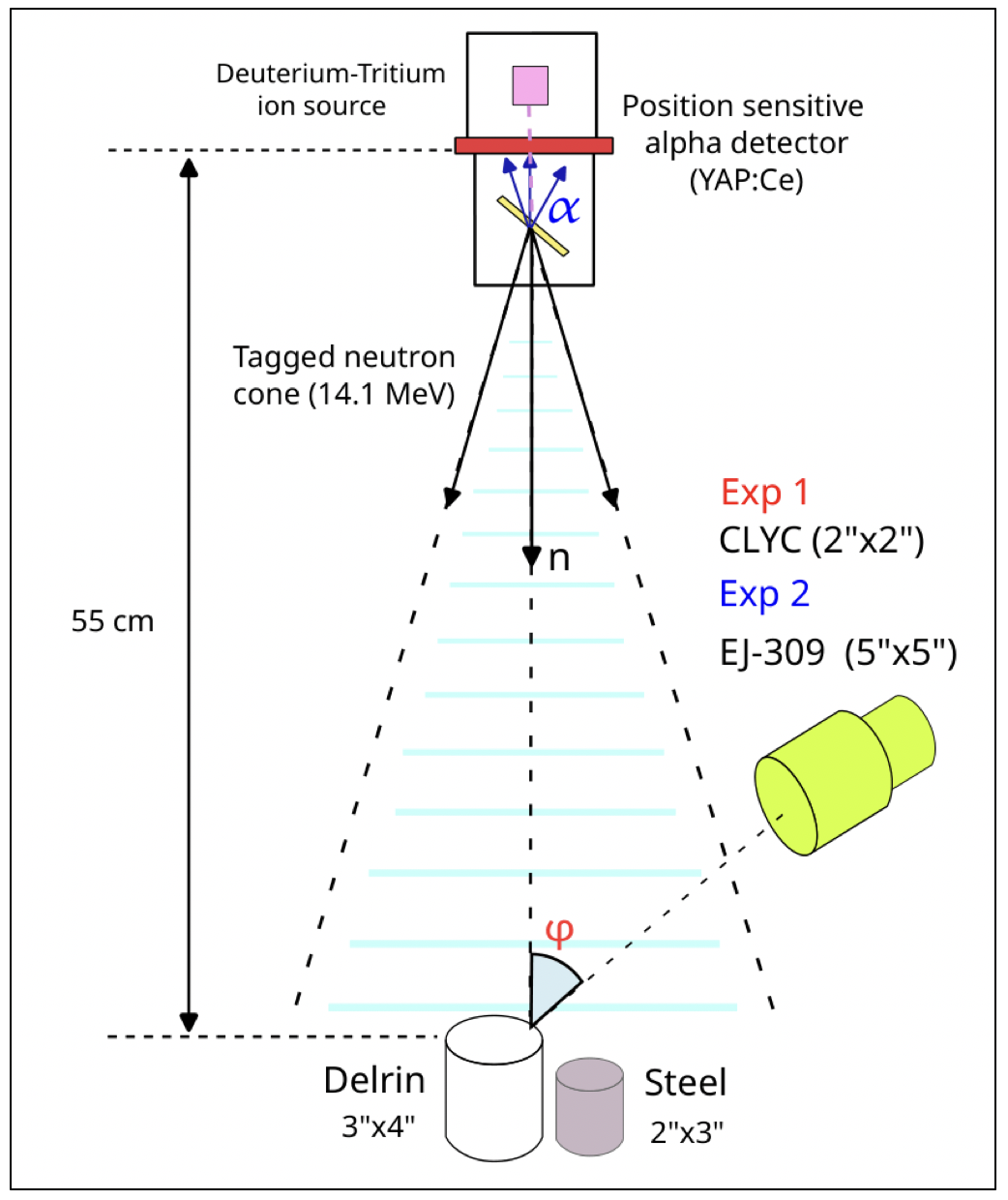
Schematic illustration of the API system and experimental geometry, including the D–T neutron generator, the position-sensitive YAP:Ce alpha detector, and the tagged neutron cone (14.1 MeV) directed toward the sample region located at a stand-off distance of ∼55 cm.
Existing API systems for planetary science have primarily focused on prompt gamma-ray spectroscopy (API-GRNS) to identify elements such as O, Mg, Al, Si, and Fe. However, hydrogen does not emit a gamma-ray signal via inelastic scattering, making it largely invisible to this approach. This study addresses that limitation by exploiting hydrogen’s exceptionally large elastic-scattering cross-section for fast neutrons: hydrogen-rich materials cause neutrons to lose energy very efficiently, producing a distinct contrast in neutron images compared with those of heavier materials.
The goal of this study was to demonstrate, as a proof of concept, that API-based fast neutron backscatter imaging can provide spatially resolved material characterization, particularly by distinguishing hydrogen-rich from hydrogen-deficient targets in a planetary backscatter geometry. The work establishes backscattered fast neutron imaging as a complementary diagnostic to gamma-ray methods within the API framework, thereby extending the technique’s sensitivity for hydrogen detection and supporting the maturation of an integrated API-GRNS.
Results and Path Forward
Experiments at Berkeley Lab produced images that clearly distinguish hydrogen-rich targets (Delrin) from hydrogen-deficient materials (steel) based on backscattered neutron count rates coincident with alpha particles. GEANT4 Monte Carlo simulations reproduced the observed image contrast and confirmed that the signal arises from a combination of elastic and inelastic scattering kinematics, as well as material density and attenuation effects. These results validated the technique’s physical basis and provided a simulation framework for future instrument design.
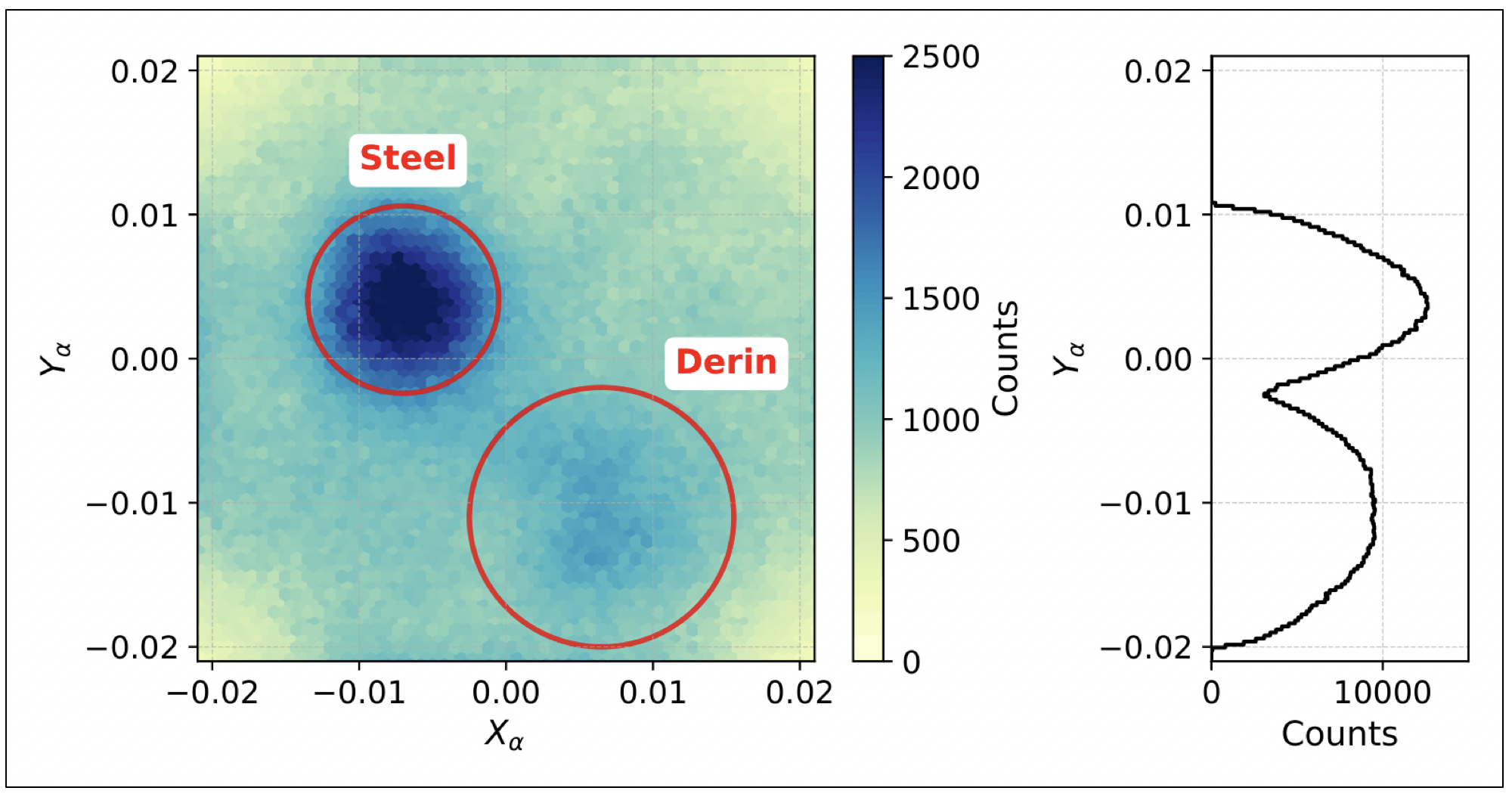
EJ-309 detector-reconstructed images for the diagonal cylinder configuration with steel (top-left) and Delrin (bottom-right) samples. 𝛾-ray events showing similar spatial contrast between materials due to differences in inelastic scattering cross sections.
Next steps include improving spatial resolution through detector optimization, extending to 3D volumetric imaging to enable depth profiling using neutron time-of-flight information, and testing with planetary regolith simulants to assess readiness for integration into future lander or rover mission concepts. Together, these studies aim to pave the way for a complete API-based active nuclear spectroscopy instrument suite capable of measuring and localizing hydration and bulk geochemical variations within the upper several tens of centimeters of a planetary surface.
Research Details
The researchers used a deuterium-tritium (D–T) neutron generator-based API system at Berkeley Lab. The API technique detects the alpha particle produced in coincidence with each 14 MeV fast neutron from D-T fusion reactions, thereby tagging the neutron’s direction and time of emission. In this work, backscattered fast neutrons were recorded in coincidence with their associated alpha particle using CLYC (⁶Li-enriched Cs₂LiYCl₆:Ce) detectors provided by Arizona State University and EJ-309 liquid scintillator detectors, enabling pulse-shape discrimination to separate neutron signals from the gamma-ray background. Targets with contrasting hydrogen content were imaged in a backscatter geometry, the same configuration required for planetary surface deployments, in which the instrument and target surface material are on the same side. GEANT4 Monte Carlo simulations were performed to interpret the measured image contrast and to model the relative contributions of elastic and inelastic scattering and of material attenuation to the observed neutron signals.
Contact: Mauricio Ayllon Unzueta
Researchers: Mauricio Ayllon Unzueta, Arun Persaud (ATAP), Deniz Ölçek (Centre for Space Sensors and Systems), and Craig Hardgrove (Arizona State University)
Funding: NASA Planetary Science Division, PICASSO program. Work was performed at Berkeley Lab, supported by the U.S. Department of Energy Office of Science and, in part, by the Research Council of Norway, Centre for Space Sensors and Systems, through its SFI Centre for Research-based Innovation program..
Publication: Deniz Ölçek, Maurico Ayllon Unzueta, Craig Hardgrove, and Arun Persaud. “Concept development of an active fast neutron backscatter imaging technique for planetary subsurface studies,” Nuclear Instruments and Methods in Physics Research Section A, 2026, doi:10.1016/j.nima.2026.001695.
For more information on ATAP News articles, contact caw@lbl.gov.