
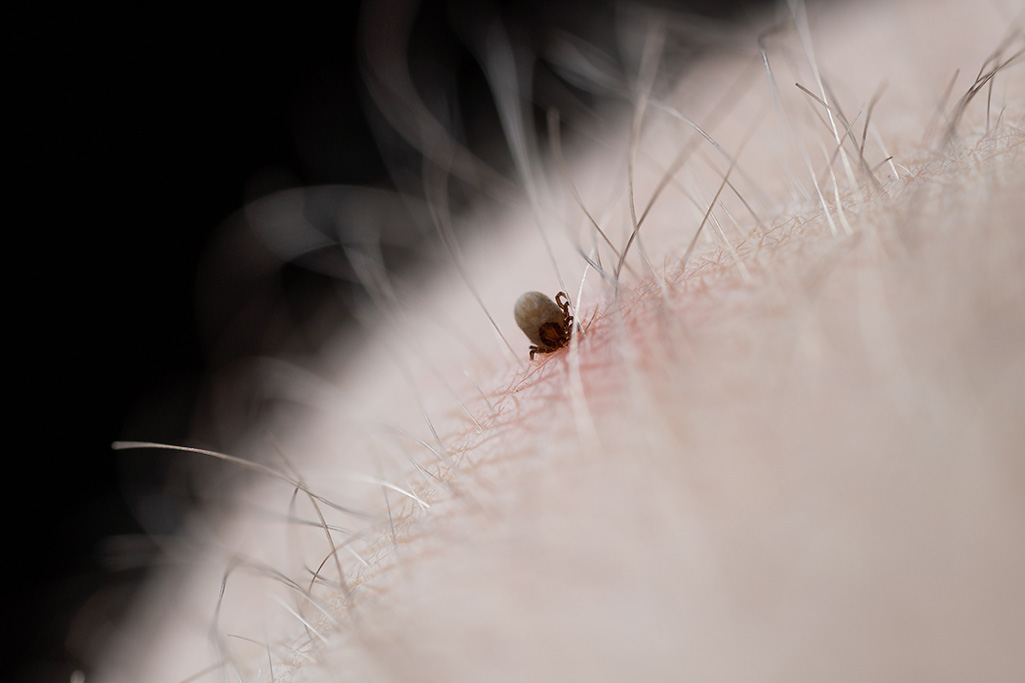
What is a tick?
Ticks are parasitic arachnids, related to mites and spiders, that attach to a host and feed on blood. They detect body heat, carbon dioxide, odor, and vibration, and they find hosts by waiting rather than hunting. Clinging to grass or brush with their back legs, they hold their front legs outstretched and grab whatever brushes past. They do not fly or jump. Every tick that reaches your skin got there by direct contact with vegetation or with clothing and gear that touched vegetation.
Ticks do serve a purpose in the local ecosystem; small mammals, reptiles, chickens, and ground-feeding birds all eat them. Unfortunately, many of them may also transmit pathogens while feeding.
In our region, Lyme disease (Borrelia burgdorferi) and tick-borne relapsing fever (Borrelia miyamotoi) are the primary concerns. Elsewhere in the United States, ticks spread anaplasmosis, babesiosis, ehrlichiosis, Rocky Mountain spotted fever, Powassan virus, tularemia, and Alpha-Gal Syndrome, a delayed allergy to red meat. The Lyme rash, erythema migrans, does not always resemble the classic bullseye; it can appear uniformly red, blistered, blue-red, or patchy.
Where do you find them?
Ticks are found across the Lab site and throughout the East Bay hills. On site, you may encounter ticks when:
- Rubbing up against tall grass and brush,
- Stepping through leaf litter and along wooded paths.
- Contacting vegetation in areas frequented by deer, rodents, and birds.
Ticks most often hitch a ride on clothing seams, socks and boot tops, backpack straps, pant cuffs, and waistbands, then crawl upward until they find skin.
If you notice overgrown vegetation crowding a Lab walkway, submit a Work Request or contact your Facilities Area Manager or Building Manager. Trimming the contact zone removes the hazard for everyone who uses that route.
Recommendations you can take to reduce the likelihood of a tick bite
Stay on walking paths and avoid wooded, brushy, and grassy areas when you can. When your work takes you into them, dress deliberately: long sleeves, long pants, tall socks, closed-toe shoes or boots, and a hat. Tuck your pants into your socks, tape the cuffs, or wear gaiters. Choose light-colored clothing so dark ticks stand out.
Use a CDC-recommended repellent according to its label:
- DEET 20-30% (Most Effective),
- Picaridin (Most Effective),
- IR3535,
- Oil of Lemon Eucalyptus (OLE)
Apply sunscreen first, then repellent. Keep in mind that DEET attacks plastics and some synthetic fibers, so protect eyewear, instrument housings, and technical fabrics. Consider treating outdoor clothing with Permethrin, according to label directions.
Check your whole body and hair after any activity in brushy or grassy areas, and check again during long jobs with heavy brush contact. Use a mirror. Remember to CHECK for the places ticks hide:
- In and Around The Hair
- In and Around The Ears
- Under The Arms
- Inside The Belly Button
- Around The Waist
- Between The Legs
- Back of The Knees
If you find a tick on your skin:
- Grasp the tick with fine-tipped tweezers as close to your body as possible, aiming for the head and avoiding pressure on the body.
- Pull straight up with steady, even force. Never twist the tick, squeeze it, crush the head, or apply petroleum jelly, nail polish, nail polish remover, or a flame.
- Clean the bite with soap and water or antiseptic, then wash your hands. If mouthparts remain, leave them alone and let them work out on their own—digging increases the risk of soft tissue infection. Try to identify the species, and keep the tick if you can.
- Call Health Services at 510-486-6266 if the bite happened at work, even if you also see your own physician.
- Contact a healthcare provider if you develop a fever, flu-like symptoms, or a rash that appears or expands, or if any symptoms occur after a tick exposure. Ticks generally must remain attached for >24 hours to transmit the bacteria that cause Lyme or other diseases, so the risk is low if you find and remove a tick quickly.
- For Alpha-Gal, seek medical guidance if you develop delayed allergic reactions after eating red meat, and call emergency services immediately if you experience difficulty breathing, swelling, or other signs of anaphylaxis.
- Prompt removal is the most effective step after a tick attaches to your skin. If your work or play will take you into grass or brush, wear protective clothing and use repellent. Even on a routine walk, avoid brushing against vegetation, check yourself after possible exposure, and report any tick bite that occurs at work to Health Services.
Prompt removal is the most effective step after a tick attaches to your skin. If your work or play will take you into grass or brush, wear protective clothing and use repellent. Even on a routine walk, avoid brushing against vegetation, check yourself after possible exposure, and report any tick bite that occurs at work to Health Services.
For more information on ATAP News articles, contact caw@lbl.gov.
