
Key Takeaways
- The research establishes a “proof of concept” for the design and fabrication of an elliptical-aperture, combined-function magnet based on a canted-cosine-theta geometry, using niobium-titanium conductors.
- By simultaneously steering and focusing particle beams, the prototype magnet could lay the groundwork for more compact, high-power particle accelerators.
- The elliptical design offers unique opportunities for future accelerator magnets, including better matching of the beam-sampling region in fixed-field accelerators and enabling a more concentrated radiation-shielding distribution in a muon collider.
Particle accelerators are among the most powerful tools in modern science. From probing the building blocks of matter to enabling cancer therapies, they have advanced our understanding of the universe and led to numerous scientific discoveries. Key components of these accelerators include superconducting magnets that steer and focus beams of charged particles as they race around the accelerators at nearly the speed of light.
However, to build next-generation machines, such as muon colliders and fixed-field accelerators (FFAs), advanced superconducting magnets with characteristics beyond those of today’s circular-aperture designs are needed.
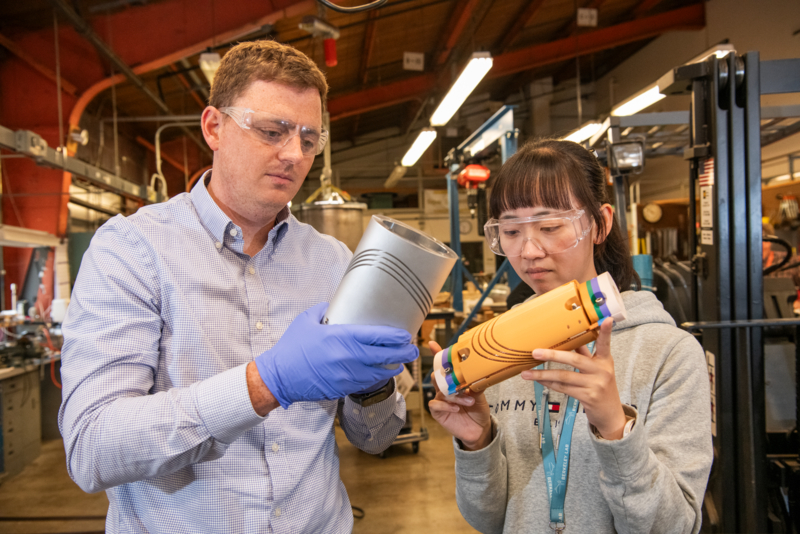
A new study by researchers from the Accelerator Technology & Applied Physics (ATAP) and Engineering Divisions at Berkeley Lab presents a prototype superconducting magnet featuring an elliptical aperture. Fabricated from niobium-titanium (Nb-Ti) superconducting coils and based on a canted-cosine-theta (CCT) winding configuration, the prototype could pave the way for advanced accelerators and a new era of scientific discovery.
“This new magnet is unusual in two key ways,” says Yufan Yan, a postdoctoral researcher in ATAP’s Superconducting Magnet Program and the study’s lead author. “First, it has an elliptical aperture rather than the traditional circular one; second, it generates combined dipole and quadrupole fields simultaneously—bending and focusing the particle beam.”
This flexibility to generate multiple magnetic field harmonics, adds Yan, makes the prototype magnet particularly well suited for next-generation accelerators, such as FFAs and muon colliders. This advancement would align with the goals of the U.S. Magnet Development Program, led by Berkeley Lab, and with the recommendations of the 2023 P5 Report, which outlines a pathway for particle physics over the next decade and strongly supports accelerator R&D.
While conventional accelerators use two types of magnets to handle different tasks—dipole magnets bend particle beams around curves in the accelerator tunnel, and quadrupole magnets focus the beams, keeping them tight and preventing them from spreading—this “combined-function” magnet performs both functions at once.
“If we can do both together, we can potentially make the accelerator more compact and more efficient,” says Yan.
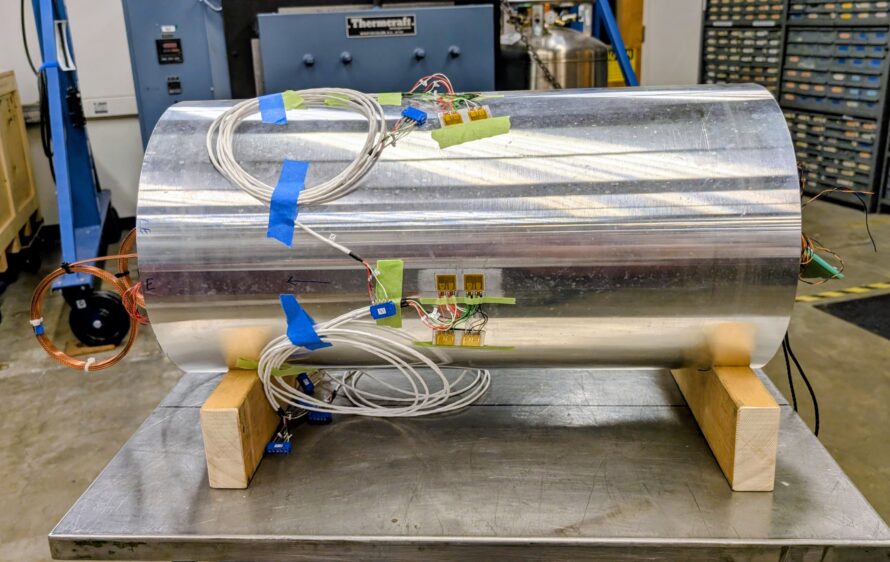
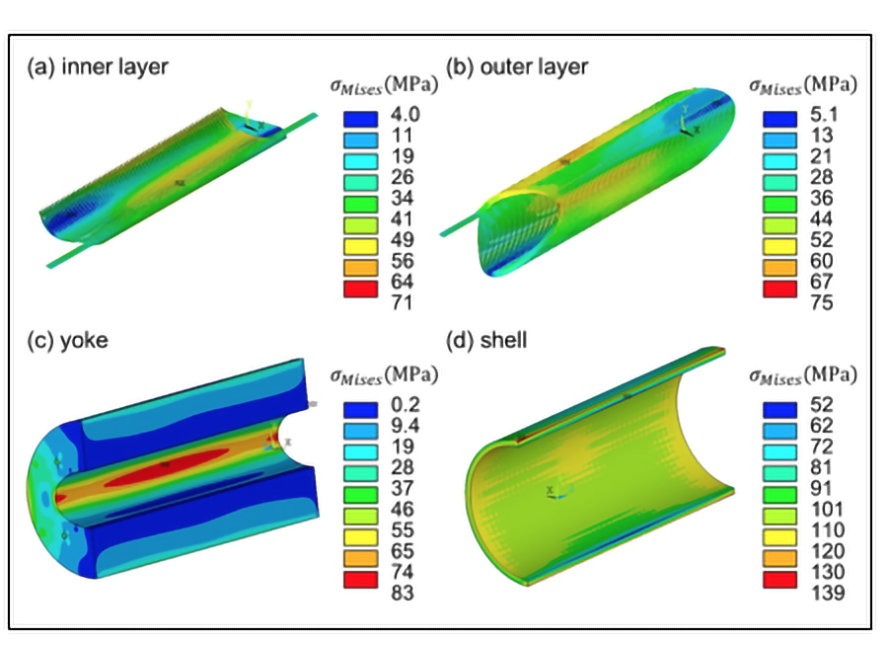
In specific parts of accelerators—such as the region just before the collision point of a collider—the use of combined-function magnets can pack everything into a much smaller volume, enabling a more compact accelerator design. For some accelerator designs, such as FFAs, where the magnetic field remains fixed, combined-function magnets aren’t just more efficient—they’re necessary.
Furthermore, in FFAs, beams of different energies follow slightly different paths, moving back and forth in the horizontal plane of the magnets and sampling a larger area of the magnet’s bore.
“An elliptical magnet bore produces a magnetic field that better matches this region than a circular bore, enabling more efficient magnet designs for this application,” explains Lucas Brouwer, a research scientist in ATAP’s Superconducting Magnet Program (SMP) who developed the analytic framework used to design and build the prototype magnet.
A future muon collider would smash together heavier cousins of electrons, called muons, which are more than 200 times heavier. However, these particles are unstable and decay rapidly, showering the surrounding equipment with radiation and requiring substantial shielding around the beam. Furthermore, this radiation pattern is uneven—stronger in some directions than in others.
“To make this shielding as effective and compact as possible, one option is to match the shape of the radiation shield to the radiation pattern, which has one axis shorter and one longer—so it’s approximately elliptical,” says Yan.
According to Brouwer, radiation shielding is the primary reason for adopting an elliptical magnet bore in a muon collider. “Additionally, a more compact magnet requires less material, smaller surrounding systems, and lower overall cost.”
Design and fabrication challenges
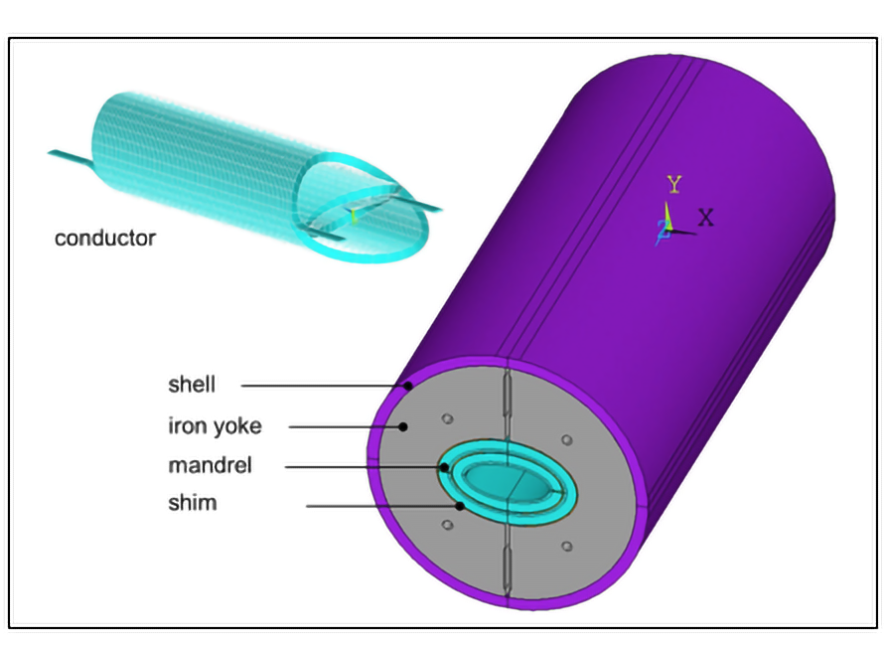
To build the prototype magnet, the researchers used a CCT coil-winding design. In a CCT magnet, the superconducting cables sit in precisely shaped grooves within a metal tube, following a complex three-dimensional path. Brouwer says this design produces a precisely tuned combination of dipole and quadrupole fields.
“A key benefit of this design is the magnetic field quality of the CCT magnet, which depends on the precise positioning of the superconducting windings,” he explains. “The winding grooves provide this precise positioning, resulting in a high-quality field.” This is crucial for accelerator magnets, adds Yan, which typically require field uniformity within 1 part in 10,000.
This elliptical CCT configuration, however, presents several unique mechanical and geometric challenges compared with traditional designs. For instance, to achieve an elliptical winding geometry, the conductor must be closely aligned with the curving path to maintain field quality and enable machining. To achieve this alignment, the researchers bend the cable along its thin edge rather than its broad flat face, a process known as “hardway” bending. Hardway bending is most severe near the magnet’s midplane, where the cable crosses the magnet’s major axis. It can cause “springback,” in which the cable’s stiffness prevents it from staying at the bottom of the machined groove. At lower path tilt angles, hardway bending can also occur near the magnet’s poles, adding another fabrication challenge.
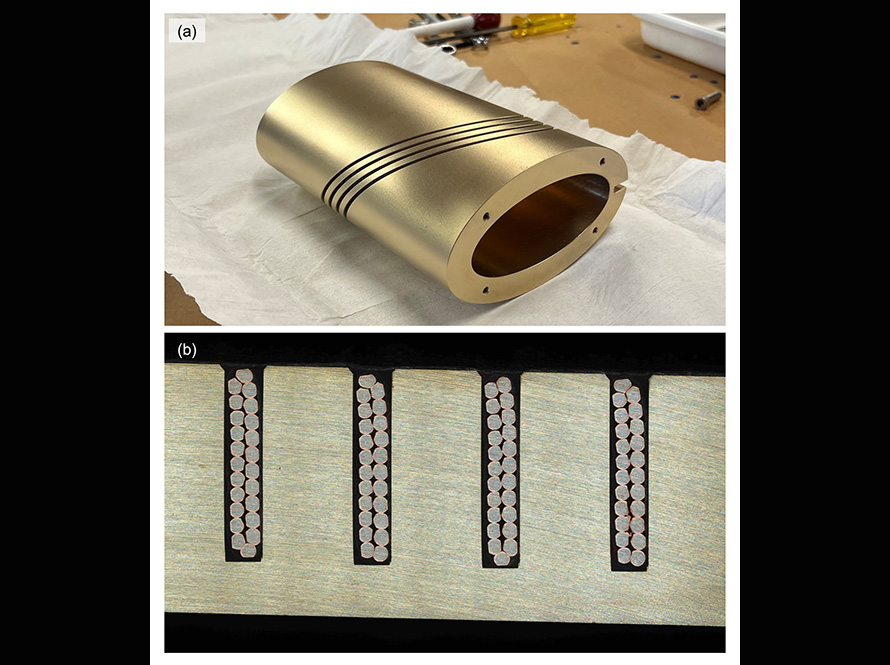
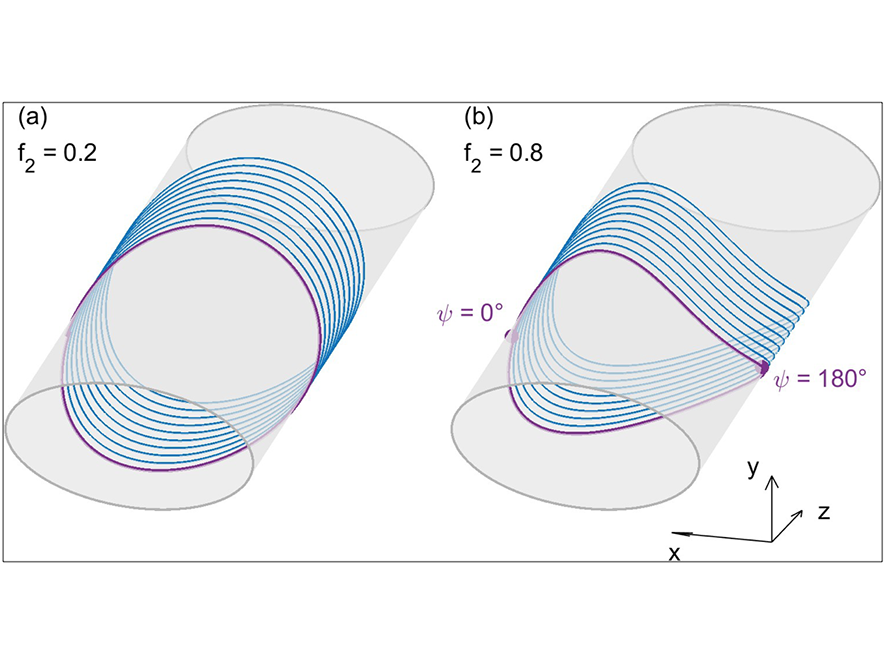
In addition to bending, the cables follow a complex geometry that varies along the magnet’s length, producing both dipole and quadrupole fields. This combined-function geometry induces significant torsion along the cable’s length. The most severe mechanical failure occurs when strong torsion coincides with a sharp, hardway bend. This combination can cause “decabling” in the Rutherford cables, which comprise 23 strands of Ni-Ti wires, leading to physical unraveling and loss of orientation.
To manage these mechanical stresses, the team conducted extensive winding tests using superconducting cables and 3D-printed mandrels to determine the maximum curvature and torsion the cables could withstand. They then fine-tuned the CCT winding geometry to improve packing efficiency and ensure the winding remains manageable, avoiding cable protrusion or decabling.
“Additionally, fabricating the elliptical mandrels into which the superconductor cable is wound to form the coil posed another challenge,” says Brouwer.
Luckily, the Lab has extensive experience with CCT magnet designs. To address the unique aspects of the elliptical design, the team used wire electrical discharge machining to fabricate the elliptical tubes and partnered with a local machine shop that used a 5-axis computer numerical control machine to carve the complex channels needed to secure the cables.
The team first fabricated a short mandrel, impregnated it with epoxy to secure everything in place, and then cut and polished sample sections to confirm that the conductor was in the correct position. They then fabricated the full-length coils, impregnated them with wax, and assembled them with the surrounding structures. Brouwer noted that Tom Lipton, Jim Swanson, and Chet Spencer from the Engineering Division played key roles in turning the design into hardware.
“Developing both the unique magnet designs and the fabrication techniques that enable combined-function elliptic magnets exemplifies Berkley Lab’s capabilities across the ATAP and Engineering Divisions,” says SMP Head Soren Prestemon. “The magnet technology has significant potential for FFA accelerators and for scientific and industrial applications requiring high-power beams.”
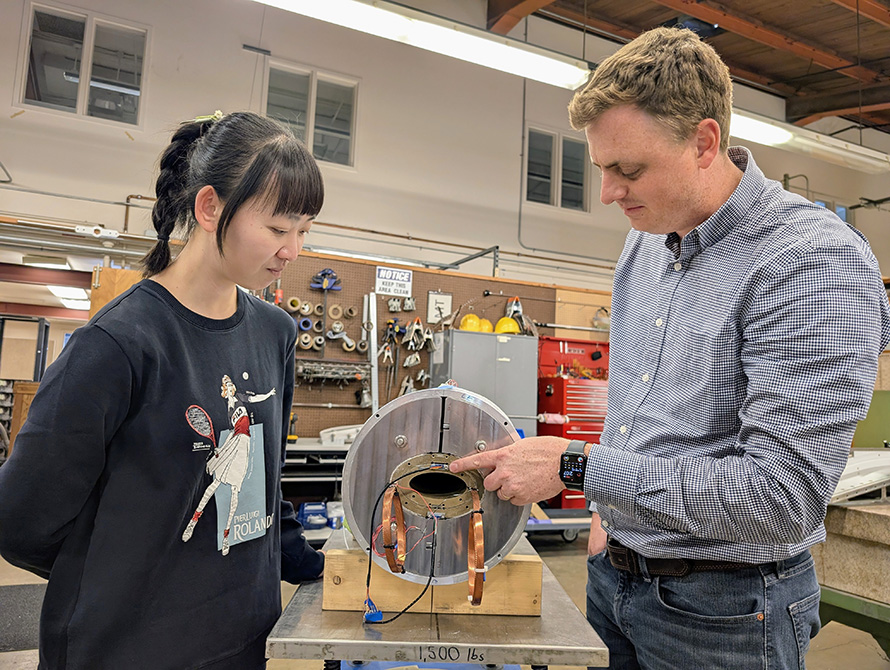
Because creating a magnet with both an elliptical aperture and a combined function is already highly complex, the team chose Nb-Ti superconductors for the prototype magnet. “Niobium-titanium is mechanically robust and less brittle than niobium-tin,” explains Yan. “It’s also a well-understood material that we know how to handle, making it a very good candidate for a first magnet.”
The prototype is now ready for testing, with tests scheduled for the coming months. The team aims to achieve a dipole field of 3.83 tesla (T) and a quadrupole field gradient of 27 T/m at an operating current of 10 kA, resulting in a 5 T magnet. The researchers plan to test whether the magnet can reach its design current; whether the field produced by the magnet meets the required quality for accelerator use (to assess field quality, they are developing a specialized probe, in collaboration with Fermilab, to map the field along the magnet’s full length); and how the magnet performs during ramp-up and operation.
“We demonstrated the feasibility of fabricating an elliptical combined-function magnet,” says Yan. “The next step, already underway, is to build a similar magnet with an elliptical bore and different field harmonic components using niobium-tin, a more advanced superconductor that should roughly double the achievable field strength, reaching 10 T.”
That higher-field magnet would bring the technology much closer to meeting the requirements of real-world muon colliders and high-energy FFAs.
“By demonstrating that elliptic, combined-function superconducting magnets can move from theory to prototype, the Berkeley Lab team has taken an important step toward future accelerators and colliders,” says ATAP Division Director Cameron Geddes. “These magnets promise more powerful, smaller, and more efficient machines that better meet the demanding requirements of future high-energy physics experiments and real-world applications.”
The Department of Energy’s Office of Science, Office of High Energy Physics, funded the work presented here.
To learn more…
Yufan Yan, Lucas Brouwer, Diego Arbelaez, Jean-Francois Croteau, Paolo Ferracin, Jose Luis Rudeiros Fernandez, Ian Pong, Thomas Lipton, and Soren Prestemon. “Design of an Elliptic-Aperture Combined-Function Superconducting Magnet,” in IEEE Transactions on Applied Superconductivity, vol. 36, no. 2, pp. 1-9, March 2026, Art no. 4003109, https://ieeexplore.ieee.org/document/11303872
For more information on ATAP News articles, contact caw@lbl.gov.