
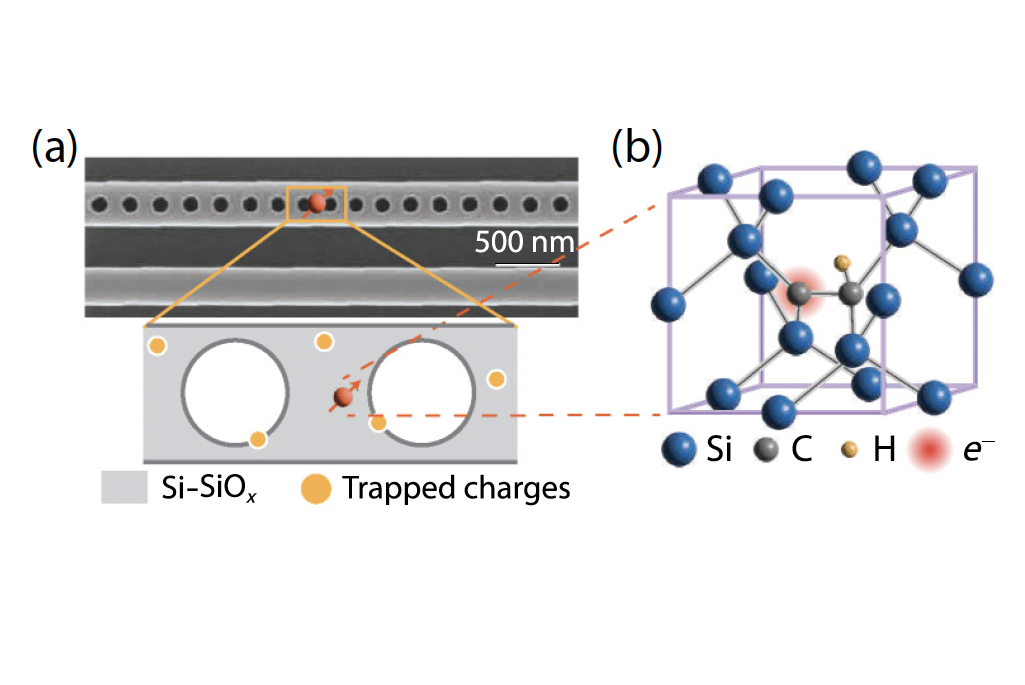
Scientific Achievement
New research provides the first detailed analysis of how the optical properties of T centers in silicon change over time after interacting with laser light. T centers, tiny defects introduced into silicon, show useful quantum features for applications in quantum information processing and quantum communication. One key achievement of the work is the successful measurement of laser-induced spectral diffusion effects on these T centers.
The work, a collaboration between ATAP, Berkeley Lab’s Materials Sciences Division, and the University of California, Berkeley, could lead to significant improvements in the efficiency of T centers, paving the way for their use in quantum networks.
Significance and Impact
Color centers in silicon are atomic-scale defects that function like artificial atoms and are promising building blocks for quantum networks. Among these defects, the T center is a promising candidate because it can connect quantum information stored in spins to photons at telecommunication wavelengths, making it ideal for transmitting quantum signals over long distances using existing fiber-optic infrastructure. In nanophotonic devices, however, T centers often exhibit spectral diffusion, leading to a shift in the color of their emitted light over time, which makes it challenging to produce identical photons for quantum communication.
The research has demonstrated the potential of T centers as long-lasting qubits for quantum communication and computation. By reducing spectral diffusion, the work could enable significant improvements in the efficiency of T centers, paving the way for their use in quantum networks.
Research Details
The research aims to understand when and why the emission frequency of T centers in a silicon photonic crystal cavity changes. To achieve this, they used a series of precisely timed optical pulses—a check pulse, a perturbation pulse, and a probe pulse—to quantitatively examine how T centers behave under different experimental conditions. The addition of the perturbation pulse was essential for simulating the conditions of optical pumping, which is crucial for initializing the spin states of T centers for quantum applications.
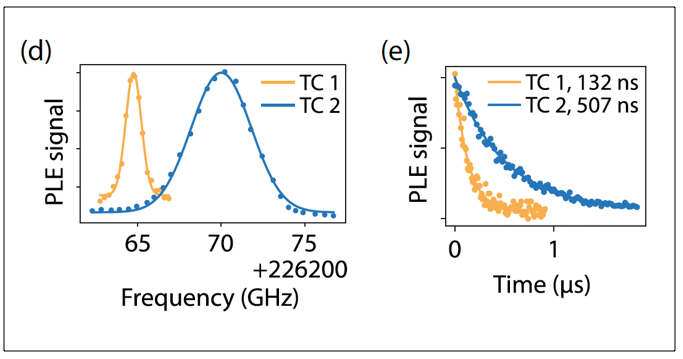
The optical-linewidth broadening of T centers. The (d) photoluminescence-excitation (PLE) spectra and (e) cavity-enhanced lifetimes of two T centers under study.
Using these two complementary measurement techniques—spectral hole burning to examine short-timescale effects and check-probe spectroscopy to monitor longer-timescale changes—they found that the emission frequency remains stable for at least 3 milliseconds in the absence of light. The primary cause of spectral diffusion, they concluded, was not intrinsic instability but the laser light itself: even sub-band-gap illumination, far from resonantly exciting the T center, can cause nearby charges to rearrange, shifting the emission frequency.
The researchers used a semiconductor optical amplifier to generate the required pulse shapes and durations while minimizing background interference, enabling them to measure both conditional and unconditional counts per pulse accurately and directly correlate them with spectral diffusion rates. They also employed variable optical attenuators and acousto-optic modulators to precisely control power and timing, further enhancing the reliability of their method.
The results showed that as the power of the perturbation pulse increases, conditional counts decrease, demonstrating the effect of laser light on spectral diffusion. Analyzing the power dependence in the experiments helped the researchers further their understanding of the interaction dynamics.
Contact: Alp Sipahigil
Researchers: Xueyue Zhang (formerly from the University of California, Berkeley, now at Columbia University); Niccolò Fiaschi, Lukasz Komza, Hanbin Song, and Alp Sipahigil (Berkeley Lab and the University of California, Berkeley); and Thomas Schenkel (Berkeley Lab)
Funding: This work was primarily supported by the U.S. Department of Energy, Office of Advanced Scientific Computing Research, Office of Science.
Publication: Xueyue Zhang (formerly at the University of California, Berkeley, now at Columbia University), Niccolò Fiaschi, Lukasz Komza, Hanbin Song, Thomas Schenkel, and Alp Sipahigil. “Laser-Induced Spectral Diffusion of T Centers in Silicon Nanophotonic Devices,” PRX Quantum 6, 030351 (2025). https://doi.org/10.1103/x2cv-2gcw
For more information on ATAP News articles, contact caw@lbl.gov.