
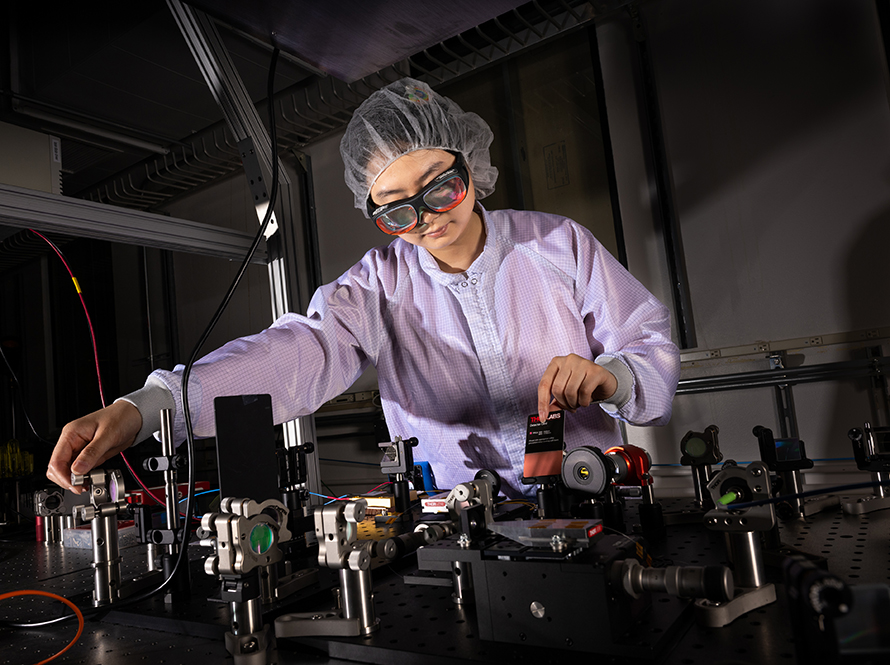
A scientist conducting research on coherent combining of fiber lasers at Berkeley Lab.
The Berkeley Advanced Laser Group is responsible for the R&D and implementation of fiber laser technologies and controls for particle accelerators and various applications.
High-pulse-energy, high-average-power lasers present many opportunities for new applications, including kilohertz laser-plasma accelerators for light sources and colliders, beam shaping and diagnostics at radio-frequency accelerator facilities, and diverse uses in material discovery, manufacturing, security, and medical treatment. One of the most promising laser technologies in this area is high-power/energy fiber lasers and their coherent combination, a method the Berkeley Lab team is developing with collaborators at the University of Michigan, Lawrence Livermore National Laboratory, and industry partners.
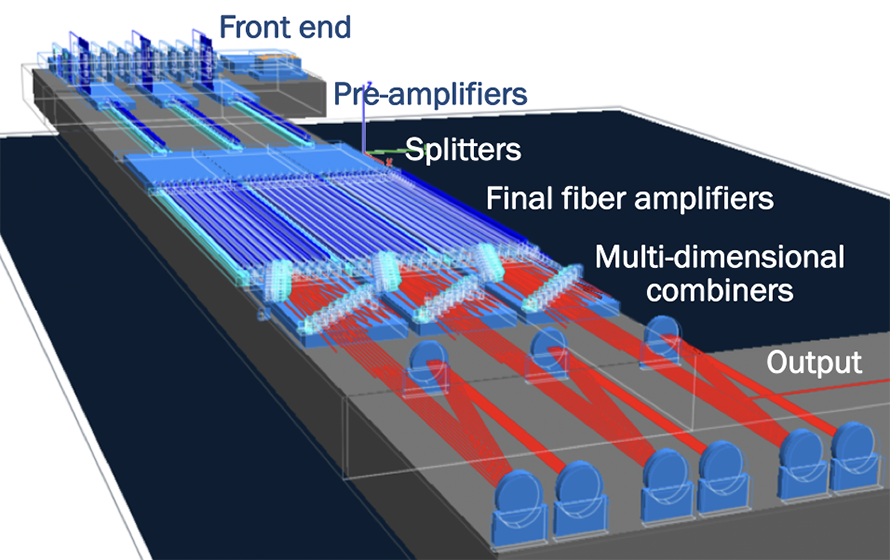
Layout of a 1 kW, 0.1 Joule ultrafast fiber laser (in construction) at Berkeley Lab.
Fiber lasers are the most efficient high-power laser technology to date. They excel in thermal management, beam quality, robustness, and integration. High-pulse-energy, short-pulse-duration operation can be achieved by multidimensionally combining amplified pulses from fiber laser arrays, which is modular and scalable. Such systems can achieve high precision by leveraging their inherent control flexibility and active feedback at high repetition rates, including through AI/ML.
Supporting DOE Office of Science missions, a flagship initiative is kBELLA, a next-generation kilohertz-repetition-rate and kilowatt-average-power laser and accelerator facility. Applications of fiber laser technology at radio-frequency facilities include advanced beam diagnostics and shaping (e.g., via laser-based outer-electron removal or exchange) at Fermilab PIP-II, Oak Ridge National Laboratory SNS, and the Future Circular Collider-ee, as well as synchronous pump-probe capabilities at SLAC LCLS-II and Berkeley Lab ALS-U.