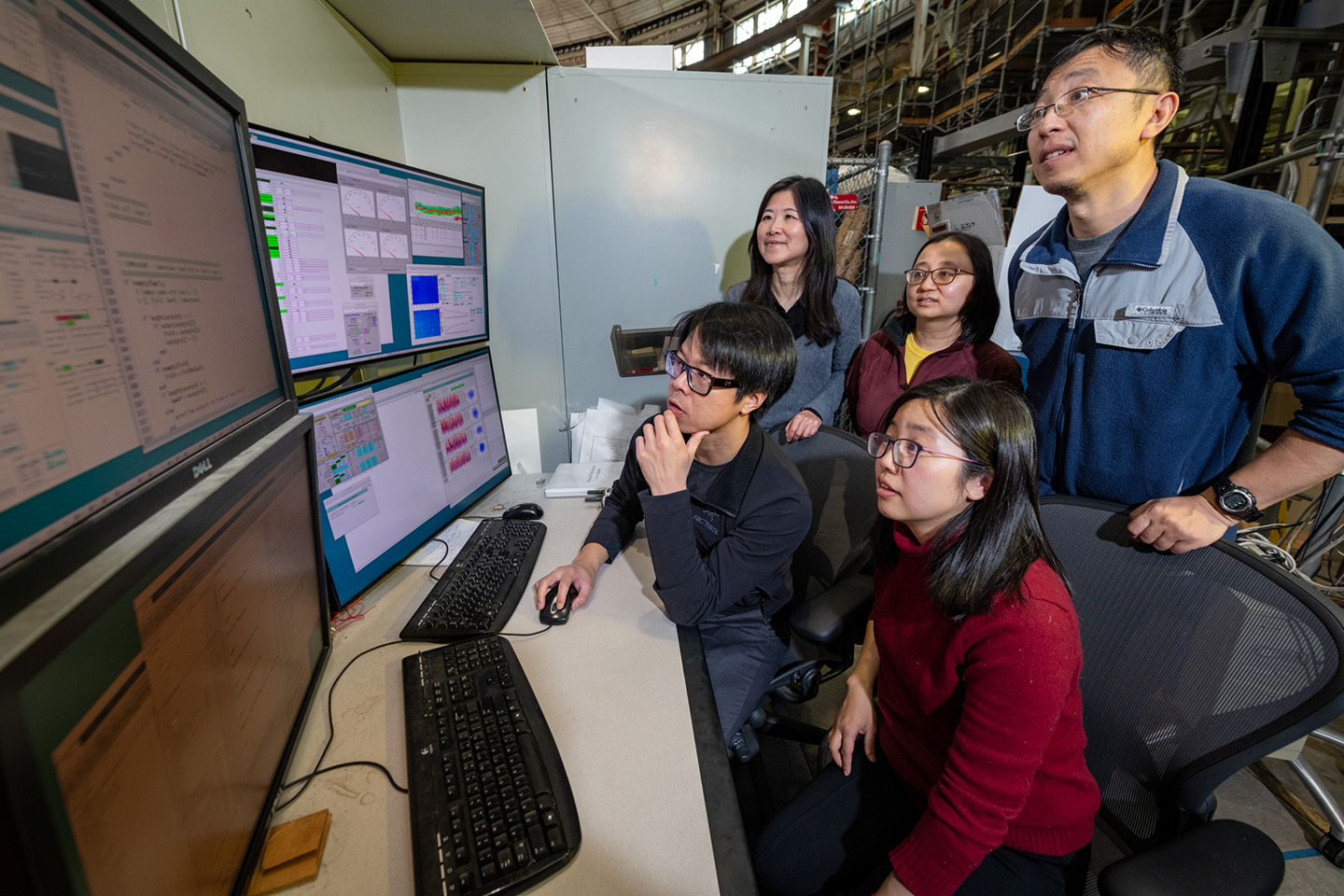
(l-r) Wei Liu, Qing Ji, Tianhuan Luo, Dan Wang, and Gang Huang analyze data to improve particle accelerator performance for the AI Genesis Mission project. (Thor Swift/Berkeley Lab)
Superconducting radio-frequency (RF) cavities store energy to accelerate particles at a single, precise frequency. They are so sensitive that even a small vibration or a shift in helium pressure can detune them, waste power, and potentially trip the machine off. This project will develop artificial intelligence- and machine-learning-based controllers to keep cavities at the correct frequency. Berkeley Lab’s Accelerator Technology & Applied Physics and Engineering Divisions will jointly develop the AI layer, which will run on the open-source low-level RF platform they are building. The project partners will share data and benchmarks so that what works at one facility can be applied across all facilities.