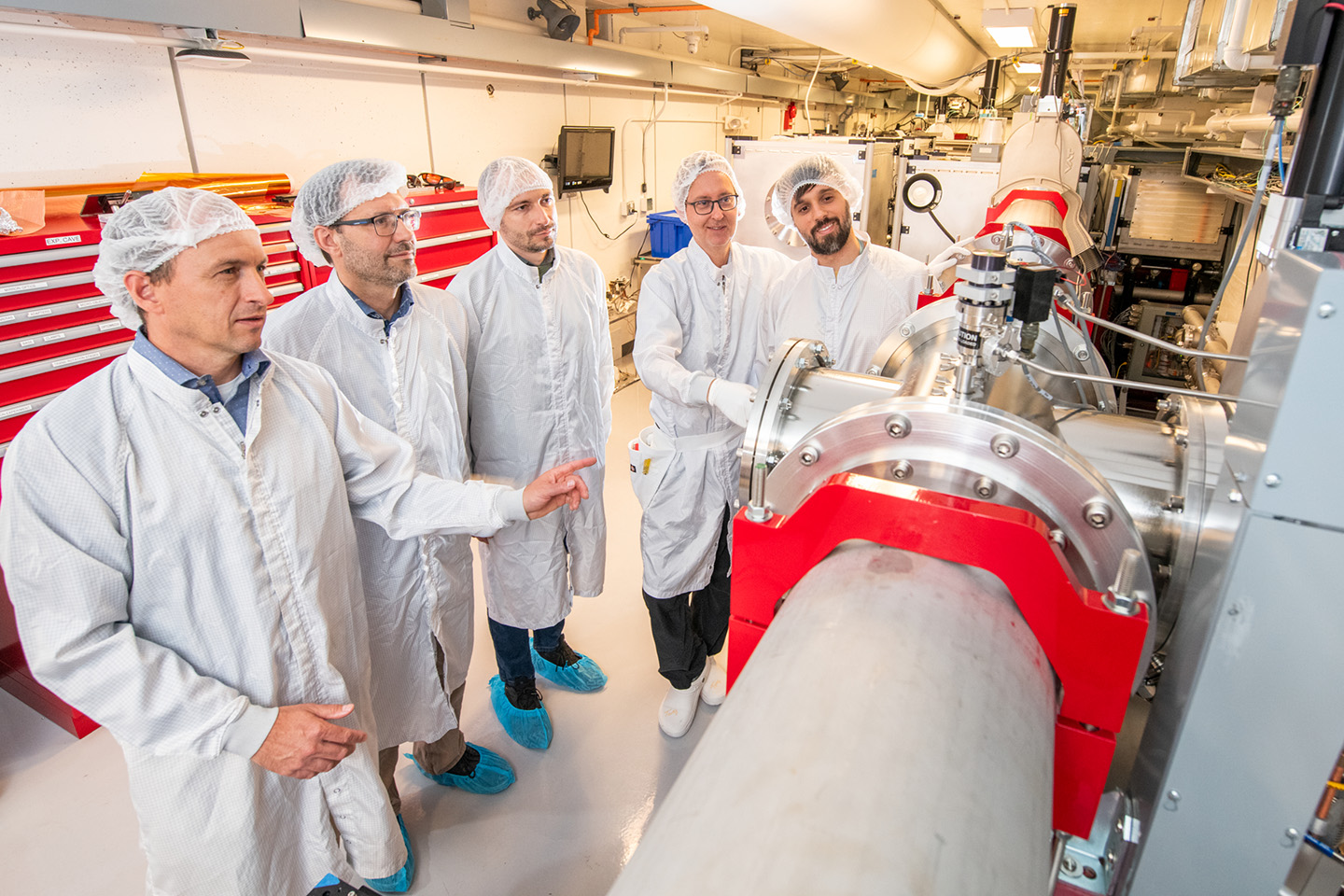
(l-r) Jeroen van Tilborg, Carl Schroeder, Stanimir Kisyov, Anthony Gonsalves, and Davide Terzani at ATAP’s BELLA Center, a key facility used in the AI Genesis Mission project. (Robinson Kuntz/Berkeley Lab)
The project will create an AI-enabled, multi-fidelity digital twin for laser-driven plasma acceleration, a compact method for generating energetic electrons, and an accessible, good model for others. This surrogate model of the laser-plasma accelerator will be modular, linking laser ionization and thermalization, hydrodynamic plasma-channel formation, and particle-in-cell wakefield acceleration. Trained on simulation datasets, the surrogate model’s predictions will be validated against historical experimental data. Developing this high-fidelity digital twin will enable rapid parameter optimization without running computationally expensive direct simulations and will support deployment as a real-time digital twin alongside high-repetition-rate laser-plasma accelerator experiments.