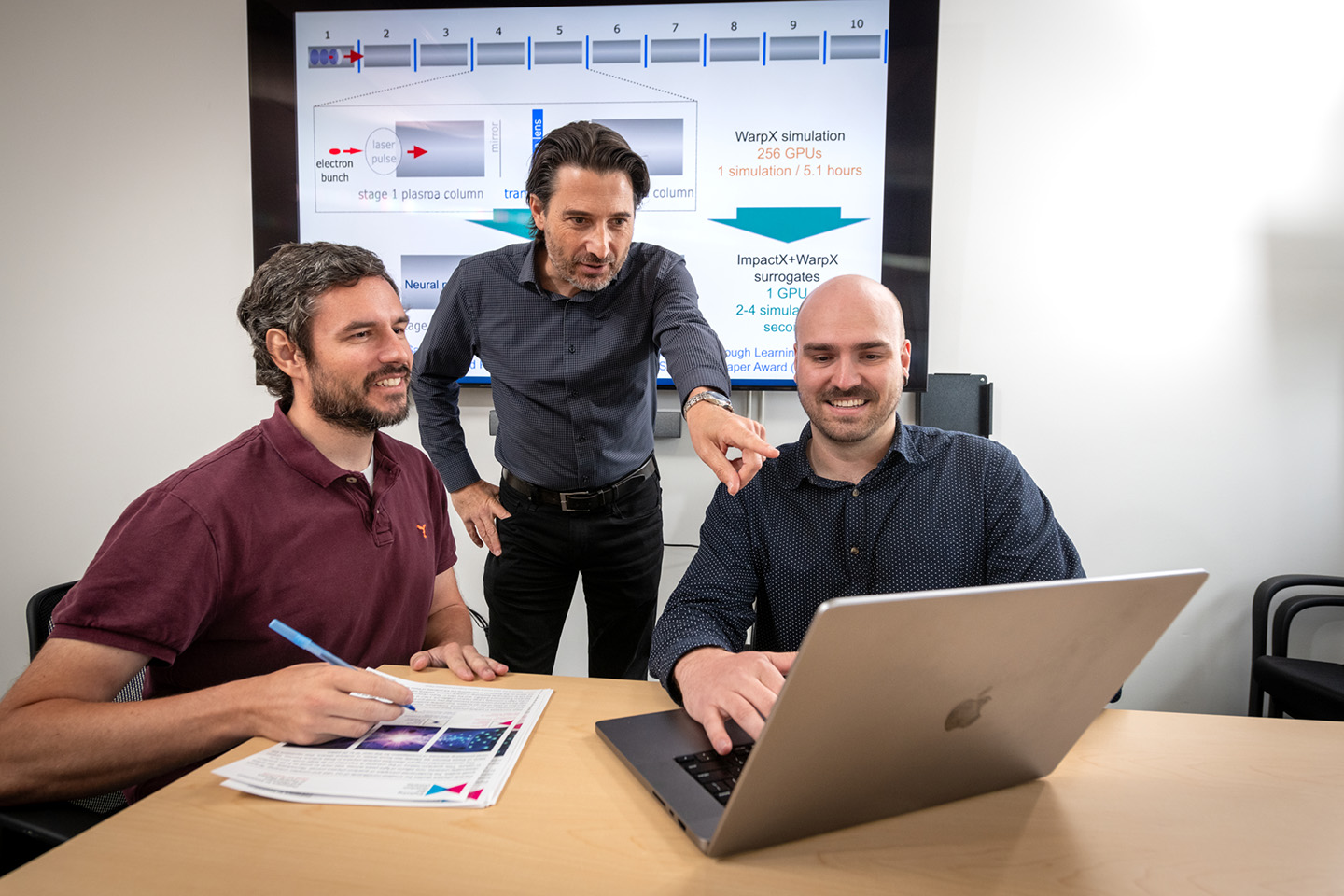
(l-r) Ryan Sandberg, Jean-Luc Vay, and Axel Hueb discuss simulations to improve particle accelerator performance as part of the AI Genesis Mission project. (Thor Swift/Berkeley Lab)
LaserNetUS facilities produce valuable laser-plasma and fusion data, but the know-how to interpret it can remain trapped in site-specific control systems, calibration details, and expert knowledge. Building a new diagnostic pipeline can take many months per facility. The project will use large language model agents, with curated facility context and validated tools, to automate diagnostic analysis, data triage and schema translation, and device onboarding for new experimental diagnostics. The nine-month demo will cover multiple diagnostics at collaborating facilities, targeting 5x faster analysis, timely cross-facility data transfer, and a common metadata schema. Success makes facility expertise portable rather than site-locked and sets up a Genesis Phase II national scale-up.