
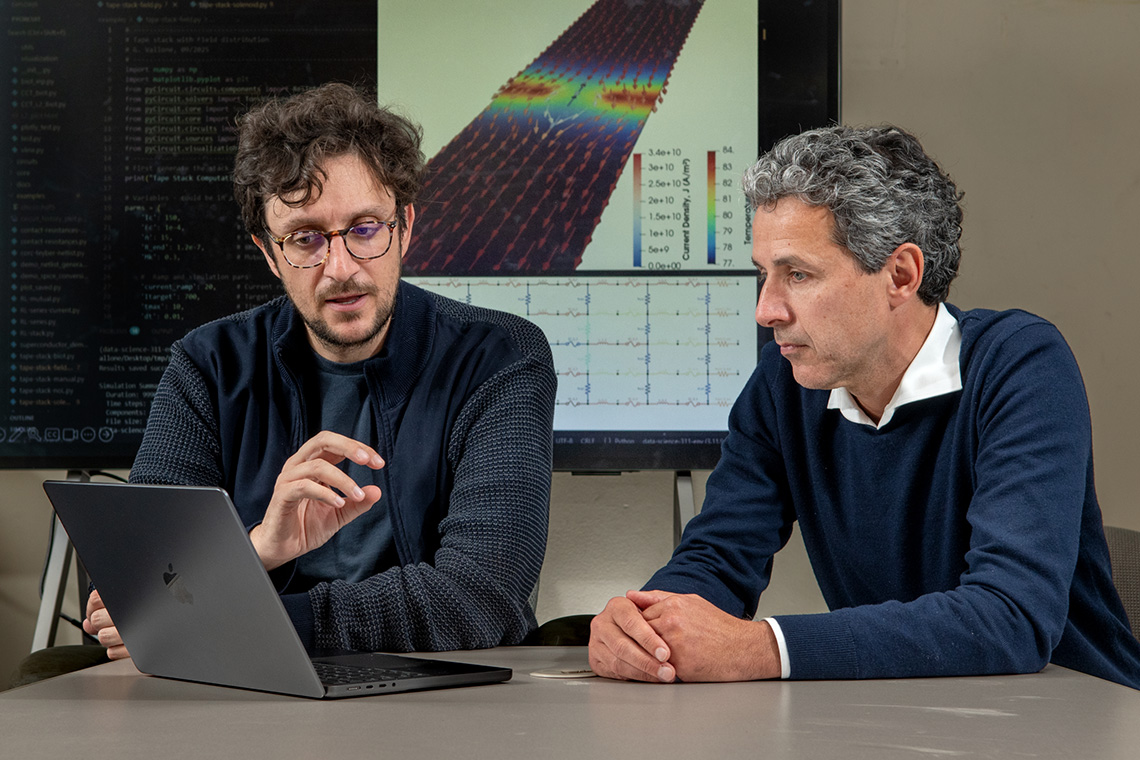
(l) Giorgio Vallone and Paolo Ferracin discuss their AI Genesis Mission project, which will use AI to develop reliable, safe superconducting magnets for fusion. (Thor Swift/Berkeley Lab)
High-temperature superconductors (HTS) are crucial to future compact magnetic-confinement fusion power plants. However, their reliability is limited by the difficulty of detecting defects and managing sudden, unpredictable losses of superconductivity—a phenomenon known as quenching—that can generate temperatures high enough to destroy the magnets, resulting in millions of dollars in damage. The project, a partnership among researchers from the Accelerator Technology & Applied Physics (ATAP) Division and Engineering Division at Berkeley Lab and their collaborators, will use artificial intelligence to integrate models and measurements into a “digital twin” that assesses the real-time risk of quenching-induced damage, helping protect and control HTS magnets in future fusion reactors.
