Berkeley Lab is a world leader in developing and applying state-of-the-art simulation, artificial intelligence, and machine learning (AI/ML) capabilities to tackle the immense complexities of fusion energy. Researchers use the Lab’s exascale computing resources at DOE labs, including the National Energy Research Scientific Computing Center (NERSC), to model everything from the fundamental behavior of plasma to the multi-physics, multi-scale dynamics of an entire fusion facility. This work is powered by advanced simulation codes. One of them—the Gordon Bell Prize-winning WarpX code—is being used to simulate several fusion energy concepts with unprecedented speed and fidelity.
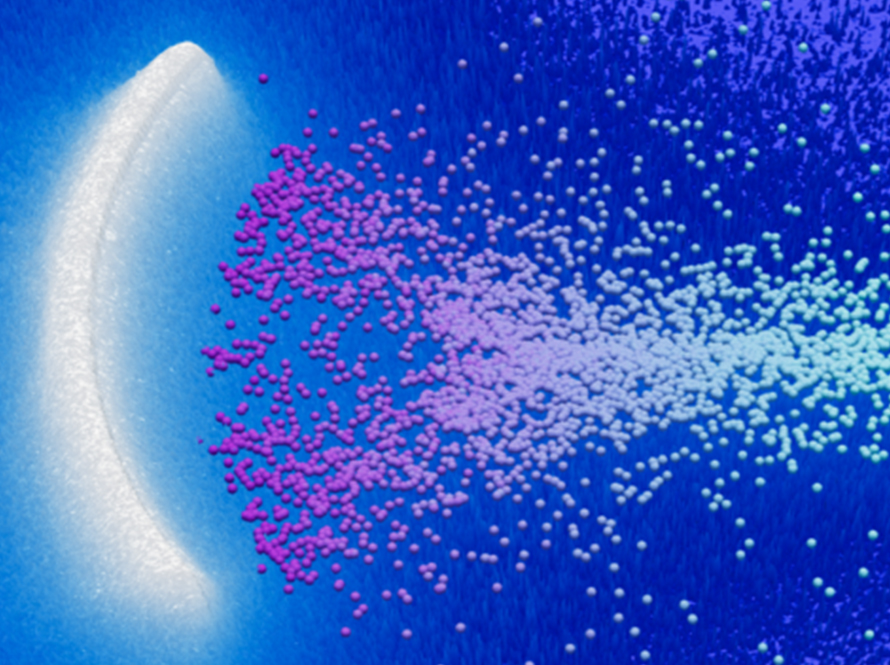
WarpX simulation of the generation of energetic protons for inertial-confinement fusion (proton-based fast ignition)
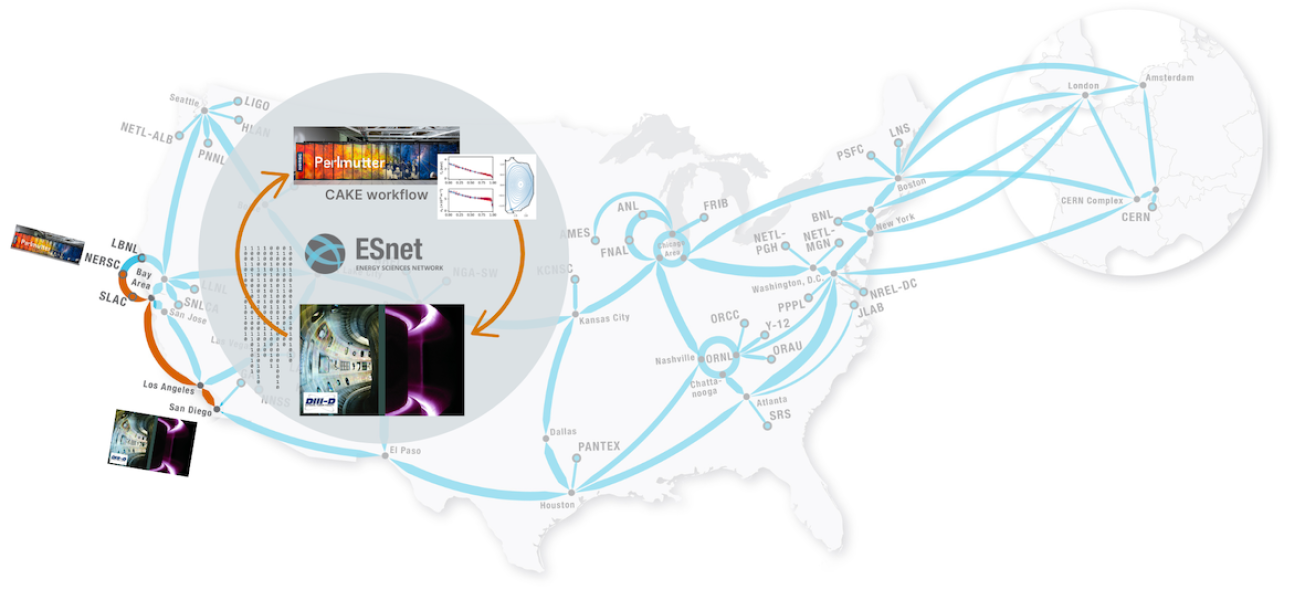
The Superfacility model connected the DIII-D tokomak and NERSC via ESnet, enabling DIII-D to send fusion experiment data to NERSC’s Perlmutter supercomputer for large-scale automated analysis and high-fidelity reconstruction of plasma pulses.
The Superfacility model connected the DIII-D tokomak and NERSC via ESnet, enabling DIII-D to send fusion experiment data to NERSC’s Perlmutter supercomputer for large-scale automated analysis and high-fidelity reconstruction of plasma pulses.
Beyond providing the raw computational power for these high-performance computing (HPC) simulations, the Lab is a pioneer in integrating these powerful codes with AI and ML. Leveraging HPC and AI/ML, researchers are developing data-driven methods to detect plasma instabilities, create fast, accurate surrogate models to augment simulations, and develop HPC-optimized frameworks for whole-facility modeling. This integration enables the creation of sophisticated digital twins of fusion reactors, providing real-time modeling and predictive capabilities to guide experiments and dramatically accelerate the design and optimization of future fusion power plants.