
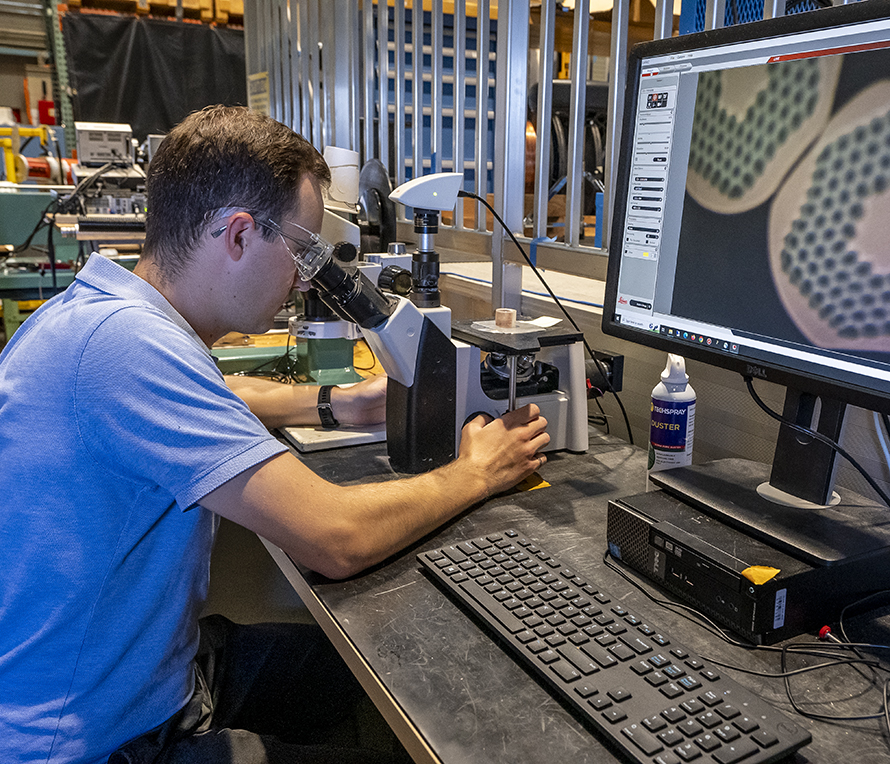
A BCMT researcher examines the microstructure of a multifilamentary superconducting wire. Our “from melt to magnet” understanding of superconducting technology has been vital to progress.
BCMT supports the DOE Office of Science through magnetics advancements in multiple areas. For example, high energy physics drives the development of superconducting accelerator magnets; light sources advance permanent magnet systems; and the emerging compact fusion industry requires advancements in REBCO-based magnet technologies. However, these technologies have broader uses, and in some cases, their applications can inspire new directions. BCMT aims to identify and support these opportunities by leveraging our expertise and facilities. Such opportunities often come from collaborations with industry, national labs, or international collaborators, and can lead to future programs or projects or create new capabilities for existing facilities.
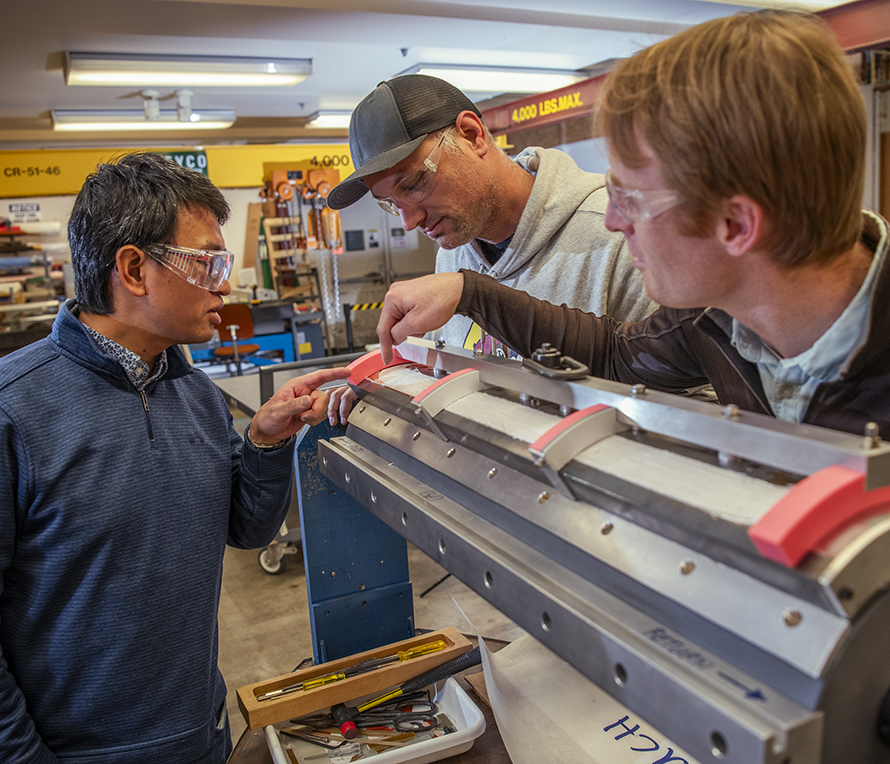
BCMT personnel adjust a prototype coil for a FRIB ECR-source magnet.
For example, superconducting magnet technology developed for HEP has been used to design, build, test, and deliver the Electron Cyclotron Resonance (ECR) source magnet for the Facility for Rare Isotope Beams (FRIB) at Michigan State University. The ECR source is the facility’s flagship, providing record ion charge states and ion current to enhance user science.
We are also constructing a state-of-the-art high-field dipole that will be a key component of a world-leading cable test facility at FNAL. This facility will enable cable testing and characterization in a high magnetic field for both fusion energy sciences and HEP. The system benefits from advancements made over the past two decades within the Superconducting Magnet Program and the broader accelerator magnet community, as well as the highest quality Nb3Sn conductor produced by industry to date.