
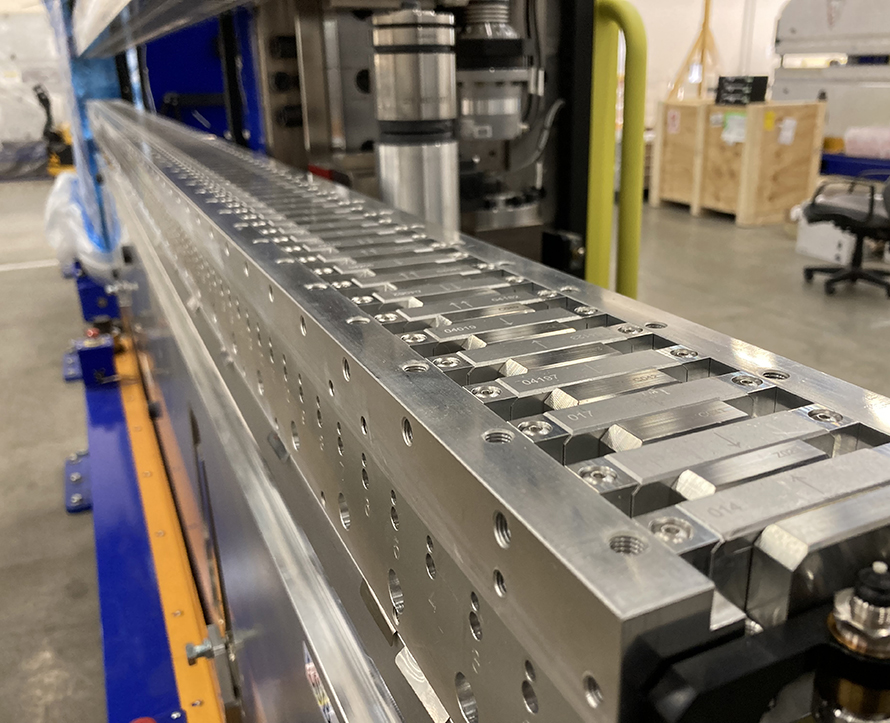
An undulator for LCLS-II HE shows the alternation of permanent-magnet blocks (with arrows) and pole pieces, as well as the massive machinery needed to make the gap between the upper and lower magnet arrays both precisely and reproducibly variable. (Photo courtesy Philip Mallon.)
Permanent-magnet systems such as undulators are key to the light sources, such as storage rings and free-electron lasers (FELs), that have become vital infrastructure for discovery science. Both ATAP and the Engineering Division’s Magnet Systems Department have extensive expertise in light-source magnet technologies, including the groundbreaking work of Klaus Halbach in the 1980s that led to the development of permanent magnet undulators and the rise of third-generation light sources. This pioneering work continued with developments such as the “Apple II” variable polarization undulators and more recent R&D into superconducting undulators, in particular using niobium-tin (Nb3Sn). At the same time, BCMT scientists spearheaded the development of hybrid permanent magnet undulators used in the Linac Coherent Light Source-II (LCLS-II) free electron laser and have led the design, fabrication, and delivery of the undulators for the LCLS-II High Energy (LCLS-II-HE) upgrade project.
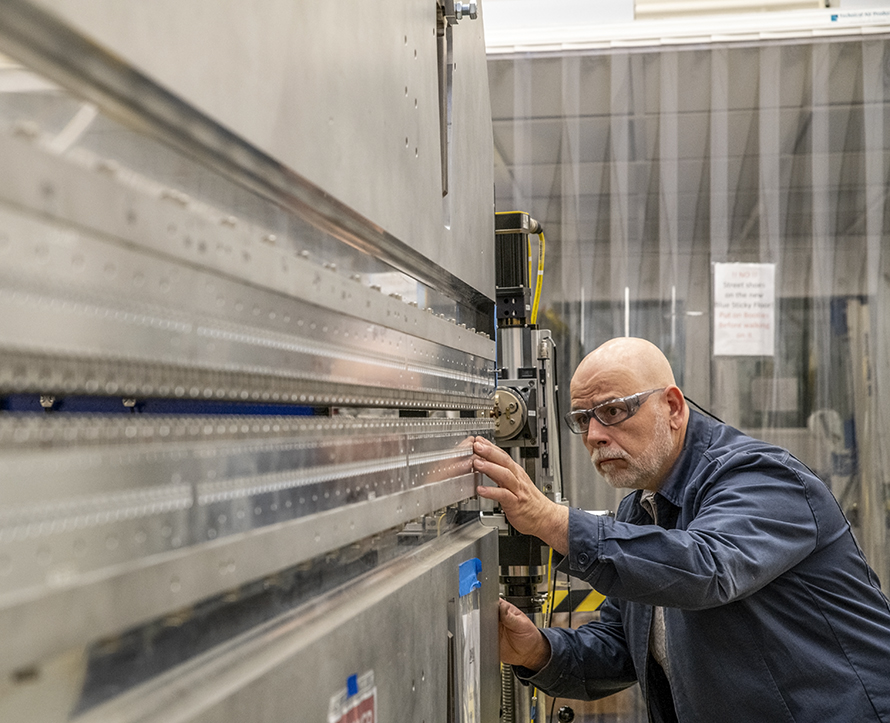
Tom Lipton performs checks on an LCLS-II undulator. The electron beam passes along the length of the device through the gap in the middle. The alternating-polarity blocks of powerful permanent magnets wring photons out of the electron beam in a way that forms intense beams of X-rays for user experiments.
BCMT scientists and engineers have expertise in modeling and optimizing permanent, hybrid, and superconducting undulator systems. They work closely with X-ray scientists to design the entire light source facility to meet the required spectrum and brightness needs, build the undulator systems with the necessary tuning capabilities, and measure and shim the undulator system to satisfy phase error and beam trajectory requirements. As the community advances toward the next generation of light sources, expertise in magnet technologies will play a key role in designing facilities with significantly enhanced capabilities.