
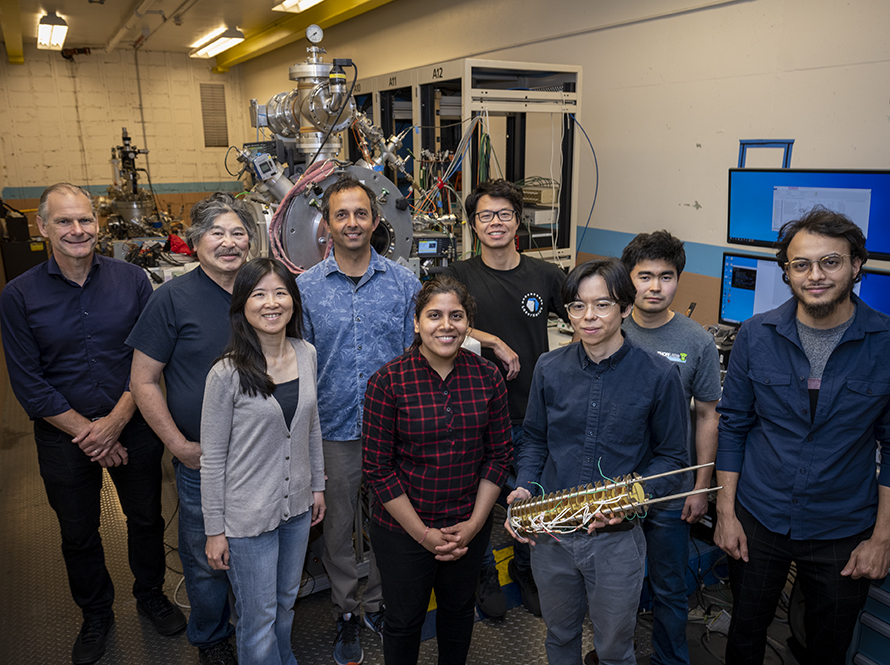
The research team with one of the ion accelerators that form quantum light emitters in silicon.
Applications of quantum information science in quantum sensing, networking, and computing rely on the precise control of highly coherent qubits. Color centers in semiconductors, such as silicon and diamond, are promising qubit candidates because they allow direct optical access. Silicon is especially promising due to its compatibility with traditional microelectronics manufacturing processes, which could potentially enable high-precision, scalable integration.
FS&IBT is researching novel qubit candidates and qubit synthesis approaches enabled by beams and plasmas, including advancements in traditional ion implantation and the use of femtosecond lasers and laser-driven ion pulses to create qubits and quantum materials. The work connects to the DOE Office of Science’s Quantum Application Network Testbed for Novel Entanglement Technology and several quantum sensing projects.
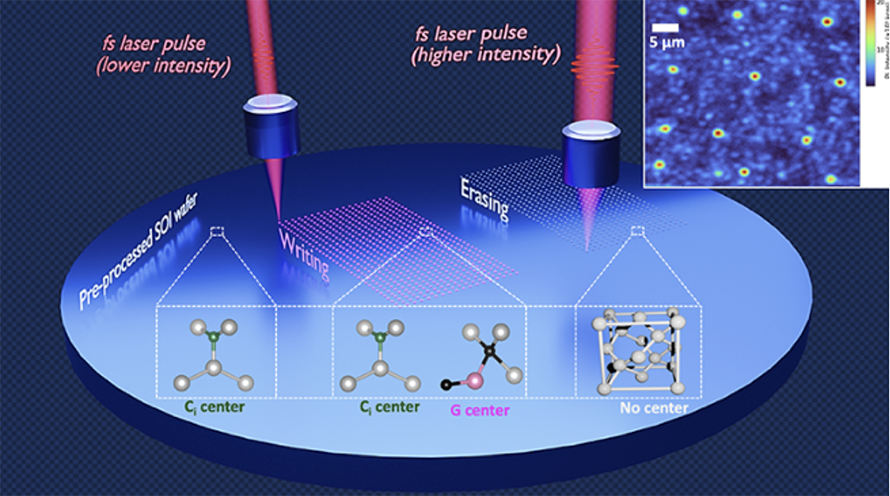
An artistic depiction of a new method to create high-quality color centers (qubits) in silicon at specific locations using ultrafast laser pulses (femtosecond, or one quadrillionth of a second). The inset at the top-right shows an experimentally observed optical signal (photoluminescence) from the qubits, with their structures displayed at the bottom.
Quantum sensing applications use the high sensitivity of qubits in coherent states. Working with colleagues from the University of California, Berkeley, and the Lab’s Physics Division, we are developing qubits that couple the spin of atoms with photons in semiconductors such as silicon and diamond.
These “color-center” qubits have applications in quantum sensing for detecting tiny energy transfers during rare events, such as dark matter searches and neutrino research, and for accurately measuring the quantum state of these entangled photons at a subatomic level.