High-power lasers are fueling scientific discovery and enabling new technologies and tools in manufacturing, medicine, and security. These lasers have wide-ranging applications, including the potential for increased intensity and improved control at facilities such as Fermilab’s PIP-II and Oak Ridge National Laboratory’s SNS through advanced beam diagnostics, beam shaping, stripping, and collimation to improve the performance of the Future Circular Collider-ee concepts. They can also provide synchronous pump-probe capabilities at light sources such as SLAC’s LCLS-II and Berkeley Lab’s ALS-U.
These lasers are also key to enabling next-generation laser-plasma accelerators for compact, high-performance light sources and future high-energy particle colliders, as well as to supporting pump-probe and other light-source applications.
However, realizing their full potential requires lasers that combine very high peak power with high average power, operate reliably at high repetition rates, and offer programmable control over pulse shape, timing, and synchronization. The Accelerator Technology & Applied Physics (ATAP) and Engineering (EG) Divisions at the Department of Energy (DOE)’s Lawrence Berkeley National Laboratory (Berkeley Lab) are jointly launching the Berkeley Advanced Laser Group (BALG) to deliver on this promise by turning ambitious ideas into practical tools for science, medicine, industry, and defense.
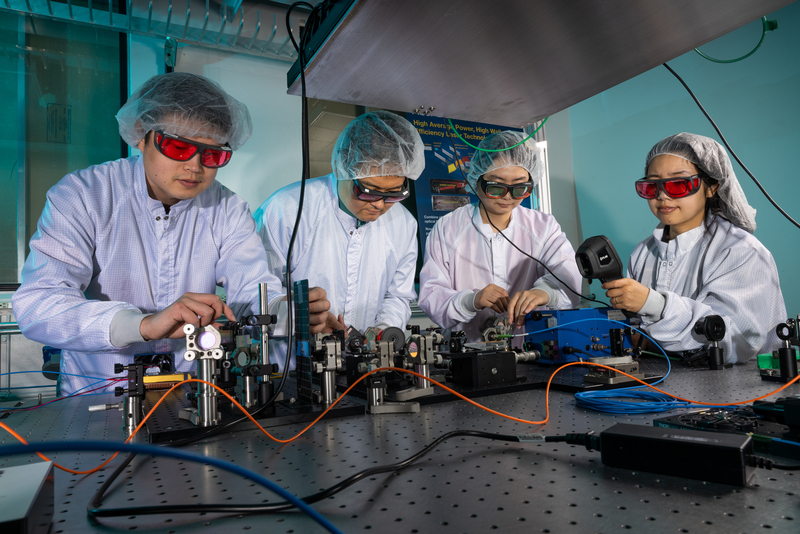
Tong Zhou, a staff scientist at ATAP’s BELLA Center, teamed up with Qiang Du, group leader of the EG Accelerator Technology Group and a member of the Berkeley Accelerator Controls & Instrumentation (BACI) Program, and others across all three programs, to form this expert group. Zhou is the head of BALG, with Du as the group deputy head. Each played a foundational role in the technology: Zhou received grants from the DOE Early Career Research Program (ECRP) and the Moore Foundation, starting in 2020, focused on high-energy combining, following his PhD on this topic, and Du led a DOE ECRP award starting in 2017, focused on controls for coherent combining.
The BALG team collaborated across ATAP’s BELLA Center, the BACI group, and the Engineering Division’s Accelerator Technology Group to develop BALG’s roadmap. Under their leadership, BALG aims to provide a powerful, versatile, programmable laser platform for diverse experiments and industrial applications and to train the next generation of scientists and engineers in high-power laser science and applications.
“BALG builds on and expands its existing partnerships, including those within the Lab, such as the Energy Sciences and Energy Technologies Areas and the Advanced Light Source Upgrade project, as well as those with other national labs, universities, and industry,” says Zhou.
Leveraging existing collaborations, the BALG network already includes the University of Michigan, Lawrence Livermore National Laboratory, Fermilab, Oak Ridge National Laboratory, Optical Engines, and nLight, among others. The network aims to translate BALG’s advances in fiber lasers, coherent combining, and AI-driven control into accelerator upgrades, diagnostic tools, and industrial applications—spanning fundamental physics experiments, real-world manufacturing, and medical applications. These efforts will complement and enhance current facilities, fostering collaborative development and broader adoption.

Zhou says the group’s primary goal is to advance high-power, precisely controlled fiber lasers from the lab to real-world applications, including accelerators and other uses. “Fiber lasers are the core platform because they offer efficiency, thermal management, beam quality, robustness, and a monolithic, scalable architecture, all essential for achieving both high peak and average power in a compact footprint.”
Fiber lasers’ direct-diode pumping and low quantum defect enable superior wall-plug efficiency—essential for scaling to multi-kilowatt average power. Their large surface-area-to-volume ratio also enables rapid heat dissipation. Additionally, fiber lasers maintain excellent beam quality and are well suited to compact, robust, monolithic designs.
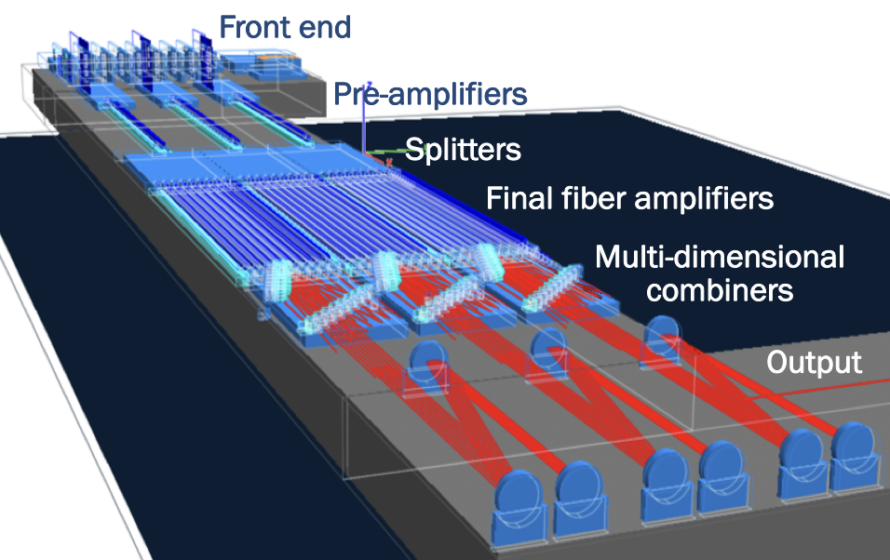
“BALG is developing methods to synthesize ultrafast, high-energy pulses by coherently combining fiber laser arrays using powerful control systems,” says Du. This approach, pioneered by Berkeley Lab and the University of Michigan (Professor Almantas Galvanauskas’s group), enables customized pulse shapes through programmable architectures and spatial, temporal, and spectral combination—producing pulse energies that far exceed those achievable with single fibers.
“This modular and scalable approach allows researchers to tailor energy, pulse duration, and repetition rate to the physics under study or the process being supported,” explains Zhou. The team has been developing these laser-combining methods in collaboration with colleagues at the University of Michigan, Lawrence Livermore National Laboratory, and industry partners.
The group uses AI- and machine-learning (ML)-based control systems that use feedback from laser diagnostics and application performance to optimize operations in real time. “This smart control is not a secondary feature; it is essential for achieving stable, optimized results at high power and high repetition rates—a requirement for both accelerator physics experiments and industrial applications,” says Du.
BALG is developing next-generation kilohertz-repetition-rate, kilowatt-average-power laser operation with ultrafast pulses at currently inaccessible energy levels. When coupled to a plasma accelerator, this enables precision performance through active feedback and the shot rates needed for applications ranging from light sources to future particle physics, as in the kBELLA initiative. This fiber-laser technology also aims to meet the demanding needs of upgrades to radio-frequency facilities and light sources.
Its strong track record and expertise position the group to advance these initiatives. For example, the team has achieved record-high energy amplification in single-mode operation of monolithically integrated fiber amplifiers; demonstrated a novel coherent beam-combining method using diffractive optics; shown coherent combination of 81 beams using Al/ML-based control; generated record-short pulses from spectrally combined ytterbium fiber lasers; and demonstrated temporal coherent pulse stacking of ultra-broadband pulses.
The group is developing a 100-millijoule-class fiber laser system capable of producing tens-of-femtosecond (one millionth of one billionth of a second) pulses at multi-kilohertz repetition rates and kilowatt-class average power, with coherent combination to achieve new levels of performance. This program aims to push fiber laser pulse energy and peak power toward new records, establishing a path to beam shaping and stripping to increase intensity for current accelerator facilities, to new pump-probe capabilities, and to enabling multi-kilohertz laser-plasma acceleration and related technologies.
The work aims to accelerate progress in laser-plasma accelerators, particle-beam diagnostics and manipulation, and new light sources, and to enable broad, transformative capabilities across industry, medicine, and security. With an expanding network of collaborators at Berkeley Lab and worldwide, BALG aims to push the frontiers of high-power lasers and translate ambitious science into practical tools for society.
For more information on ATAP News articles, contact caw@lbl.gov.