

Quantum Information Science, or QIS, is a transformative field with the potential to revolutionize global security, drug discovery, materials science, and more. However, realizing this potential depends on overcoming significant challenges in qubit fabrication and the precise control and measurement of quantum states at the atomic level.
The Accelerator Technology & Applied Physics (ATAP) Division at Lawrence Berkeley National Laboratory (Berkeley Lab), in collaboration with researchers across the Lab and beyond, is at the vanguard of the QIS revolution. Leveraging decades of experience in particle accelerator technology, ATAP is applying this expertise to connect fundamental research with engineering-grade quantum technologies. The division’s specialized infrastructure—including high-powered petawatt lasers, neutralized drift-compression ion beams, and advanced radio-frequency control electronics—provides a crucial platform for creating, controlling, and reading quantum states, which are essential for ushering in the quantum era.
Here are some ways ATAP and its partners are advancing the frontiers of QIS, with ongoing efforts to overcome existing challenges and realize practical applications, ensuring the research’s relevance to real-world needs.
Qubit Synthesis and Quantum Materials: Defect Engineering in Semiconductors
While the concept of a quantum revolution is exciting, developing reliable, robust, and scalable quantum bits (qubits)—the core components of quantum technologies—remains a major challenge.
To tackle this challenge, researchers from ATAP’s Fusion Science & Ion Beam Technology (FS&IBT) Program, working with colleagues from the University of California, Berkeley, are leading efforts at the Berkeley Lab Laser Accelerator (BELLA) Center, a world-renowned hub for high-power laser science and applications, to create tiny defects in semiconductors such as diamond and silicon. These microscopic defects can couple photons to the spin states of electrons and nuclei, forming “color-center” qubits, which are emerging as ideal candidates for quantum applications, including single-photon sources and quantum networks—secure communication systems that connect quantum devices.

ATAP researchers have also demonstrated a programmable method for creating color-center qubits by doping silicon crystals with hydrogen using high-intensity, ultrafast laser pulses. This laser-ion doping technique “programs” the formation of telecom-band qubits in silicon, which, due to silicon’s compatibility with traditional microelectronics manufacturing processes, could enable high-precision, scalable integration. This advance could enable quantum computers that utilize programmable optical qubits for a future quantum internet.
Unlocking the promise of quantum computing, however, requires connecting these qubits in the thousands or even millions—an immense challenge due to the high sensitivity of color-center qubits to external forces, which can cause them to decohere (lose their quantum state).
A collaboration among researchers from FS&IBT, the Berkeley Accelerator Controls and Instrumentation (BACI) Program at ATAP, and the Lab’s Molecular Foundry has used the Universal Linear Accelerator at the Helmholtz Center for Heavy Ion Research in Darmstadt, Germany, to direct 1-GeV gold and uranium ion beams onto a single-crystal nitrogen-doped diamond. As these high-energy, heavy ions—known as swift heavy ions (SHI)—move through the diamond, they excite and ionize electrons in the lattice structure via a process called electronic stopping, which transfers energy to the lattice atoms.
These SHI provide high-density entanglement, with nanometer-scale spacing that enables electron-spin entanglement necessary for encoding and transmitting quantum information along a one-dimensional chain of color-center qubits. The technique, which builds on and expands the Lab’s research on defect engineering in semiconductors, could pave the way for devices such as quantum registers for future quantum computers.
This work is primarily supported by funding from the U.S. Department of Energy’s Office of Science, Office of Fusion Energy Sciences. Work at the Molecular Foundry was supported by the Office of Science, Office of Basic Energy Sciences. The optically detected magnetic resonance experiments were performed at the Geoscience Quantum Sensing Laboratory at Berkeley Lab, supported by the Office of Science, Office of Basic Energy Sciences, Chemical Sciences, Geosciences, and Biosciences Division.
Quantum Sensing: The Search for Dark Matter
Researchers from FS&IBT have proposed a new approach to detect low-mass dark matter (below 1 GeV). Using quantum sensing to monitor the spin of helium-3 (3He) atoms, they can detect tiny energy transfers from dark matter interactions. The process involves quantum evaporation of 3He atoms triggered by phonon interactions, measured through nuclear spin-induced decoherence of an electron in a spin-based quantum sensor.
The work, a collaboration among researchers from FS&IBT, Princeton University, and the California Institute of Technology, is part of a multi-divisional project led by Berkeley Lab’s Physics Division. This effort focuses on detecting dark matter at energy ranges below 1 GeV, including the TESSERACT collaboration led by Dan McKinsey of the Lab’s Physics Division. It promises a new technique that extends the search for dark matter into mass ranges below the detection thresholds of current detectors and could lead to more powerful sensors for use in particle physics, astrophysics, and cosmology.
The research was funded by the Department of Energy Office of High Energy Physics through the Quantum Information Science Enabled Discovery (QuantISED) program. Maurice Garcia-Sciveres, a senior scientist in the Physics Division, leads QuantISED.
Qubit Control and Measurement: QubiC, Machine Learning, and Error Reduction
Superconducting qubits are among the leading platforms for scalable quantum computing. However, superconducting qubits can only maintain their quantum state (“coherence”) for a very short period, and current methods for accurately measuring their quantum state, then reading and transmitting this information to a computer—an essential step for processing quantum information—are slow and prone to errors.
Additionally, as the number of qubits needed for practical quantum computing increases, the cost, size, and complexity of qubit-control and measurement systems also grow. These limitations hinder the advancement of superconducting quantum circuits for scalable quantum computing.
Led by researchers from ATAP’s BACI program in collaboration with the Lab’s Applied Math and Computational Research Division in the Computing Sciences Area and the Quantum Nanoelectronics Lab at the University of California, Berkeley, the Quantum Bit Control (QubiC) system is the first open-source controller for superconducting quantum processing units since 2018. A modular control system, QubiC, includes digital-to-analog converters to generate radio-frequency pulses for controlling qubits, analog-to-digital converters to measure qubit responses, and digital signal-processing units on standard electronic control circuits known as field-programmable gate arrays (FPGAs) to analyze the data.
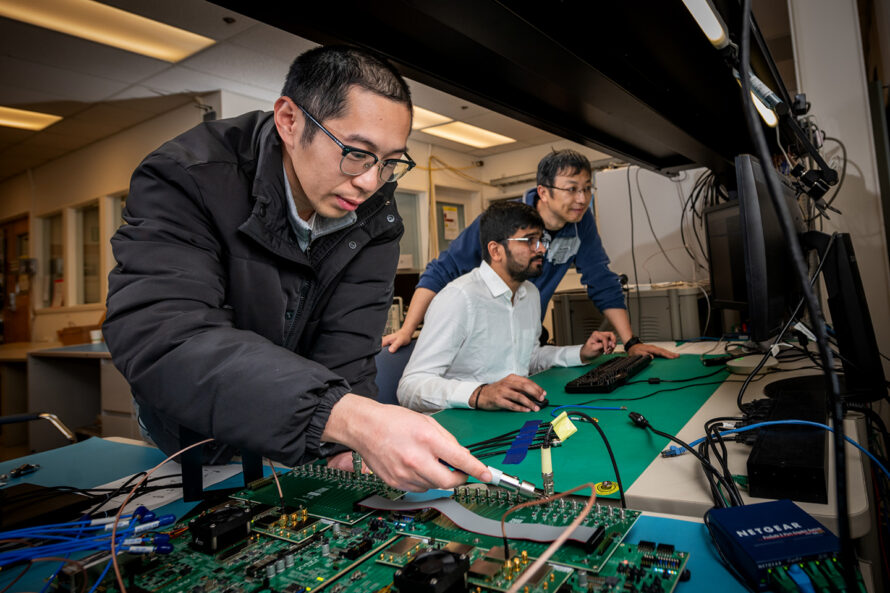

Because the system is open source, its complete code stack can be accessed, improved, and used by the broader QIS community. Its development into QubiC 2.0 added mid-circuit measurement and feed-forward capabilities, enabling conditional operations crucial to quantum error correction.
Building on and expanding QubiC’s capabilities, QubiCML combines machine learning with the FPGA. Developed by researchers from BACI, along with colleagues from the University of California, Berkeley, and the University of Massachusetts Amherst, QubiCML allows real-time state discrimination with an inference time of just 54 nanoseconds and an average readout accuracy of 98.46%. Additionally, the readout time is only 500 nanoseconds, which is substantially faster than the superconducting qubit’s coherence time and is considered cutting-edge in the quantum computing field. By performing state discrimination within the coherence window of superconducting qubits, QubiCML enables the low-latency feedback necessary for sophisticated quantum algorithms.
Open-source control systems, such as QubiC and the patented QubiCML technology, are essential for advancing scalable quantum computing by providing a method for real-time state discrimination. It offers the quantum community a valuable tool for exploring and developing advanced quantum algorithms and applications.
A new partnership between Berkeley Lab and NVIDIA is harnessing QubiC and NVIDIA’s NVQLink, a high-speed interconnect that connects quantum processors to leading supercomputing labs. The integration of these cutting-edge technologies enables the rapid transfer of large data volumes, helping researchers meet the massive computational demands of quantum error correction. This work, which is essential for providing stable, reliable qubits for quantum computers to perform advanced applicationsalso aligns with new research on automating the discovery, optimization, and control of quantum circuits led by our Advanced Light Source Accelerator Physics Program.
The development of the QubiC system was supported by the Advanced Quantum Testbed and the Quantum Systems Accelerator, both hosted at Berkeley Lab and funded by the U.S. Department of Energy (DOE)’s Office of Science, Office of Advanced Scientific Computing Research, the Quantum Information Science Enabled Discovery program funded by the DOE’s Office of Science, and the DOE’s Office of Science Laboratory Directed Research and Development program.
To learn more
Color Center Qubits Could Illuminate the Path to a Quantum Future
Lasers, Ions, and Silicon: Expanding the Toolkit and Building Blocks for Quantum Information Science
Bringing the Quantum Internet One Step Closer
Supporting National Efforts To Advance Quantum Technologies
New Technique Could Help Build Quantum Computers of the Future
Quantum Sensing: Shedding New Light on Dark Matter
Machine Learning Accelerates Progress Toward Scalable Quantum Computers
QSA Drives Breakthroughs with Superconducting Qubits
Open Sourced Control Hardware for Quantum Computers
For more information on ATAP News articles, contact caw@lbl.gov.