
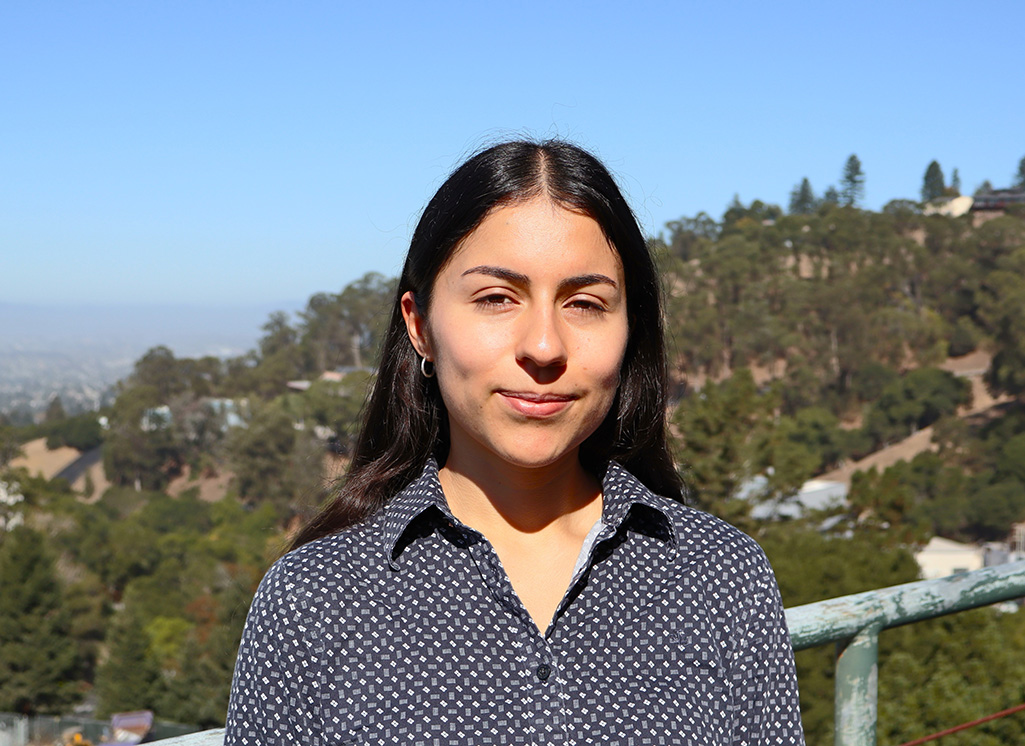
Claudia Navarro, a doctoral student at Tufts University in Medford, Massachusetts, has been selected as a Department of Energy (DOE) Office of Science Graduate Student Research (SCGSR) Program scholar. Navarro will join researchers at the Berkeley Center for Magnet Technology, a center of excellence for superconducting magnet technologies that brings together design, fabrication, instrumentation, testing, and project expertise from researchers in the Accelerator Technology & Applied Physics (ATAP) and Engineering Divisions at Lawrence Berkeley National Laboratory (Berkeley Lab) for a yearlong research project.
The SCGSR program prepares doctoral students for career success in fields that support the DOE Office of Science mission. This includes “delivering scientific discoveries and tools that help advance the country’s energy, economic, and national security.” The program is sponsored by the Office of Science’s Office of Workforce Development for Teachers and Scientists, in collaboration with the DOE national laboratories.
Navarro says, “Winning the award is meaningful for two reasons. First, it has given me the opportunity to return to Berkeley Lab. My experiences at Tufts and Fermilab have been invaluable to my research and professional development, but Berkeley Lab is unique. I may be speaking for more than just myself when I say that Berkeley Lab is a place one always wants to return to. Second, the award is an encouraging sign that I am headed in the right direction in my research.”
The SCGSR fellowship “is a highly prestigious award, and having Claudia join us is a tremendous benefit for our group,” says Paolo Ferracin, deputy head of SMP and co-supervisor of Navarro’s research. “This is a fantastic opportunity for both Claudia and our team to collaborate on developing the next generation of superconducting magnets based on new and advanced superconducting materials.”
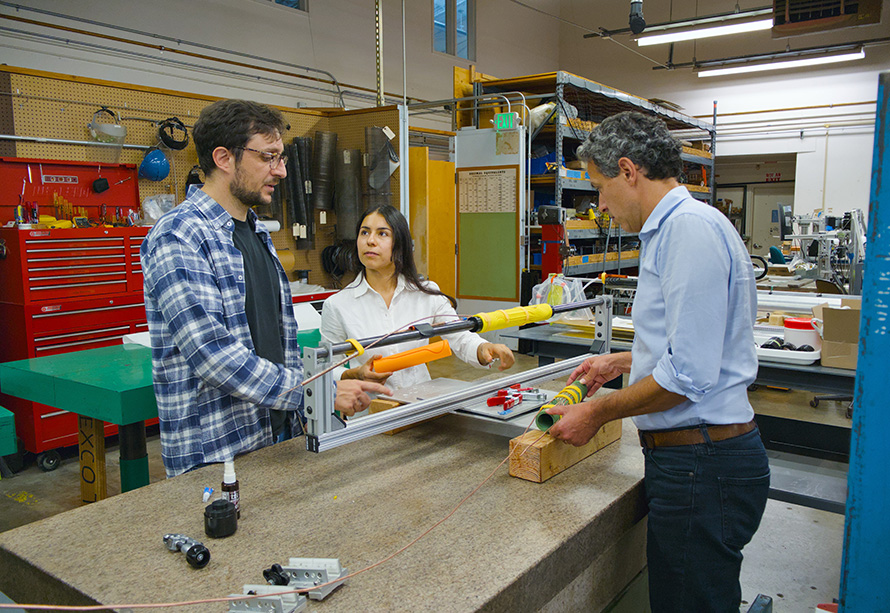
(l-r) Giorgio Vallone, Claudia Navarro, and Paolo Ferracin at Berkeley Lab’s Magnet Test Facility. (Credit: Matthew Fullmer/Berkeley Lab)
Navarro’s research focuses on high-temperature superconductors (HTS) based on rare-earth barium copper oxide (REBCO) as part of the U.S. Magnet Development Program (USMDP). Supported by the DOE Office of High Energy Physics and managed by Berkeley Lab, the USMDP aims to maintain and strengthen U.S. leadership in high-field accelerator magnet technology for future colliders, further develop and integrate magnet research teams across partner national laboratories and universities, and identify and nurture cross-cutting and synergistic activities with other programs, such as Fusion.
“We are focused on developing manufacturing methods for HTS accelerator magnets, particularly those based on REBCO tapes,” explains Navarro. “As these conductors reach higher current densities, the challenge becomes increasingly mechanical because of their brittleness.”
“The SCGSR program gives students like Claudia access to the facilities and expertise to turn their research ideas into experiments they can build and test,” says Giorgio Vallone, a research scientist in Berkeley Lab’s Engineering Division and co-supervisor of Navarro’s research.
“That experience is invaluable for a young researcher. For our team, working with Claudia is an opportunity to advance the science behind REBCO magnets, a key technology for future particle colliders and fusion power plants.”
Navarro says the research aims to address both the mechanical and electrical challenges posed by these conductors. This includes exploring methods, such as metal impregnation, that would mechanically support them and improve their electrical stability; for example, in multi-tape cables, such as twisted stack tape cables or conductor-on-round-core cables, metal impregnation may improve current sharing between tapes.
“Understanding the current redistribution in these multi-tape configurations is important because the behavior is not yet fully understood,” says Navarro, adding that the end goal is to support the design of next-generation superconducting magnets by making HTS-based technologies safe and reliable.
“What excites me most about working at Berkeley Lab is the people,” she continues. “I am very fortunate to work in the magnets group, which I feel has a strong sense of purpose and clear direction from leadership. Perhaps more importantly, the team of students, engineers, technicians, and scientists embodies the spirit of team science.”
For more information on ATAP News articles, contact caw@lbl.gov.
