
Key Takeaways
- Operating a free-electron laser (FEL) driven by a laser-plasma accelerator continuously for a record eight hours without operator intervention marks a significant milestone in developing plasma accelerators for real-world applications.
- The breakthrough could help advance the development of smaller, cheaper, and more powerful radiation sources for research, including compact X-ray FELs and high-performance electron injectors for current facilities.
- These advanced light sources could support advancements in physics, chemistry, biology, materials science, and many other fields.
Advanced particle accelerators, known as laser-plasma accelerators (LPAs), have emerged as promising sources of compact, high-quality electron beams for next-generation light sources, such as X-ray free-electron lasers (FELs). These light sources can produce ultrashort, high-brightness X-rays, allowing scientists to create “molecular movies” that capture atomic and molecular motion in real time. However, historically, instabilities in the LPA’s electron beam have posed significant challenges to developing LPA-driven light sources and systems.
The successful operation of an LPA-driven FEL for eight hours straight without intervention marks a critical milestone toward maturing the LPA as a robust accelerator system component and toward developing smaller, more affordable, and more reliable light sources for diverse fields such as the semiconductor industry, medicine, and security.
The research, reported in Physical Review Accelerators and Beams, a journal of the American Physical Society, was led by the researchers at the BELLA Center in the Accelerator Technology & Applied Physics (ATAP) Division and the Engineering Division at the U.S. Department of Energy’s Lawrence Berkeley National Laboratory (Berkeley Lab), in collaboration with TAU Systems, a U.S.-based technology company.
“This is the first time that this level of stability for a FEL driven by LPA has been demonstrated over such a long period,” says Finn Kohrell, a BELLA postdoctoral researcher and lead author of the paper.
“Maintaining FEL stability for a record eight hours represents a significant advancement in LPA-driven FELs and provides deeper insights both into achieving optimal FEL performance and into validating LPAs as high-brightness injectors, which is crucial for LPA application in future light source facilities.”
Active stabilization
The key to unlocking the LAP’s potential for future light sources is maintaining stable, high-power drive lasers. Any instability in these lasers directly degrades the generated electron beam, thereby impacting performance. However, these lasers are highly sensitive devices, and even minor disturbances can cause instabilities.
For example, mechanical vibrations from nearby lab machinery, temperature fluctuations as components heat or cool, air turbulence from air conditioning, and even people moving around can all cause shifts in the laser’s optical parts, leading to laser instability.
“The difficulty of stabilizing the laser mainly arises from the fact that key laser parameters controlling its operation are highly interconnected and very sensitive to non-linear effects,” explains Kohrell.
Understanding and optimizing these interconnected parameters, he says, requires a comprehensive approach that actively stabilizes key laser properties, because even small shifts in any of these can degrade the LPA’s performance. These include the transverse (side-to-side and up-and-down) and longitudinal (focus position relative to the target) positions of the laser, as well as adjustments to many other parameters.
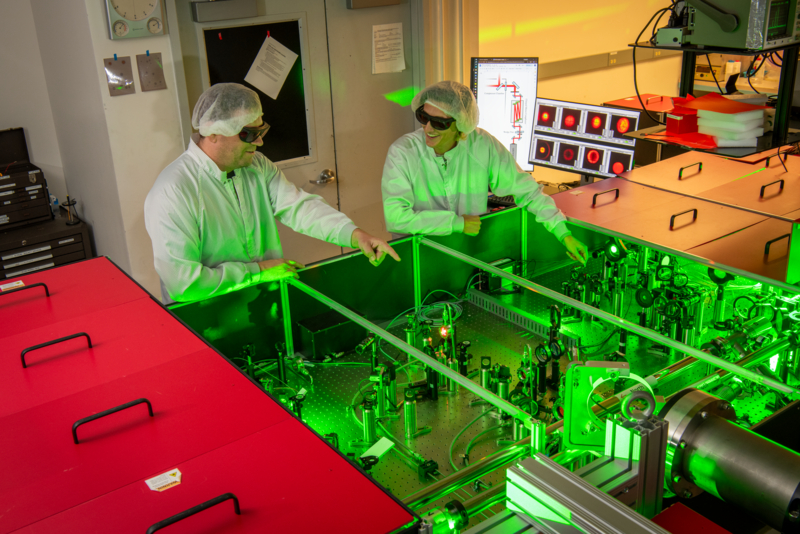
To achieve this, the researchers installed a set of advanced active stabilization systems on the Hundred-Terawatt Undulator (HTU) beamline at ATAP’s BELLA Center. This state-of-the-art laser facility can generate 100-terawatt laser pulses lasting tens of femtoseconds (a millionth of a billionth of a second) at a repetition rate of 1 Hz.
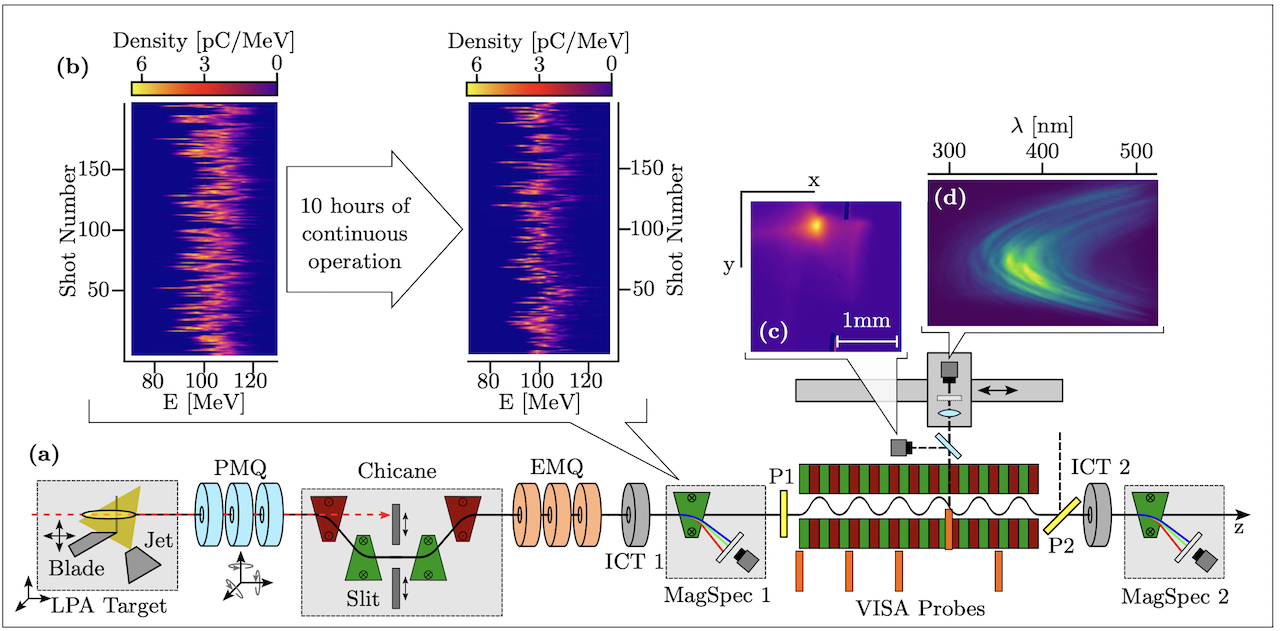
The experimental setup involved passing laser pulses through multiple amplification stages and focusing them onto a supersonic gas jet, creating a density shock that accelerates electrons to approximately 100 MeV. These electron bunches then pass through a permanent-magnet quadrupole triplet, a magnetic chicane, and an electromagnetic quadrupole triplet before entering the undulator, which generates FEL radiation at 420 nanometers (nm).
“The laser’s longitudinal focus position relative to the gas target is critical for achieving a stable electron beam; however, this would drift during experiments,” says Kohrell.
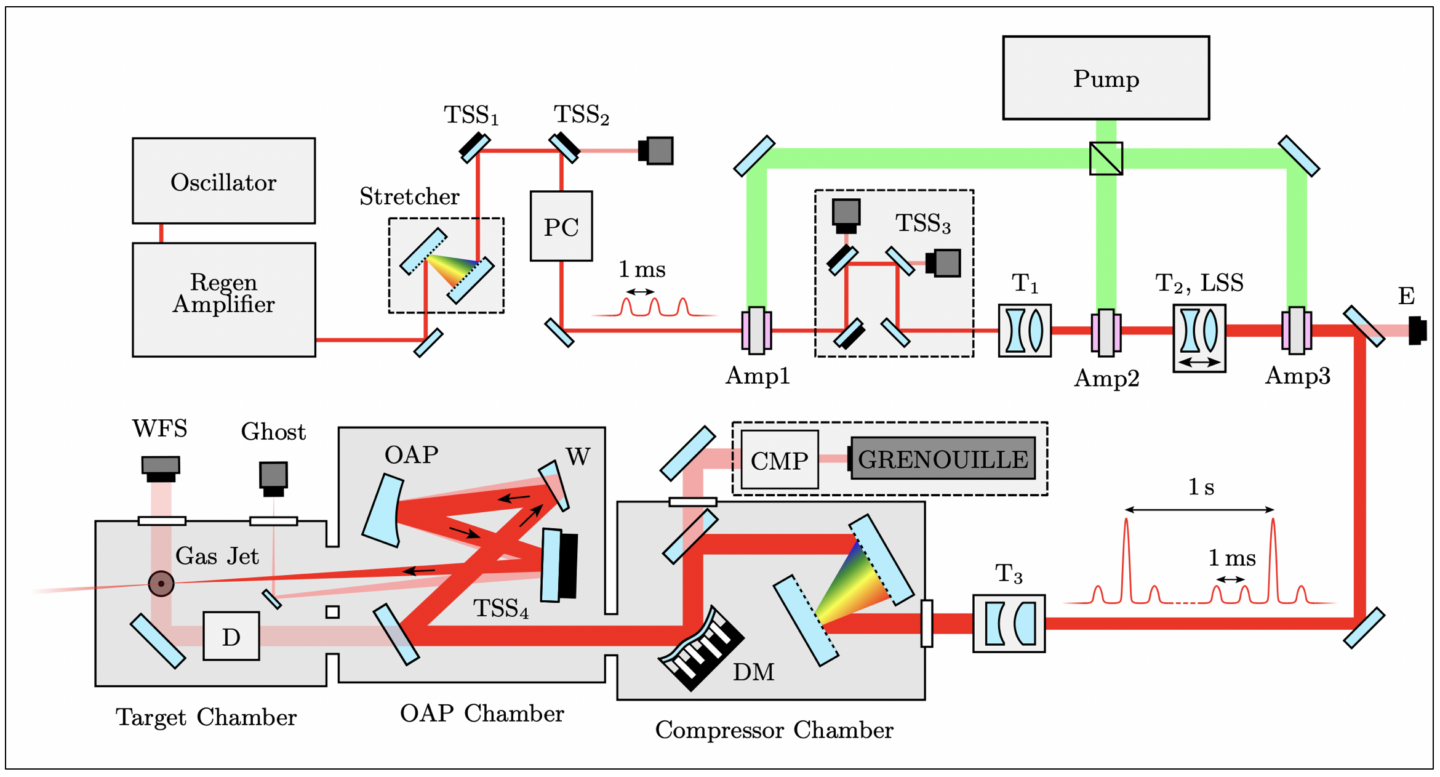
To address the drift in the laser’s pointing focus, the researchers used a low-power, high-repetition-rate “ghost beam” as a proxy for the high-power main HTU beam, enabling them to monitor fluctuations and frequencies that could not be observed directly in the main beam due to its intensity. This low-power beam also helps prevent damage to key optical components.
They then installed a high-resolution wavefront sensor in the ghost beam line to continuously monitor and adjust the radius of curvature (RoC) of the laser pulses. The RoC determines the longitudinal focal point of the beam relative to the supersonic gas target. Any drift or positional fluctuations (known as “jitter”) in this focal point greatly reduce the stability of the generated electron beam.
To actively stabilize the laser, the team employed a transmissive telescope on a motorized stage within a closed feedback loop with a wavefront sensor co-developed with RadiaSoft LLC, a U.S.-based research, design, and scientific consulting firm. (A paper on this topic was published in Physical Review Accelerators and Beams, a journal of the American Physical Society.) The sensor continuously monitors and adjusts the laser’s RoC, ensuring consistent focus and beam stability.
“By continuously adjusting the pulse’s RoC, it largely eliminated long-term drift in the longitudinal focus and reduced jitter in the laser pointing position by 40%,” says Kohrell.
To reduce transverse fluctuations in the laser, a camera continuously tracked the ghost beam’s transverse centroid (its geometric center perpendicular to its longitudinal axis). Positional data captured by the camera actively adjusted a motorized mirror to align the main beam’s transverse position with the target. An additional transverse stabilization system that monitors the laser beam position throughout amplification further reduces transverse jitter and stabilizes both the laser’s pulse energy and pulse duration, two key parameters that significantly impact the laser-plasma interaction.
“The stable performance measured on the HTU beamline highlights that the LPA is no longer simply a laboratory curiosity,” says Stephen Milton, vice president of accelerator science at TAU Systems. “With such stability, it is now a tool, a compact accelerator enabling a paradigm shift in the use of accelerators for applications such as free-electron lasers used in discovery science and industrial applications. TAU Systems is thrilled to have been part of this team.”
Through these improvements to the drive laser’s stability, the team achieved the electron-beam performance needed for reliable FEL operation. Because the FEL process is a sensitive test of beam quality, this also indicates the maintenance of an ultra-high-brightness LPA beam over many hours, opening the path to applications ranging from light-source injectors—for FELs or synchrotrons—to future particle physics machines.
“For an FEL to be useful as a scientific light source, it has to run reliably for long periods without constant operator intervention,” says BELLA Staff Scientist Sam Barber, who supervised the HTU experiment. “This work shows that with the right stabilization strategies, laser-plasma accelerators can provide the beam stability needed to support sustained FEL operation.”
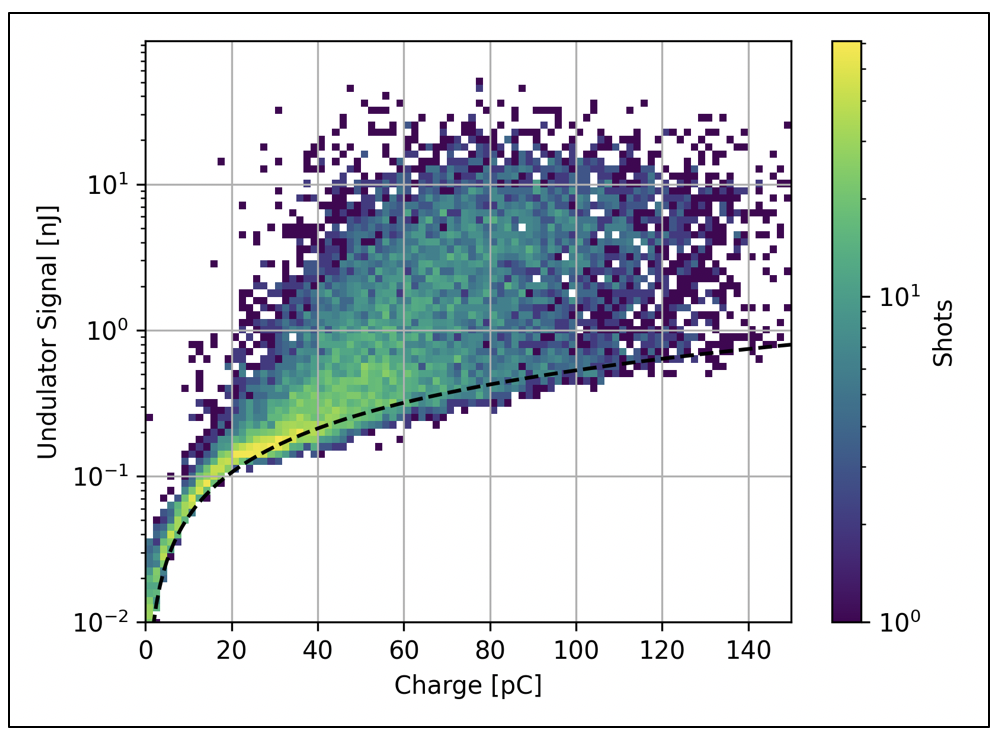
Histogram of integrated undulator radiation energy Utotal(q) (blue) for all shots taken over the > 8 hrs of continuous operation, plotted against electron bunch charge q. The black dashed curve represents the experimentally determined scaling of incoherent undulator radiation. The color bar represents the number of shots included in each binned pixel.
By systematically addressing these sources of instability, “we were able to run the LPA reliably for over ten hours and maintain continuous FEL operation for over eight hours without requiring any manual operator intervention,” says Kohrell. To put this into context, he notes that while recent experiments at BELLA demonstrated a breakthrough in shot-to-shot reliability and peak performance of an LPA-driven FEL, the system at that time only remained stable for about 30 minutes to an hour.
Commenting on the research, ATAP Director Cameron Geddes says: “This remarkable achievement marks a significant step forward in laser science and the development of next-generation accelerators. Demonstrating the reliable operation of a high-quality beam from a compact plasma system opens the door to future light sources, potential for new particle physics machines, and broad applications.”
The team’s next goal is to optimize peak performance by achieving FEL saturation, which involves extracting the maximum physically possible amount of FEL radiation from the system by increasing the electron beam energy to 500 MeV.
“At this level, we can lower the undulator radiation wavelength to the 20-30 nm range, placing it in the hard ultraviolet or soft X-ray regime—a crucial step toward making the technology viable for real-world applications,” says Kohrell.
The Department of Energy’s Office of Science, Offices of Basic Energy Sciences and High Energy Physics, as well as grants from TAU Systems and the Gordon and Betty Moore Foundation, funded various aspects of the work presented here.
To learn more
Diagnostic Tool Sheds New Light on Instabilities in High-Power Lasers
Researchers Make Key Gains in Unlocking the Promise of Compact X-ray Free-Electron Lasers
Machine Learning Helps Ease the Jitters of High-Power Lasers
Beam Stabilization Key to Unlocking Potential of Next-Generation Accelerators
For more information on ATAP News articles, contact caw@lbl.gov.