
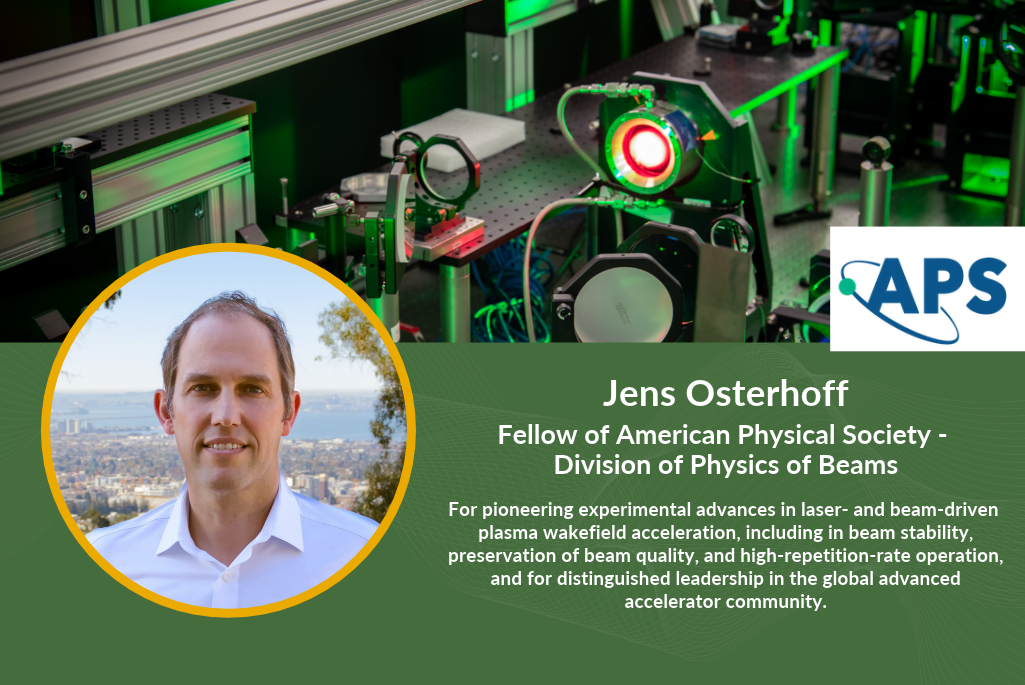
Jens Osterhoff, a senior scientist and head of the BELLA Center in the Accelerator Technology & Applied Physics Division at the Department of Energy (DOE)’s Lawrence Berkeley National Laboratory (Berkeley Lab), was elected a Fellow of the American Physical Society (APS) in October 2026.
The society’s Council of Representatives recognized Osterhoff: “For pioneering experimental advances in laser- and beam-driven plasma wakefield acceleration, including in beam stability, preservation of beam quality, and high-repetition-rate operation, and for distinguished leadership in the global advanced accelerator community.”
“Being elected an APS Fellow by one’s peers is a special kind of recognition,” he says. “It tells me that my research has had a real impact and that the long hours and the high standards I’ve tried to uphold in my work have been meaningful to others in the field. It also fuels my enthusiasm for the next set of goals as plasma accelerators prepare for applications.”
He adds, “I’m deeply indebted to the colleagues I’ve had the privilege of working with over the years, most importantly at Berkeley Lab and previously at DESY. This recognition belongs to them as much as to me, and I’m very thankful for their dedication, creativity, and partnership. BELLA is truly an exciting place to be right now. I see this Fellowship as a small part of BELLA’s deepening integration with the broader accelerator and application communities.”
Osterhoff’s research spans all aspects of plasma wakefield accelerators and their applications. His career began with work on laser technology and laser-driven plasma accelerators during his PhD and postdoctoral appointments. For about 10 years, his work shifted predominantly toward beam-driven plasma acceleration and the integration of plasma accelerators into accelerator-user facilities, while he continued laser-driven research in parallel. Since joining Berkeley Lab in 2024, his research has focused entirely on laser-plasma accelerators (LPAs).
These next-generation particle accelerators use ultra-intense laser pulses to generate a wake in the plasma. Electrons surfing that wake can gain billions of electron volts over centimeters, rather than the kilometers required by today’s machines. These advanced accelerators can sustain accelerating fields orders of magnitude stronger than those in metallic radio-frequency machines, enabling the construction of accelerators that are far more compact and affordable while delivering high-energy, high-brightness, ultrashort electron bunches. They have applications ranging from future colliders to X-ray free-electron lasers and high-brightness photon sources.
“Over the past two decades, the field has made enormous strides in performance, stability, and beam quality,” says Osterhoff. “Today, plasma accelerators are approaching the point where they can serve real applications, and they are taken seriously by the broader accelerator community.” He adds that this recognition from the APS Division of Physics of Beams community “is confirmation of that progress, for my work and for the field as a whole.”
The central aim of his work is to advance plasma acceleration from promising laboratory research to a dependable, high-performance accelerator technology. He says this means pursuing the qualities highlighted in the Fellowship citation: stable operation, preservation of beam quality during acceleration, and high repetition rates. “These are what applications ultimately require.”
In 2024, the BELLA team reached a major milestone in LPA development by accelerating a high-quality electron beam to 10 GeV in just 30 centimeters, marking notable improvements in energy conversion and beam quality compared with previous efforts. The following year, they operated a free-electron laser powered by an LPA continuously for an unprecedented eight hours without operator intervention.
The potential applications of LPAs span the interests of many agencies and DOE offices. They include high-energy physics, basic energy sciences, and fusion energy sciences, as well as research for agencies such as the Advanced Research Projects Agency–Energy, the Defense Advanced Research Projects Agency, the Joint Directed Energy Transition Office, and others.
“We are now taking concrete steps to prepare the technology, and we benefit from the DOE’s AI Genesis Mission. AI and machine learning are critical to controlling these complex systems and enabling active stabilization. Equally important is close collaboration with the broad accelerator physics community and prospective users,” Osterhoff says.
For more information on ATAP News articles, contact caw@lbl.gov.
